No other nation makes war its business

“What’s more, war is obsolete.  Most nations don’t make war anymore, except when coerced by the United States to join some spurious ‘coalition.’  The earth is so small, and our time here so short.  No other nation on the planet makes war as often, as long, as forcefully, as expensively, as destructively, as wastefully, as senselessly, or as unsuccessfully as the United States.  No other nation makes war its business.”

— Excerpt from Ann Jones’ new book, They Were Soldiers: How the Wounded Return from America’s Wars — The Untold Story

Americans can never be defeated by war

“Without a war, America would descend into total confusion and would have to form itself into a police state to survive, because its people no longer have any internal structure. Americans can never be defeated by war. It is peace they find intolerable.”

A line from a novel by John Burdett (2005). As we wind down two wars and crank up the police state in America, Mr. Burdett seems frighteningly prescient.

And Then There Was One

Form Tom Engelhardt’s thought-provoking essay on “Imperial Giantism and the Decline of Planet Earth.”
“And here was the curious thing after centuries of arms races: when there was no one left to race, the U.S. continued an arms race of one. […] What could possibly go wrong?  What could stand in the way of the greatest power history had ever seen?”
“Under the circumstances, nothing could have been stranger than this: in its moment of total ascendancy, the Earth’s sole superpower with a military of staggering destructive potential and technological sophistication couldn’t win a war against minimally armed guerillas.  Even more strikingly, despite having no serious opponents anywhere, it seemed not on the rise but on the decline, its infrastructure rotting out, its populace economically depressed, its wealth ever more unequally divided, its Congress seemingly beyond repair, while the great sucking sound that could be heard was money and power heading toward the national security state.  Sooner or later, all empires fall, but this moment was proving curious indeed.”

Providence (short film about Bradley Manning leaks)


The military (and many outside the military) consider Bradley Manning a traitor for leaking classified documents. Let’s imagine we’re in the latter days of World War II and a German soldier leaks thousands of documents related to concentration camps and the atrocities committed there. Is he a traitor? Probably. Did he do the right thing? Depends on who you ask? If the only difference between my hypothetical and the Manning case is whose ox was gored, that’s morally thin ice.

But the Manning leaks could have endangered American lives, goes one argument. No doubt, although I’ve not seen anything to suggest any lives have actaully been lost. Would it matter if some of the leaked documents revealed American actions were costing innocent lives?

I thought the Viet Nam war was a bad idea, primarilly because it could have gotten me killed. Turns out there were plenty of other reasons. Like the the mass murder of between 347 and 504 unarmed civilians near the village of My Lai on March 16, 1968, by United States Army soldiers. Most of the victims were women, children, infants, and elderly people. Some of the women were gang-raped and their bodies were later found to be mutilated and many women were allegedly raped prior to the killings.

Would it be treason to tell the world about My Lai?

“My country, right or wrong!” was a popular slogan for those supporting that war. That did work for me then and it doesn’t work for me now.

Brave New War

Here’s my over-simplification of John Robb’s thesis in Brave New War: A few, dedicated “Global Guerrillas” can defeat the army of a nation state by disrupting critical systems. I thought he made a pretty good case. Not sure about his timing, however. The book, written in 2007, suggests a dire sceneria for 2016:

“Security will become a function of where you live and whom you work for, much as health care is allocated already. Wealthy individuals and multinational corporations will be the first to bail out of our collective system, opting instead to hire private military companies, such as Blackwater and Triple Canopy, to protect their homes and facilities and to establish a protective perimeter around daily life. Parallel transportation networks—evolving out of the time-share aircraft companies such as Warren Buffett’s Netjets—will cater to this group, leapfrogging its members from one secure, well-appointed lily pad to the next. Members of the middle class will follow, taking matters into their own hands by forming suburban collectives to share the costs of security—as they do now with education—and shore up delivery of critical services. These “armored suburbs” will deploy and maintain backup generators and communications links; they will be patrolled civilian police auxiliaries that have received corporate training and boast their own state-of-the-art emergency response systems. As for those without the means to build their own defense, they will have to make do with the remains of the national system. They will gravitate to the cities, where they will be subject to ubiquitous surveillance and marginal or nonexistent services. For the poor, there will be no other refuge.”

I kept looking for “the good news” but this was the best he offered:

“The strikes of the future will be strategic, pinpointing the systems we rely on, and they will leave entire sections of the country without energy and communications for protracted periods. But the frustration and economic pain that result will have a curious side effect: they will spur development of an entirely new, decentralized security system, one that devolves power and responsibility to a mix of local governments, private companies, and individuals.”

Brave New War was only a couple hundred pages and well worth the read for those that share my sneaking suspicion a) our governments don’t tell us the truth, and b) we are not winning The War on Terror because it can’t be won.

The Business of War (VICE News)

In the last couple of days I’ve watched three or four news documentaries produced by Vice.  The one below is titled “The Business of War: SOFEX”

If you invest the 20 minutes to watch this you might conclude — as I did — the world is fucked. Not a little bit fucked. Not “It’s okay, I think we can un-fuck this.” We are Ving-Rhames-Pulp-Fiction fucked.

This documentary explains SO much of what is happening in the world. As you watch it, try to imagine Anderson Cooper or Brian Williams (and the corporations they work for) doing this kind of reporting.

As I watched these reports, I kept contrasting them to the network news formats of the past 20+ years. Half-hour summaries with forest fires and floods at the top, followed by fluffy pretend news at the bottom. With lots and lots of commercials mixed in.

In all fairness, you can sort of imagine a piece like the one below on 60 Minutes but only after the teeth have been extracted.

I spotted the link to this documentary in my Twitter stream. I can play these on my iPhone, any time, anywhere. Or, using AirPlay to stream them to my big screen, watch them at home via Apple TV.

I can only assume the gasping, lumbering news organzations of yore know they are irrelevant but just don’t know what to do about it.

There is nothing on CNN or Fox or XYZ for which I’d pay cash money. But yeah, I’d pay for reporting this good.

The Wisdom of Scott Adams

Common sense isn’t a real thing. And its ugly cousin, fairness, is a concept invented so dumb people could participate in arguments. Fairness isn’t a natural part of the universe. It’s purely subjective.

My idea is that the United States, China, and Russia – the three biggest nuclear powers – sign a joint agreement that goes like this: The three powers agree that if any country in the world, excluding the big three nuclear powers, uses nuclear weapons, the offending country will be denied military and economic aid for the next hundred years. In return for this agreement of non-support from the big three nuclear powers, both Israel and Iran would be asked to agree to nuclear inspections. Israel’s inspections would be handled by the United States military. Iran’s inspections would be handled by an international team of inspectors excluding the United States and Israel. That’s the fake deal.

I see life as a process, not a goal. If my goal had been to create world-changing ideas that worked right away, I would be a complete failure. But I don’t have that goal. Instead, I have a process that involves seeding the universe with ideas and waiting for the strongest to evolve and make a difference. The worst case scenario is that my ideas cause the eventual best ideas to compete harder and evolve to even better forms. When you use a process that makes sense, even the unanticipated outcomes are good.

If you want a president who promotes freedom of religion, choose a non-believer such as me. Think of it like a eunuch guarding a harem. I won’t try to convert you to my belief system because I don’t have one. Some of the people I respect the most are believers of one sort or another. I’m in favor of whatever works in your personal life. But I prefer science over belief when it comes to government.

My plan for shrinking government is to freeze total federal spending immediately and forever, and let inflation eliminate the bureaucracy by chewing into its budget over a few generations. That way, the government can unwind at a leisurely pace, allowing technology, competition, and better ideas to deliver natural cost reductions over time. With my plan of gradual government shrinkage, there’s no shock to the system, and no outsized risk.

Someday, technology will make it possible for governments to shrink down to nearly nothing. Well-informed citizens, connected by the Internet, could accomplish almost all that government does for us today, including much of foreign policy. But that day is not today. I think the best path to smaller government involves the government transitioning into an information clearinghouse.”

“In the long, long term, I see governments as being nothing but intelligent managers of information. That’s a few hundred years from now.”

Time to end the war in Afghanistan

British MP Rory Stewart walked across Afghanistan after 9/11, talking with citizens and warlords alike. Now, a decade later, he asks: Why are Western and coalition forces still fighting there? He shares lessons from past military interventions that worked – Bosnia, for instance – and shows that humility and local expertise are the keys to success.

Scott Adams: Education as national defense issue

“In a world where education is branded as the foundation of national defense, if we didn’t get enough high quality volunteer teachers, a draft would be instituted. If parents didn’t ensure that their kids finished their homework, the entire family would be deemed unpatriotic. I assume we can’t get to that imagined place from here because of the political clout of unions. But just for fun, imagine a third-party candidate for president who cleverly brands education as a national defense issue, and labels anyone who disagrees with him as both unpatriotic and soft on defense.”

— From post by Scott Adams

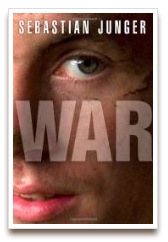
War by Sebastian Junger

Sebastian Junger was recently a guest on The Daily Show but you really don’t get much of a feel for a book (or the author) from those segments. Not sure why I picked up War but it’s hard to put down.

The war in Afghanistan seems very… abstract to me. I know it’s going on and people are dying (although we see almost no images of that) but it doesn’t seem real. Junger’s book (and the documentary, I assume) makes it seem very real.

I can’t tell if Junger has any views about whether the war is right or wrong or if that’s even a relevant question from the perspective the people fighting it. But his account makes it difficult to imagine anything like “winning.”

“The fact that networks of highly mobile amateurs can confound –even defeat– a professional army is the only thing that has prevented empires from completely determining the course of history. You can’t predict the outcome of a war simply by looking at the numbers.” – page 83

“The moral basis of the war doesn’t seem to interest soldiers much, and its long-term success or failure has a relevance of almost zero. Soldiers worry about those things about as much as farmhands worry about the global economy, which is to say, they recognize stupidity when it’s right in front of them but they generally leave the big picture to others.” – page 25

“…at one mile out (an) aircraft carrier is the size of a pencil eraser held at arm’s length. The plane covers that distance in thirty-six seconds and must land on a section of flight deck measuring seven yards wide and forty-five yards long.” – page 34

“…he joined the Army because he was tired of partying and living at this mother’s house, and now he’s behind sandbags on a hilltop in Afghanistan getting absolutely rocked.” – page 67

“Once while leaning against some sandbags I was surprised to feel some dirt fly in my face. It didn’t make any sense until I heard the gunshots a second later. How close was that round? Six inches? A foot?” – page 71

“It certainly isn’t beautiful up there, but the fact that it might be the last place you’ll ever see does give it a kind of glow.” – page 71

“The problem with fear, though, is that it isn’t any one thing. Fear has a whole taxonomy — anxiety, dread, panic, foreboding — and you could be braced for one form and completely fall apart facing another.” – page 73

“If I had any illusions about personal courage, they dissolved in the days or hours before something big, dread accumulating in my blood like some kind of toxin until I felt too apathetic to even tie my boots properly.” – page 74

“There are different kinds of strength, and containing fear may be the most profound, the one without which armies couldn’t function and wars couldn’t be fought (God forbid).” – page 74

“…an enormous amount of war-fighting simply consists of carrying heavy loads uphill.” – page 75

“If you’re not prepared to walk for someone you’re certainly not prepared to die for them, and that goes to the heart of whether you should even be in the platoon.” – page 77

“(He) had some kind of crazy redneck strength that was more like hydraulics than musculature.” – page 75

“The fact that networks of highly mobile amateurs can confound –even defeat– a professional army is the only thing that has prevented empires from completely determining the course of history. You can’t predict the outcome of a war simply by looking at the numbers.” – page 83

A “Vietnam moment” was one in which you weren’t so much getting misled as getting asked to participate in a kind of collective wishful thinking.” – page 132

“…much of modern military tactics is geared toward maneuvering the enemy into a position where they can essentially be massacred from safety. It sounds dishonorable only if you imagine that modern war is about honor; it’s not. It’s about winning, which means killing the enemy on the most unequal terms possible. Anything less simply results in the loss of more of your own men.” – page 140

“The enemy now had a weapon that unnerved the Americans more than small-arms fire ever could: random luck. Every time you drove down the road you were engaged in a twisted existential exercise where each moment was the only proof you’d ever have that you hadn’t been blown up the moment before.” – page 142

“War is a lot of things and it’s useless to pretend exciting isn’t one of them. It’s insanely exciting. The machinery of war and the sound it makes and the urgency of its use and the consequences of almost everything about it are the most exciting things anyone engaged in war will ever know.”

“War is supposed to feel bad because undeniably bad things happen in it, but for a nineteen-year-old at the working end of a .50 cal during a firefight that everyone comes out of okay, war is life multiplied by some number that no one has ever heard of.” – page 144

“The moral basis of the war doesn’t seem to interest soldiers much, and its long-term success or failure has a relevance of almost zero. Soldiers worry about those things about as much as farmhands worry about the global economy, which is to say, they recognize stupidity when it’s right in front of them but they generally leave the big picture to others.” – page 25

“…at one mile out (an) aircraft carrier is the size of a pencil eraser held at arm’s length. The plane covers that distance in thirty-six seconds and must land on a section of flight deck measuring seven yards wide and forty-five yards long.” – page 34

“…he joined the Army because he was tired of partying and living at this mother’s house, and now he’s behind sandbags on a hilltop in Afghanistan getting absolutely rocked.” – page 67

“Once while leaning against some sandbags I was surprised to feel some dirt fly in my face. It didn’t make any sense until I heard the gunshots a second later. How close was that round? Six inches? A foot?” – page 71

“It certainly isn’t beautiful up there, but the fact that it might be the last place you’ll ever see does give it a kind of glow.” – page 71

“The problem with fear, though, is that it isn’t any one thing. Fear has a whole taxonomy — anxiety, dread, panic, foreboding — and you could be braced for one form and completely fall apart facing another.” – page 73

“If I had any illusions about personal courage, they dissolved in the days or hours before something big, dread accumulating in my blood like some kind of toxin until I felt too apathetic to even tie my boots properly.” – page 74

“There are different kinds of strength, and containing fear may be the most profound, the one without which armies couldn’t function and wars couldn’t be fought (God forbid).” – page 74

“…an enormous amount of war-fighting simply consists of carrying heavy loads uphill.” – page 75

“If you’re not prepared to walk for someone you’re certainly not prepared to die for them, and that goes to the heart of whether you should even be in the platoon.” – page 77

“(He) had some kind of crazy redneck strength that was more like hydraulics than musculature.” – page 75

“The fact that networks of highly mobile amateurs can confound –even defeat– a professional army is the only thing that has prevented empires from completely determining the course of history. You can’t predict the outcome of a war simply by looking at the numbers.” – page 83

A “Vietnam moment” was one in which you weren’t so much getting misled as getting asked to participate in a kind of collective wishful thinking.” – page 132

“…much of modern military tactics is geared toward maneuvering the enemy into a position where they can essentially be massacred from safety. It sounds dishonorable only if you imagine that modern war is about honor; it’s not. It’s about winning, which means killing the enemy on the most unequal terms possible. Anything less simply results in the loss of more of your own men.” – page 140

“The enemy now had a weapon that unnerved the Americans more than small-arms fire ever could: random luck. Every time you drove down the road you were engaged in a twisted existential exercise where each moment was the only proof you’d ever have that you hadn’t been blown up the moment before.” – page 142

“War is a lot of things and it’s useless to pretend exciting isn’t one of them. It’s insanely exciting. The machinery of war and the sound it makes and the urgency of its use and the consequences of almost everything about it are the most exciting things anyone engaged in war will ever know.”

“War is supposed to feel bad because undeniably bad things happen in it, but for a nineteen-year-old at the working end of a .50 cal during a firefight that everyone comes out of okay, war is life multiplied by some number that no one has ever heard of.” – page 144