The wireless Super Bowl

“On the consumer side, the league sees big revenue potential in wireless. The league is moving content from its NFL Network cable channel and Sirius Satellite network to the Internet to bring more dimensions to stories. It’s the first year the Super Bowl is on satellite radio, and the league plans to make audio of the radio calls for the Pats and Eagles available for fans to download to their MP3 players for $10. And when someone calls their wireless phone, Eagles fans can hear defensive end Jevon Kearse tell them “This is Jevon Kearse. It’s time for you to pick up the phone.” [via RAIN]

BostonHerald.com

“My Very Own Radio Station”

Michael Bazeley, writing in the Mercury News (My Very Own Radio Station), does the best job of ‘splaining the podcasting thing I’ve come across:

“Thanks to a new technology called podcasting, I’ve turned my iPod into a personalized radio station, loading it with talk shows and cutting edge music that I’d never be able hear on traditional radio stations. It’s transformed my listening habits overnight. Although it’s new, I’m convinced podcasting will transform the way many people consume media, just as blogging and TiVo have. When you can program your own radio station, carry it with you anywhere and pause and restart it at will, who needs mainstream, advertising-supported broadcast radio?”

His piece quotes Doc Searls who believes:

“Podcasting will shift much of our time away from an old medium where we wait for what we might want to hear to a new medium where we choose what we want to hear, when we want to hear it, and how we want to give everybody else the option to listen to it as well.”

Hey, I’m just posting this shit so I can say I told you so.

“Radio, as we’ve known it, is dead”

Won’t someone please point me to a positive story about (what we’ve started calling) “terrestrial” radio? Mabye it’s just media dog-piling but everytime I click my mouse, someone is predicting (or declaring) the death of radio. Alyce Lomax (The Motley Fool) is pissed and sad at the passing of (Thursday) of Washington D.C. radio station WHFS.

“Radio, as we’ve known it, is dead. The news about HFS obviously struck a chord with me, but with satellite radio, Internet radio, and things like Apple’s iTunes (or even the iPod Shuffle!) revolutionizing music and giving listeners more options than ever before, chances are it won’t be missed.”

Okay, Alyce is entitled to her opinion. Now, where are those positive stories about radio?

Clear Channel’s Internet plan

“Radio analysts say Clear Channel, along with other broadcast radio stations, is being pushed online and toward new technologies by a fragmentation of its own market and by growing competition from satellite radio. Mix the power of Internet radio with those new delivery tools, and terrestrial radio begins to look increasingly fragile, unless it’s online too, some observers worry.” — CNET

Local News

The news director at the station in my home town called this morning to ask about my brother. Lots of folks in Kennett know he is in Indonesia and have been asking about him. I told him what little I knew. Just a little human interest story. Very local. A big city station or a “nothing but the hits” station wouldn’t consider this remotely newsworthy. I’m really glad to know they’ve started doing this kind of local news again (maybe they never stopped).

At about the same time, I received a pointer (from XM Ben) to an interesting article on the state of radio in 2004 (Radio in 2004: An Overview, by Lawrence Stoler):

“One of radio’s strong points that can not necessarily be achieved to the fullest extent on satellite radio is localism. In other words, being out and active in the community. Being at the scene of an important event at a moment’s notice and providing necessary information to the residents of where a station is licensed to broadcast. The industry has to resume this practice of being community active. Radio has to go back to providing information after 8:30 AM during the week or in the evening after #7 and on weekends too. Not every area of the country has a 24 hour all news station within hearable range.”

I honestly don’t see how radio stations (or TV stations, for that matter) will survive without a strong, serious commitment to local news.

National Association of Broadcasters

The cover story (by Scott Woolley) in the September issue of Forbes is really more about the National Association of Broadcasters than XM Radio.

“For decades the radio industry has crushed incipient competitors by wielding raw political muscle and arguments that are at once apocalyptic and apocryphal. Radio station owners, who formed the National Association of Broadcasters in 1923, have won laws and regulations that have banned, crippled or massively delayed every major new competitive technology since the first threat emerged in 1934: FM radio.”

What would radio be like if broadcasters put this much energy into doing better radio?

XM Radio to introduce digital storage

From NY Times story: Later this week, XM is set to introduce receivers capable of storing up to 30 minutes of any live broadcast to play back at a later time. With a function that works much like the pause control of a digital video recorder, the units will also be able to replay the last 30 minutes of the channel to which the unit was most recently tuned. Both companies also offer models that let users store the names of favorite artists and titles. When one of those is playing on another channel, the receiver beeps to alert the listener. In XM’s case, the unit will also automatically switch to that other station. Next month, Sirius will introduce its Sportster model, designed to complement its introduction of NFL Radio, which is a new talk channel, and several channels to transmit every NFL game. The radio can be programmed to jump automatically to the correct station when one of the user’s favorite teams is playing.

To appeal to investors, XM’s Roady2 can display continuously updated stock quotes across the screen. Sirius plans to introduce a radio with a similar feature. Beginning this fall, XM will offer NavTraffic, giving owners of the Acura RL and the Cadillac CTS the ability to combine XM’s continuously updated traffic information with the car’s navigation system, producing color-coded maps showing traffic delays, allowing drivers to obtain alternate routings.

To make it easier to receive satellite radio in the home, Sirius will introduce a $129 accessory antenna that, mounted on the roof, will transmit a signal through the walls into a secondary unit attached to the receiver. And by the beginning of next year, Sirius will offer a receiver that can download Sirius programming from the Internet for later playback in areas where signals cannot reach.

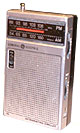
Transistor radio

Most of my in-car radio listening is XM these days. But at home I still tune in to a couple of the local stations. And it dawned on me this week that the little transistor radio I listen to is more than 20 years old. We brought it with us when we moved to Jefferson City in 1984. And it could have easily been 10 years old then. I love this little radio (made in Hong Kong for General Electric). On the front it proudly announces “Integrated Circuit” and, on the back, there’s a little plasic clip for attaching to your belt. I’m trying to think of other things in my life that have worked as well or as long as this little transistor (when did we drop that adjective?) radio. I so clearly remember when a small, portable radio like this was the ONLY way to listen to music or news away from your home, car or office.

If/when this one breaks or dies, with what sort of device will I replace it? I’m sure they still make them but for how much longer. Will they become integrated with some kind of mobile device (cell phone)? That doesn’t seem practical. I’m not going anywhere with this. Just a small ode to a long-time companion.

42 million sat radio subs by 2009?

XM Satellite Radio and Sirius Satellite Radio could have more than 42 million subscribers by the end of 2009, according to a report by SkyWaves Research. Two week ago, XM announced that it had surpassed 2 million subscribers. On May 11, Sirius said it had reached the 400,000 mark.