Net ad spending to overtake radio in 2008

Zenith Optimedia Group has revised it’s global ad spending outlook and now predicts the Internet will overtake worldwide outdoor ad spending next year, and will catch up with radio (which will have a 7.9% share, down from 8.5% in 2005) in 2008.

If you’re a radio station manager, you a) do not believe this forecast for one minute; b) think it might be true but have no clue what to do about it; c) don’t care if it’s true or not because you plan to retire in a couple of years anyway. [Radio Business Report]

Fans: Yea! Radio stations: Boo!

The St. Louis Cardinals plan to offer 50,000 fans a free radio that can pick up the broadcasts via XM Radio – which carries all major league games via satellite transmission. The catch is that to get the radio, a six-month subscription for the service must be purchased – and that sells for about $13 a month. The move is being made to try to appease those who have lost access to the broadcasts because of the club’s move from KMOX (1120 AM) to KTRS (550 AM) as its flagship station. KTRS’ signal has a much smaller reach at night, when most of the games are played, than does KMOX. [STL Today via XM Ben]

XM adding seven regional news and talk channels

“XM Satellite Radio Holdings Inc. announced a new channel lineup Monday, expanding the number of channels by a dozen, adding several new music and news channels while deleting some others. XM will also add seven regional news and talk channels, bringing its new channel total to 176 from 164. In the fall, XM is also launching a channel with talk show host Oprah Winfrey.” — MercuryNews.com

I remember hearing about the Oprah channel but somehow missed the “regional news and talk channels” item. Uh, I think our company does regional news.

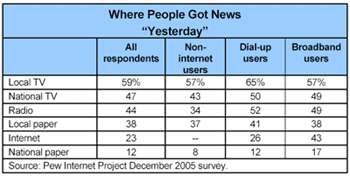
Where did you get the news yesterday?

Pew_news

Interesting answers to that question in the latest PEW study (PDF). For those of us with broadband, 49% got yesterday’s news from the radio…while 43% got it from the Internet. Will there come a time when more people get the news from the Internet than radio? If so, what does that mean for News/Talk radio? What does that mean for regional news networks like ours? [via Radio Marketing Nexus]

Radio host fired for “racial epithet”

I don’t know about this one. KTRS (St. Louis) talk show host Dave Lenihan was immediately fired after he used the word “coon,” a racial slur, instead of “coup” in describing (Condoleezza Rice’s) attributes for the post of NFL commissioner.

“She’s been chancellor of Stanford. She’s got the patent resume of somebody that has serious skill. She loves football. She’s African-American, which would kind of be a big coon. A big coon. Oh my God. I am totally, totally, totally, totally, totally sorry for that.”

I don’t know about this one. It sounds like a one-time, slip-of-the-tongue. Fruedian? Maybe. But there appears to be no history of bias or racial slurs. Anybody that’s been on the air knows that –eventually– something slips. You have to look at intent here. If Mr. Lenihan is a racist… it’s probably not hard to tell that. Read the transcipt and tell me if I’m wrong here. Why not ask the listeners? Not just the folks that grabbed the phone and called to complain, but a reasonable sample. If there’s a clean concesus that his remark was intentional, he’s gone. If there’s even a possibility it was a slip, with no malice… keep him on. I think I might have taken Mr. Lenihan off the air…had a long talk…maybe talk to members of the community…and then make a decision.

Nobody panics when Rush Limbaugh refers to “these people,” clearly referring to people of color. But Rush is bringing home the bacon. Sounds like Mr. Lenihan was new enough to be expendable.

Doing what radio does best

Tornados hammered parts of the midwest Sunday night, including Springfield, Illinois. TV was off, cable down, power out, Internet out, newspaper 12 hours from publication…but radio station WMAY was on the air, doing what radio does best. GM Glen Gardner shares this sement from a caller that illustates how to keep radio relevant. [AUDIO: 2 min MP3]

Notice that the person on the air who took the call didn’t interrupt. Didn’t feel the need to jump in and start yapping. That is so rare. If radio has a future –and I hope it does– it won’t be endlessly playing the same 400 songs or turning the signal over to Rush for 3 hours. It will be in on-the-ground, local relevance like this. Thanks, Glen.

Slow growth for HD radio

Radio research firm Bridge Ratings projects HD receivers will be in the hands of 1.06 million consumers by the end of 2007, 2.0 million by the end of 2008 and 8.84 million by the end of 2010. Meanwhile, Bridge predicts that XM Satellite Radio will grow to 9.0 million subscribers by the end of 2006 as rival Sirius grows to about 6 million subscribers over the same period. (R&R via RAIN)

Shop Talk: Covering the state basketball tournament

Three of our four state radio networks do sports reports as well as news. It’s state tournament time and each of the networks are providing coverage. Depending on the network, we do two or three brief (2-3 min) reports a day.

Doesn’t give much time to cover all the games of the tournament. Throughout the years, we tried various formats that would appeal to our affiliates but –as a general rule– each station only cared about the teams from their region of the state. This is a little less true in Iowa and Wisconsin. But the state tournament is just not a big deal (to radio stations) in Missouri.

You smell another Long Tail example, don’t you?

We knew there were “x” number of fans who cared very much about the games…but had no way to get our reports to them. And now we do. I’ve been following Missourinet Sports Director David Sprague’s reports from the state tournament. He filed a dozen reports over two days and you can see/hear a few of them here, here and here.
Basketball TournamentI assume he was in press row with his laptop and digital camera, posting reports to our website, with no limitation on the length or frequency of his reports. No satellites, no studios. Of course, the next thought that pops into my head is that any talented reporter (or fan) could have covered the state tournament just as easily as David did. It all comes down to the quality of the reporting, not to advantages of distribution. I realize I’m stating the obvious here, but after so many years of trying to meet the needs of our affiliates and their listeners, it’s…liberating…to be able to finally reach them directly.

If I were still programming the old KBOA, I like to think I would have a heavily-promoted website with a special “State Tournament” section on my sports page. And –as a Missourinet affiliate– I’d have David load it up with lots of reports on the teams of local/regional interest. I’d take everything he had time to produce.

If you spot any interesting online coverage of state tournaments…put a link in the comments below.

Audio broadcast flag bill proposed

Tod Maffin says a proposed new bill will be the “death of radio.”

It’s 2012. You turn on the radio. Some song is ending. The DJ introduces the next song and you only hear the opening second of it, when suddenly, a voice cuts in and says:

“I’m sorry, but since you indicated your household has more than four people in it, and you haven’t licenced your home for ‘public performance’ of musical works, we are unable to play this song.”


This just became a very likely reality thanks to U.S. lawmaker Mike Ferguson. He’s introduced an audio broadcast flag bill that would let the FCC force radio stations to provide “so-called “flag” technology be used to prevent content on HD Radios and satellite digital radios from being re-distributed.”

Cool. I can’t wait to buy a new HD radio with this cool feature. Worser and worser.

Does public broadcasting need a new name?

“…broadcasters (should) start viewing themselves as multimedia companies, and even changing their names to help spread the message both internally and externally. The internet is NOT broadcasting, and the more we understand that, the quicker we’ll get on with business models that’ll meet our needs in a Media 2.0 world.” – Terry Heaton

A couple of years ago we dropped the “network” from one of our networks because it was felt to be somewhat…limiting. No long reflective of what we are or are becoming.