Right of the Dial (The Clear Channel Story)

I’ve been around radio most of my life. My dad was a radio guy. I became a radio guy. And I was doing affiliate relations for our radio networks when things started to change in the late 90’s, when federal media ownership rules were relaxed and companies like Clear Channel started buying up hundreds of local stations.
BustedradioAlec Foege has written a book –Right of the Dial– that tells the Clear Channel story. According to the review in the New York Times, Foege tried to give the company the benefit of the doubt.

“I was not out to do a hatchet job,” he writes in the preface to “Right of the Dial,” “but rather to get to the bottom of a company that I suspected had gotten a raw deal as its bad publicity had snowballed.”

The reader need wait only three paragraphs before Foege renders his final verdict: “Having spent a lot of time talking to some of the company’s most prominent critics, as well as some of its most devout supporters, I have concluded that Clear Channel is indeed to blame for much of what it has been accused of.”

The Internet and iTunes and all the rest were going to have a big impact on radio, no matter what. But I have to wonder if local radio stations might not have been better prepared for the challenges if they hadn’t been gutted and commoditized by the Clear Channel’s.

Nawww.

[Thanks, Henry]
In search of radio’s romance, longing and connection

From a speech by NAB President-CEO David Rehr at the National Association of Broadcasters Conference:

“Rehr then turned to radio, first talking about a widely reported BusinessWeek column by Jon Fine, headed “Requiem for Old-Time Radio.” Though Fine believes radio isn’t well-suited to moving its business model online, he wrote that he remembers radio with “ridiculous fondness” and recalled “huddling with it long past bedtime, the volume set low, hoping to hear something I loved.”

“Rehr said, “Ladies and gentlemen, that is romance, that’s longing, that is a connection. Listeners still want what they’ve always wanted. Technology hasn’t changed that — it has just changed the devices of delivery.”

According to Mr. Fine, Mr. Rehr missed the point of his article:

“You don’t need to huddle with a radio long after dark to hear new music; you can form that romance or connection with a hundred other things.”

Sirius-XM merger approved

“The companies have pledged that the combined firm will offer listeners more pricing options and greater choice and flexibility in the channel lineups they receive. If the deal is approved, the companies have said they would offer pricing plans ranging from $6.99 per month, for 50 channels offered by one service, up to $16.99 a month, where subscribers would keep their existing service plus choose channels offered by the other service.” [AP]

I think I’m paying about $13 a month and listen to far fewer than 50 channels. I’d love to see an even lower price for 10 channels. Stay tuned.

Sharpen your writing skills with “Stopwatch Challenge”

Stopwatchsmall
Dan Rieck suggest we can sharpen our copywriting skills with what he calls the "Stopwatch Challenge." The exercise is basically writing a radio spot that can be spoken aloud in exactly 60 seconds.

Brings back fond memories of my radio days. For a dozen years, about half of my 10 hour days were spent on the air and the other half writing and producing radio commercials. Let’s see… we’ll call it 50 spots a week. 200 spots a  month. 2,400 spots a year. Let’s round it down to 28,000 commercials.

We had to knock ’em out fast and get ’em on the air. And the client always gave you more stuff that you could fit in 30 or 60 seconds. So part of the challenge was boiling it down.

Sixty seconds is about 16 lines. But you have to spell out numbers (one-eight-hundred-five-five-five-sixty-four-hundred).

I’ve never considered myself a great writer. But writing radio spots was pretty good training for blogging. Or maybe any kind of writing. Fewer words always better than more words.

I often send emails with nothing but "see subject line" in the body. I try to put it all in the subject line. Try it on your next email.

And, yes, I know this post is longer than sixty seconds.

Radio owners waiting out “this Internet thing”

“As an advertising medium, the Internet is already larger than radio. It will approach $34 billion this year and is on a trajectory to overtake newspaper advertising within five years. In virtually all markets, the largest local Web site (typically run by a newspaper company) is now grossing more ad revenue than the largest radio station in that market. In some markets, the largest site is grossing more than the largest cluster of stations.”

“Your radio reps have a bounty on their heads. We survey more than 3,000 local Web sites every year about their revenues, expenses, number of salespeople and other revenue-related topics. The ones with the greatest market share and revenue have an interesting characteristic in common: a star-performing “former radio rep” on the sales staff. The word has spread that radio salespeople know how to sell the Internet, and newspaper and TV Web site managers have been recruiting them left and right. Radio reps know how to cold-call, how to generate new business, and how to sell reach and frequency. That’s a perfect match for Internet sales.” — Gordon Borrell, writing in Inside Radio

Where is the innovation in radio?

“Where are the new formats? Where is the new talent? Why is Talk Radio pretty much the only form of radio that isn’t music-intensive? Why are most Talkers late-middle-aged conservative white dudes? Our non-music format options are ridiculously thin – why?” — Mark Ramsey

I’ve wondered the same thing. It’s not uncommon for an owner to have five or six stations in a market, running some safe format on everyone of them. As Mr. Ramsey points out in his post, to try something innovative would require imagination, talent and guts. Short supply these days.

Public radio and podcasting

Mark Ramsey points us to an interesting piece by “The Long Tail’s” Chris Anderson on how his listening behavior to public radio has been transformed by podcasting.

“I realized that I don’t really support my local affiliate. I love some of the shows it broadcasts and hate others. My attachments are to individual shows, not to a broadcast station. My engagement with public radio is at a more granular level than the affiliate.

Now that I get my radio via podcast, I don’t have to take the bad shows with the good. I’ve got an a la carte menu, and I assemble my own schedule with what I want and when I want it.

But look at the arc of history here. The podcast model is getting cheaper and more ubiquitously available (who doesn’t have a cellphone?), and it serves individual needs and taste better. Meanwhile the broadcast model, which is all about one-size-fits-all taste, is based on human labor costs and costly transmission equipment and is only getting more expensive. You can see how this story ends.”

I’ve had the same guilty thoughts about my own listening habits. I like a lot of NPR programs but listen to them as podcasts. And I would be willing to pay for the best shows (This American Life, for example).

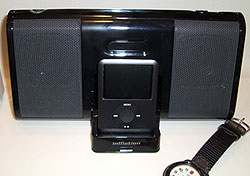
IpodspeakerAnd my morning listening routine has improved with the purchase of a small speaker/doc for my iPod nano. Each evening iTunes downloads any new podcasts to which I’m subscribed, and syncs to the nano. In the morning I pop the nano into the speaker dock and listen to a perfectly customized line-up of progams.

Brits tuning in to personalized Internet “radio”

Mark Ramsey shares some thoughts on a story in the Sunday Times of London about the growing number of Brits tuning in to personalized Internet “radio” every week (and tuning out traditional radio).

Sunday Times: “Personalised broadcasts of the future will probably have either advertising or a price tag attached, just as they do today. But once your radio knows exactly what you want to hear, the idea of a human DJ – however cheeky his banter – might start to sound a little dated.”

Ramsey: “Over the long haul I fully expect the influence of music-oriented radio to diminish. Because music, my friends, is a commodity. Not only can anyone string together a playlist, but nobody can string together my favorite playlist better than I can.”

“What it all adds up to is the gradual near-obsolescence of music radio, not in a blink, but by a slow and persistent siphoning of audience and attention and interest and advertisers. This process will take years to happen.”

I read a lot of stories like this but very few on the impact of Internet “stations” on non-music formats. Are news-talk formats feeling any effect from the web? My radio pals can feel free to post an anonymous comment.

Net makes radio and TV transmitters obsolete

Doc Searls says the Net makes radio and TV transmitters obsolete the moment high-enough-bandwidth wireless connectivity becomes ubiquitous.

“We’re one good UI away from the cell phone becoming a radio. (Thanks to the iPhone, it already serves as a TV.) And we’re one smart cell company away from radio- and TV-as-we-know-it from being replaced entirely — or from moving up the next step of the evolutionary ladder. Public broadcasters know that. That’s one reason they now call themselves “public media”, a move that separates the category from its transport methods.

Will this someday be an issue for our networks? Radio Iowa. Wisconsin Radio Network. Nebraska Radio Network. Time will tell.