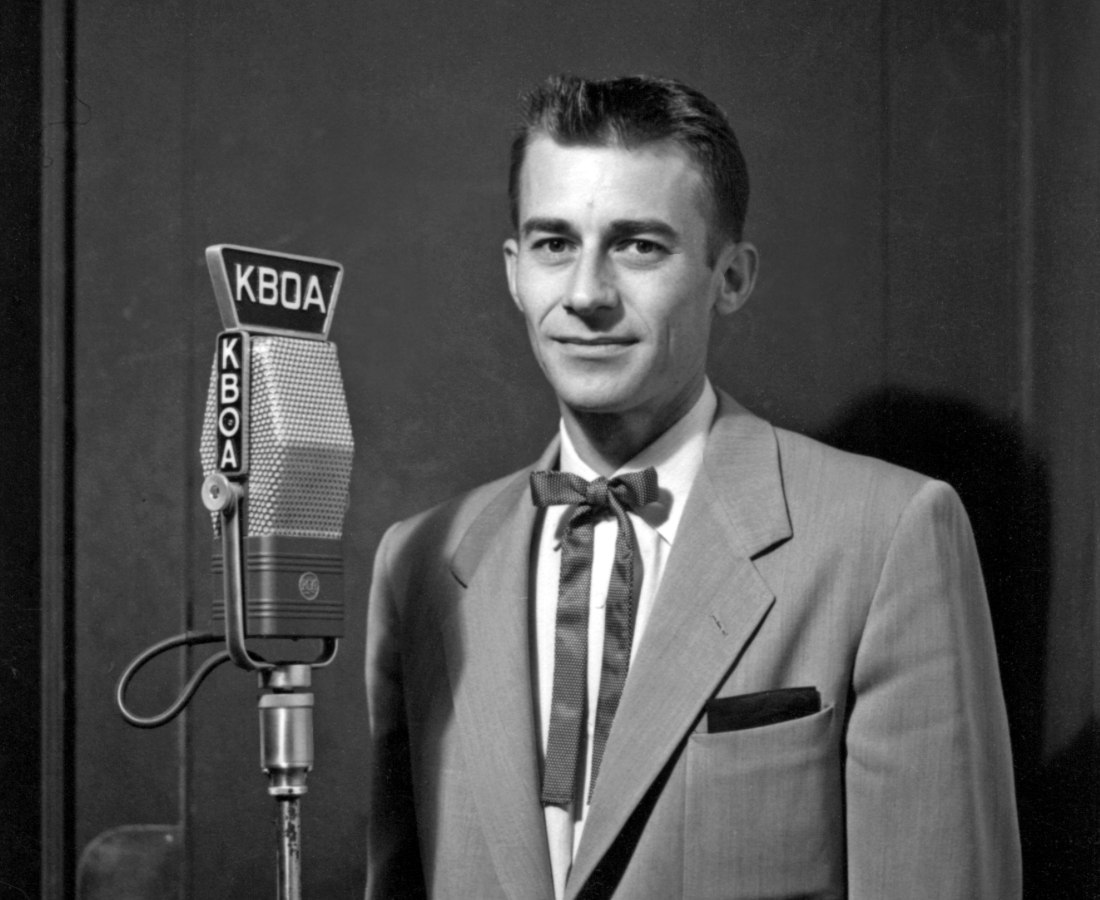
Nothing is more emblematic of the Golden Age of Radio than the microphones of that era. I asked ChatGPT to identify a few that were used at KBOA.
RCA 77-M (early) or RCA 77-A / 77-B variant. This is an earlier RCA 77, before the D / DX refinements. These were extremely common in regional stations transitioning from prewar gear.
Shure 55A or 55B (pre-“Elvis” Unidyne). This is the earlier Shure 55, before the iconic chrome “Elvis” look (the 55S). Radio stations used these constantly in the late ’40s–early ’50s. Key tells:
End-address (announcer speaking into the top)
Horizontal grille rings
Small-diameter cylindrical body
Cable exiting low, angled
RCA 44-BX ribbon microphone. The 44-BX was the mic for Groups, Music, Dramatic readings, Anything needing that huge ribbon warmth
The post below was written by ChatGPT5.1. This is not the first time I’ve done this and it is always with some trepidation. But this analysis is so on-the-money I couldn’t think of what I might add. I hope this wasn’t ripped whole-cloth from somebody’s article or blog post. If it is I’ll kill this post or give it the proper attribution.
Radio didn’t die so much as it ossified, while listeners moved on. But there’s more texture to it, and I think you’ll appreciate seeing the forces that pushed it downhill—and the narrow paths it might still have back up the mountain. Here are the big levers, in order of impact: Continue reading →
Like a lot of small town radio stations, KBOA billed itself as “Hometown Radio.” And it was truly that. My father worked in small town radio for most of his career and I was lucky enough to be part of it for a dozen years (1972-1984).
I spent most of the next dozen years doing affiliate relations for a company that operated regional radio networks throughout the Midwest. It was during this time I witnessed the beginning of the end for small market radio. GPT-5 does a pretty good job of explaining what happened: Continue reading →
I first read about –and started plays with– this technology in February of 2023. I wondered at the time how long it would be before radio station owners took notice. No time at all, it seams.
Futuri Launches RadioGPT, The World’s First AI-Driven Localized Radio Content
Cleveland, Ohio, February 23, 2023 — Futuri is revolutionizing the audio industry with the launch of RadioGPT™ — the world’s first AI-driven localized radio content solution. RadioGPT™ combines the power of GPT-3 technology with Futuri’s AI-driven targeted story discovery and social content system, TopicPulse, as well as AI voice tech to provide an unmatched localized radio experience for any market, any format.
RadioGPT™ uses TopicPulse technology, which scans Facebook, Twitter, Instagram, and 250k+ other sources of news and information, to identify which topics are trending in a local market. Then, using GPT-3 technology, RadioGPT™ creates a script for on-air use, and AI voices turn that script into compelling audio.
Stations can select from a variety of AI voices for single-, duo-, or trio-hosted shows, or train the AI with their existing personalities’ voices. Programming is available for individual dayparts, or Futuri’s RadioGPT™ can power the entire station. RadioGPT™ is available for all formats in a white-labeled fashion.
RadioGPT™ also generates social posts, blogs, and other content for digital platforms related to the content on the air in real-time. A TopicPulse Instant Video add-on creates AI-driven short videos on hot topics for social use. By adding on Futuri’s POST AI-enabled podcasting system, stations can take broadcast audio and immediately publish it on-demand with POST’s auto-publishing feature.
Fifty years ago, Jerrell Shepherd mastered a form of broadcasting alchemy that turned small town radio lead into gold. It wasn’t much of a secret, however, since he readily shared it with countless radio station owners and managers who made the pilgrimage to Moberly, Missouri, in hopes of bringing some of Shepherd’s sales and programming magic back to their stations.
While most small market broadcasters were content to get “their fair share” of local advertising budgets (the bulk went to the local newspaper), Shepherd’s sales reps were trained to ask for it all and believed in their hearts they deserved it.
Mr. Shepherd’s approach to programming his stations was deceptively simple: report anything and everything that happened in each of the communities covered by his stations’ signals. The KWIX and KRES “Red Rovers” showed up just about every high school football game, junior high choral concert and chamber of commerce ribbon-cutting. And the Shepherd stations put it all on the air. Always with local sponsors. Lots of local sponsors.
“Alpha Media’s EVP of content Phil Becker assured listeners that Elzinga’s job is safe and she’ll be receiving the same pay, telling TechCrunch that AI Ashley is a tool that will allow DJs to multitask like never before.”
I’d love to know what sort of prompt could result in an AI making a call and interacting with a listener as we heard in the clip above. As the program director of a small town radio station back in the 1970’s I was responsible for hiring and training weekend talent. I might have jumped at the chance to put an AI voice on the air.
Will the KWIX/KRES on-air staff be replaced with AI voices? If so, how will the station’s listeners and advertisers respond?
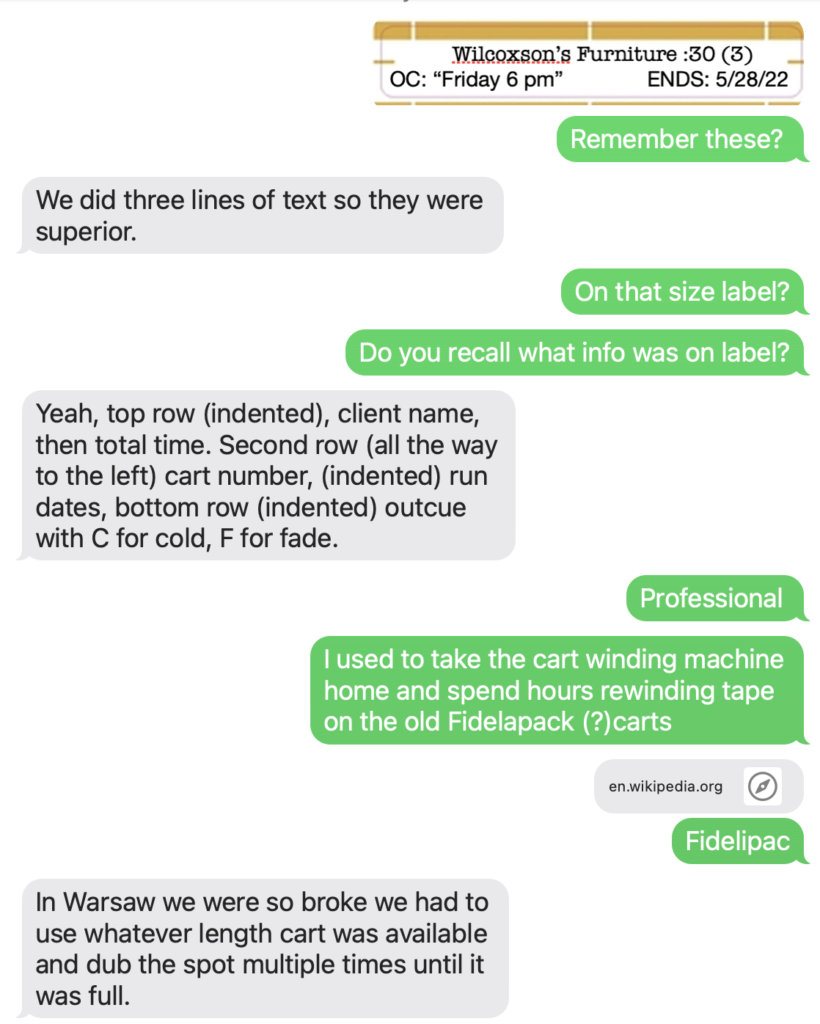
In my dozen years in small town radio I wrote a lot of commercials. Mostly thirty-second “spots” but lots of :60’s (more expensive). It wasn’t uncommon to finish a four-hour on-air shift and sit down at a manual typewriter and bang out ten or fifteen “spots” working from a newspaper “tear sheet” or a salesperson’ scribbled notes. And most of these commercials were scheduled to begin airing the following day so someone had to get in the studio and produce the ad. Point being, there was little demand or time for creativity and the sponsor wasn’t inclined to pay for it in any event.
For a variety of reasons, a :30 second ad had to be :30 seconds. Not 27, not 32. So we followed a rigid format. Given a normal reading speed, a thirty second ad was about 75 words, usually eight lines. Yeah, you could try to get cute and clever but the client wanted to hear about his business. His products or services. And if the client was a supermarket… price-and-item. As many as you could jam in.
So, no, this was rarely creative writing. It was short, simple, declarative sentences. Not a word or phrase to be wasted. I like to think I still write this way.
When email took over from letters and faxes people wrote long-winded tomes that went on for paragraphs. I went through a phase where I would put my entire message in the subject line with “see above” in the body. If it needed more space than that, I would call them or go see them. To this day I think of this approach as “write like you talk.” Which was the final test for radio commercials: reading the copy aloud before going into the studio.
Following are excerpts from a story in The Washington Post:
Ford, BMW, Volkswagen, Tesla and other automakers are eliminating AM radio from some new vehicles, stirring protests against the loss of a medium that has shaped American life for a century. […] Automakers, such as BMW, Volkswagen, Mazda and Tesla, are removing AM radios from new electric vehicles because electric engines can interfere with the sound of AM stations. And Ford, one of the nation’s top-three auto sellers, is taking a bigger step, eliminating AM from all of its vehicles, electric or gas-operated.
Some station owners and advertisers contend that losing access to the car dashboard will indeed be a death blow to many of the nation’s 4,185 AM stations. […] From the 1950s into the 1970s, Top 40 hit music stations in many big cities maintained astonishing shares of the audience, with 50 percent and more of listeners tuned to a single station. […] Ford says its data, pulled from internet-connected vehicles, shows that less than 5 percent of in-car listening is to AM stations.
Of the $11 billion in advertising revenue that radio pulled in last year, about $2 billion came into AM stations, according to BIA Advisory Services, which conducts research for broadcasters.
Some of the best years of my life were spent in and around radio. But I haven’t listened in years. The Land Rover doesn’t have a radio and the pickup truck has one but it’s never worked.
It wouldn’t be much of an exaggeration to say that radio –in one form or another– paid for every stitch of clothing I ever wore and every bite of food I ate. But it changed and I changed. I suspect FM radio will disappear some day.
During my ~30 years in broadcasting I had numerous occasions to recruit and hire reporters. Because our newsrooms were small (3 or 4 people), reporters also anchored our reports. Which meant they had to be good journalists AND have good on-air delivery. A tough compromise at times.
I wonder if technology like 11ElevenLabs’ speech synthesis will (is) changing this. The audio below is a CNN story “read” by one of their voices. (see previous post for more on this technology)


 During my ~30 years in broadcasting I had numerous occasions to recruit and hire reporters. Because our newsrooms were small (3 or 4 people), reporters also anchored our reports. Which meant they had to be good journalists AND have good on-air delivery. A tough compromise at times.