Music on an iPod

“When one out of five of everyone you know is listening to music on a portable device packed with hundreds or thousands of songs, commercial-free, what can your station bring them that they can’t self-program better?”

— Mark Ramsey quoting a national study by American Media Services

Rock and Roll Fantasy

So you have great singer/song writers like Paul Simon, Cat Stevens, Don Henley and Glen Frey who –as far as I know– aren’t making hit records any more. They’re rich, the royalties are coming in, they worked long and hard…so maybe they’re just taking it easy. Why should they bust their asses writing songs. Because they love writing songs. It was once their passion and I want to believe it still is. So where are the songs?

Let’s suppose in the hip-hop musical world of 2006, nobody wants to hear a song by these old farts. But that doesn’t sound right. I’m betting they’re still writing songs…and there are millions of fans who would love to buy/hear them.

Okay, here’s the fantasy part. Let’s say you’re one of these musical legends and you still noodle around in your home studio, writing and recording songs. Not necessarily ‘hit’ songs, just songs. Stuff you like. Why not put it up on a website, give your fans a little taste, and let us buy them?

I think Janis Ian (if you don’t know, it doesn’t matter) does something like this. And why not. If your music is no longer “commercially viable,” but you still love making it… put it up there. Let us buy it direct. Like I said, it’s a fantasy.

Speaking of music… I would love to hear Sheryl Crow do Me and Bobby McGee. Not the Joplin screamer. More of a ballad treatment maybe. Has she ever performed that song?

Still speaking of music… I kinda like the song Table for One by Liz Phair.

But reaching back it occurs to me
There will always be some kind of crisis for me

Not a good drinking song, but haunting.

If somebody has Doug Howard’s email address, he can probably answer the question above. Play the Kennett card.

End of music research?

Mark Ramsey asks: What’s the point of music research when every listener personalizes his or her music to his or her own tastes? And where’s your NON-music content, Mr. Broadcaster?

He also wants to drop the term “streaming” in favor of “Internet radio.” My only problem with that is where that leaves us verb-wise. Now I typically write/say: We’ll stream the governor’s speech at 7:00 p.m. If what we’re doing here is “Internet radio,” do I say we’ll “broadcast” the speech? It certainly is not a broadcast.

I’m becoming a fan of Mark’s blog. He seems to really know the radio business and has a firm grasp of new media.

You = Your iTunes

Tom Peters says his #1 belief about management is: You = Your Calendar.

“All we have is our time. The way we distribute it is our ‘strategic plan,’ our ‘vision,’ our ‘values.’ Period. So how’d you spend your precious time today? Tell me, and I’ll tell you what you actually care about — it’s simple and unerring.”

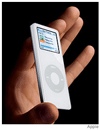
Maybe. But I don’t want to be my calendar. Nobody has to guess what bloggers care about. It’s all right here. But if I weren’t a blogger, you could look at my iPod and get a sense of who I am. In fact, here’s what you can do in lieu of a memorial service for smays: Plug my nano into a good sound system…put it on shuffle… and let it play until the battery runs down. Friends can stop by for a few minutes and listen.

Do you want to buy a new radio?

Mark Ramsey offers some insight into what’s happening (and is likely to happen) as terrestrial radio rolls out the HD channels (frequencies?).

“It couldn’t be clearer that HD will be a new battlefield where the intent of the broadcaster will be to draw the blood of their competitors. We will try to eat our young. As you evaluate this list as a listener, ask yourself the big question: do you want to buy a new radio?”

Seems like broadcasters have a lot riding on listeners adopting HD. I suppose it’s possible they’ll put some really good formats on the new channels but I’d have to hear it before I’d pop for a new receiver. And I can’t (easily) hear the new stuff …until I buy a new receiver.

A finger up my bum

I listened to my first Ricky Gervais podcast (Episode 7). I thought it was hysterical. But then I think anything said with a real British accent is hilarious. Nothing fancy going on here. Mr. Gervais and a couple of his mates (Karl Pilkington and Steven Merchant) chatting it up. Sounds like they’re only going to do 10 or 12 episodes in this first flight and (hopefully) do another batch later.


I was particularly delighted with their discussion of prostate examinations. It runs about a minute and is one of the funniest things I’ve heard in a long time. The perfect follow-up to last week’s Living Healthy Podcast.

Google-izing radio advertising: Day Two

More on Google’s foray into the world of radio advertising from RAIN’s Kurt Hanson, including quotes and links to The New York Times and the WSJ Online.

“The key to it is that Google is potentiallty bringing 400,000 new advertisers (their AdWords clients) to the radio medium. These new advertisers will (A) fill up unsold inventory and (B) eventually add increased demand for avails. Increased demand, of course, will inevitably drive up prices. That’s how supply-and-demand works.”

I’m still waiting for someone to explain what –if anything– that’s going to mean for barter arrangments with radio stations. Are we looking at a future where every avail can be sold?

Apparantly the dMarc software can automatically send advertisements right into radio station’s traffic ystems, bypassing the largely manual process currently used in the radio industry. Anybody have any first-hand experience with dMarc? Know a station that uses it? I’d love to know more about it.

Google buys dMarc Broadcasting

As a barter radio network, part of our pitch to prospective affiliates has been: Instead of letting your unsold commercial inventory “go to waste,” give them to us in exchange for some top-notch news and sports to enhance your station’s programming. Win-win.

So Google buys dMarc Brodcasting, a radio advertising firm whose technology allows national advertisers to buy unsold station inventory, and automatically inserts those commercials into the stations’ unsold slots.

In the online world, Google AdWords enables advertisers to find the lowest-possible rates publishers will take, and helps publishers find the highest-paying spots. This technology could greatly enhance the process of national ad buys — making it more efficient on both ends. [Analysis by RAIN]

Big Question: Will barter networks like ours someday (soon) have to compete for this inventory? Will station managers put his unsold avails in a big Google basket rather than barter them for programming? That might not be the question at all. I don’t pretend to understand what’s happening here. And there has always been rep outfits that promised to sell a station’s unsold avails, but most stations wisely steered clear of hese guys. Be interesting to see where Google heads with this technology.