
Sportscaster Len Berman on his move from old media to new media.
Category Archives: Media & Culture
Pandora
I really, really hope small town radio stations figure out how to survive and thrive in this new media world in which they find themselves. If I had The Secret Nazi Formula, I send guys out on motorcycles (with sidecars) to each and every station. But I don’t.
I’m taking a vacation day, sitting in the Coffee Zone fine-tuning one of my Pandora channels (“stations?”). I’d like to share just a couple of features:
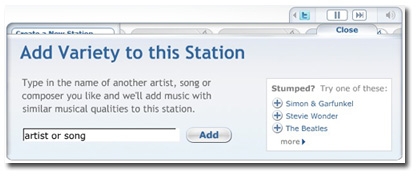
For those unfamiliar with Pandora, it’s a streaming music service. You start by picking a song or artist and Pandora starts playing songs based on that information. You vote thumbs up or thumbs down on each song, and Pandora just keeps refining the music you hear.
If it all starts sounding a bit too similar, you can “Add Variety” (see image above). For example, I added Paul Simon and Brandi Carlile to my Pomplamoose channel. The result is so finely tuned to my musical tastes, I don’t see how any radio station could match it. They could not. And with every song I listen to (or don’t) my channel gets better.
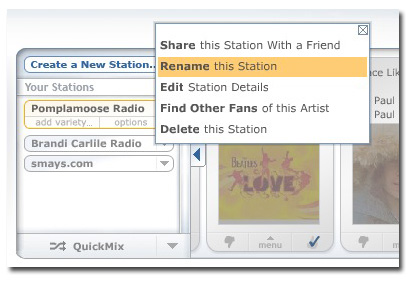
Pandora also gives me the option to share my creation and find others who like the same music.
So. What’s missing? Commercials? Weather? Sports? News about the oil gushing into the Gulf? A funny guy to talk over the beginning of my songs? Weekly specials from my local supermarket? Maybe.
Cognitive Surplus: The Great Spare Time Revolution
“Someone born in 1960 has watched something like 50,000 hours of television already. Fifty thousand hours—more than five and a half solid years.”
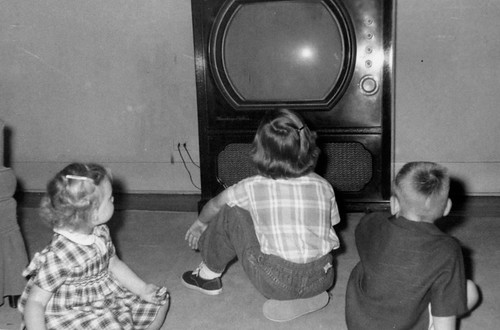
Sweet Mother of God! I can tack another 7 or 8 years on that. That daunting stat is from an article in latest issue of WIRED Magazine in which Clay Shirky and Daniel Pink share some thoughts on what Mr. Shirky calls the “cognitive surplus”:
“Television was a solitary activity that crowded out other forms of social connection. But the very nature of these new technologies fosters social connection—creating, contributing, sharing. When someone buys a TV, the number of consumers goes up by one, but the number of producers stays the same. When someone buys a computer or mobile phone, the number of consumers and producers both increase by one. This lets ordinary citizens, who’ve previously been locked out, pool their free time for activities they like and care about. So instead of that free time seeping away in front of the television set, the cognitive surplus is going to be poured into everything from goofy enterprises like lolcats, where people stick captions on cat photos, to serious political activities like Ushahidi.com, where people report human rights abuses.”
“Cognitive Surplus.” I love the very idea of that. I’m not sure I would be a better person had I spent those 50,000+ hours blogging instead of watching Maverick, but I would be different. And if I had to choose today, it would be an easy call. Come to think of it, I am choosing.
Pandora: I didn’t know what I was missing
I’m listening to Pandora more of late and with each new song/artist, I wonder at all the wonderful music and musicians I’ve never heard (or heard about). They’ve always been there, I just didn’t know about them.
It’s the same for the beautiful images on flickr, videos on YouTube and all the rest. What a pitiful trickle that used to flow through our lives. While we can never experience it all, it’s getting easier to drink a bit deeper.
Equally true for news and information, of course. How liberating to be free of the editorial decisions of a handful of editors and and programmers thousand of miles away. Not to mention that we can now contribute our own ideas and art.
How will we ever describe our pre-Internet lives to future generations? Will it be like explaining a time before electricity or indoor plumbing?
New tech continues to gnaw at radio use
That’s just one of the findings in the latest State of the News Media annual report from the Pew Project for Excellence in Journalism
“Fully 236 million Americans listened to at least some radio in an average week in the fall of 2009, a number that has been basically static for the past five years, and news/talk/ information remains among the most popular formats. NPR’s audience in 2009 rose slightly, up 0.1%, from 2008. But new technology is encroaching on the amount of traditional radio use. More than 4 –in 10 Americans now say they listen to less terrestrial radio due to iPod/MP3 use, and nearly 1in 3 now say they listen to online radio.”
Traditional broadcast radio experienced an 18% drop in ad revenue in 2009 compared to 2008. Internet and mobile radio revenues are growing (a projected 9.4%), but they do little to alleviate the pressure – counting for less than one fortieth of total. In satellite radio, SiriusXM in 2009 increased its revenue 3.7%, compared with a year earlier, to 2.5 billion compared to 2008. The company, however, both before and after the merger, has continued to report net losses in each of the last three years. In 2009 SiriusXM posted a net loss of $441 million.
The number of stations identified by Arbitron as news/talk/information rose in 2009 to 1,583, up from 1,533 in 2008. This category is broadly defined and includes a large amount of talk programming. But all-news stations make up a much smaller category. In 2009, there were just 27 commerical stations around the country that listed themselves as all news, down from 31 the year before. And even here the label is self-defined and may include talk or other less news-oriented programs. In commercial radio, local all-news stations now tend to be limited to only the largest markets.
Google Chrome speed tests
I’m sure Microsoft has some neat videos about their browser, too.
Darth Vader’s recording for TomTom GPS
Clay Shirky: The Collapse of Complex Business Models
I won’t attempt to summarize this post by Clay Shirky. The best I can do is pull a couple of quotes. If you’re in the media business, you’ll want to skip this one.
“…most TV is made by for-profit companies, and there are two ways to generate a profit: raise revenues above expenses, or cut expenses below revenues. The other is that, for many media business, that second option is unreachable.”
“When the value of complexity turns negative, a society plagued by an inability to react remains as complex as ever, right up to the moment where it becomes suddenly and dramatically simpler, which is to say right up to the moment of collapse. Collapse is simply the last remaining method of simplification.”
TV station gets iPads, saves on paper and looks hip
Last week, news anchors and producers at Barrington Broadcasting Group’s WFXL Albany, Ga., replaced their paper scripts with electronic versions displayed on the iPad. They project the move will save nearly $10,000 a year in paper costs. From the original story:
“Newscast scripts are composed as usual. But rather than printing to paper, the final version is formatted as a PDF file and transmitted to each iPad via e-mail. The PDF translation is handled by iAnnotate by Aji.LLC, a $7 program sold and downloaded via Apple’s App Store.
Although WFXL doesn’t employ iPads as teleprompters, it could if it chose to. Apple’s App Store already offers two third-party applications for scrolling copy on the iPad: Nairo Techology’s iPrompter for $2.99 and Bombing Brain Interactive’s Teleprompt+ for $9.99, which allows any iPhone to double as a remote controller.
In addition, hardware vendor Bodelin Technologies offers a new version of its through-the-lens ProPrompter HDi display, which mounts the iPad as a prompter monitor on both studio and field cameras. The $850 device includes “professional” display software, which is also controllable through an iPhone or iPod Touch.”
And they look pretty cool. No small thing in the world of TV news.
I predict it will become common practice to cover the Apple logo with the station logo.
Flight of the Bumble Bee on the iPad
No idea if this is legit.