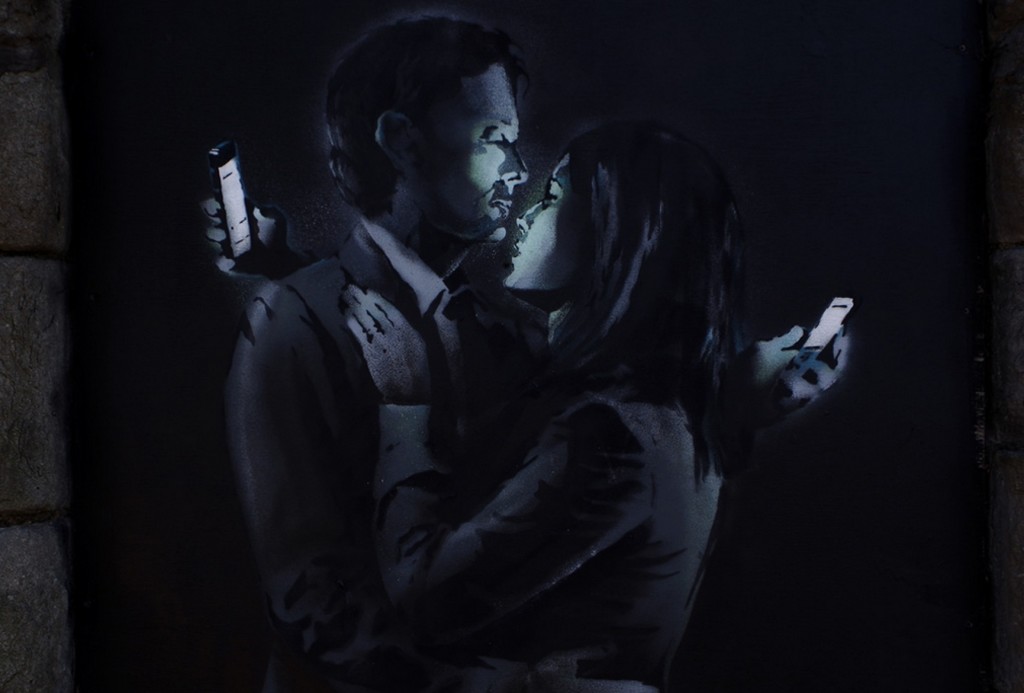
A screen that ships without a mouse ships broken

I am part of the first TV generation. Thousands of hours of my life were spent watching. Just watching. These days, like many others, I spend many of my hours online, creating, sharing and consuming media. Clay Shirky explains why this “social surplus” is a very big deal:

“Here’s something four-year-olds know: A screen that ships without a mouse ships broken. Here’s something four-year-olds know: Media that’s targeted at you but doesn’t include you may not be worth sitting still for. Those are things that make me believe that this is a one-way change. Because four year olds, the people who are soaking most deeply in the current environment, who won’t have to go through the trauma that I have to go through of trying to unlearn a childhood spent watching Gilligan’s Island, they just assume that media includes consuming, producing and sharing.”

If you are in any way connected to the business of “media,” you need to read –and understand– what Mr. Shirky has to say.

This post is about technology and media, not politics.

I "follow" Barack Obama’s Twitter feed. If you don’t know what that means, it’s okay (unless you happen to be a journalist). A few minutes ago the campaign "tweeted" that the senator was getting ready to speak in Springfield, Missouri and I could watch it live by clicking the included link.

Obamalivevideo

It took me to the "live" page on the Obama website where a USTREAM player was feeding live video. As I write this there are 830 viewers. Only a fraction of the number watching on the cable news channels that might be airing this speech.

I mention this only because no "traditional media" were necessary to make this happen. The Obama campaign has an email address for each of the millions (?) of people who have contributed to his campaign. We all got a ping that he was about to speak.

[901 viewers]

I think this is huge. Sure, a campaign still need MSM to get elected. Today. Will that be as true four years from now? Will it be true at all 8 years from now?

[1,045 viewers]

Of course it is not just the live stream. This speech –and all of the others– will be available from now until election day. And beyond?

[1,095 viewers]

Will everyone need a web page?

WSJ’s Jason Fry wonders if we’re getting closer to the day when everyone will need a web page. He starts with the question of how we’re to find each other in a rapidly evolving future.

“…landlines are disappearing, yet there’s no “white pages” for cellphones. And we don’t want one — the rise of email, IM and other forms of messaging have transformed the phone call into an intrusive way to communicate, best reserved for certain situations between people who already have a relationship. Which is fine, but raises the issue of how we’re supposed to get in touch with people we don’t already know. The most likely solution to the problem is a single point of contact, with additional levels of contact information unlocked by us as we deem appropriate. A Web page — whether it’s on an outpost such as Facebook or LinkedIn or a site built out with communications tools — can serve that function pretty well.

A personal Web page is an opportunity to tell your story and balance out other narratives that you can’t control.”

I found this piece very interesting. When I google “steve mays” I want this blog to show up on the first page of results. Ego? Sure, for now. And it will probably never have financial or business implications for me but that might not be true for a twenty-something.

“Go-to device for local information”

Lost Remotes Corey Bergman predicts the iPhone (and the apps that will be written for it) will have huge impact on local news and information:

“…the location-aware phone (and similar phones that follow) will become the go-to devices for local information. In fact, I believe local information ultimately will be consumed more on mobile than PCs.”

Where have we been getting our local information? Oh yeah, radio.

All networking will be social

Planet Nelson points us to this insightful article on social networking from Managing Technology:

“…how we exchange information is changing, from sharing information actively (emailing photos to friends) to sharing it passively (uploading those photos to Facebook and emailing notification to friends). “What’s happening is that we’re separating access from notification,” said Kraus. This leads to more sharing because people don’t worry as much about interrupting others with emails, calling attention to themselves and appearing too self-important.

Third, and most important, Kraus sees the web eventually becoming entirely social. “Today, social computing is something you do at a specific site,” said Kraus. “But we’re realizing that being social is not a site. It’s a concept.”

If you don’t use Twitter, flickr, YouTube, Facebook, My Space, Digg or any of the countless other social networking tool, this idea seems ridiculus. Just as the Internets once seemed like a silly waste of time.

The Future Radio Morning Show

It isn’t simply streaming your current morning show. Or putting it online for download. Jerry Del Colliano lays it out — in ten easy steps — on his blog (invitation only).  #1 gives you the setup and #7 and #8 my favorites.

1. Start ten morning shows (other than the one that is airing on your terrestrial station). The content should aim at one demographic that is desirable to sell. Example: women 25-54. Ten shows that don’t air on the radio.

7. Hire the right person(s) to host this 45-minute show – not, I repeat, not anyone from your airstaff. Podcasting is not to be confused with broadcasting. You may be a professional broadcaster but it is not in your best interest to make these podcasts son of what is already on your air. Give the host a piece of the show and lock him or her into it for the long term. As it develops it will be a moneymaker for you and for your talent.

8. Do not include traditional spots in the podcast. Commercials have seen there better days. Young people don’t listen – but consider the “live read” approach that goes over very well with young people. If they are hooked on a podcast then they will listen to a “live read” by the host(s) if it is sincere and keeping with the overall approach of the show.

Mr. Del Colliano concludes his post with a bit of insight into Generation Y:

(Gen Y) went through childhood without a love for radio, unlike baby boomers or Gen X. They are attached to their iPods and smart phones – their new radio. If you still want to be in the content business when the last baby boomer passes into The Hall of Fame, learn about the new radio – podcasting.

The “ten morning shows” had me puzzled at first. But I’m guessing you need this many, all aimed at the same demo, to reach the numbers that will be attractive to advertisers. The advertises cares about reaching the demo (Women 25-54 in the example above) and not so much about how many shows he sponsors to reach them, assuming the price makes sense.

So let’s assume we have a 25 minute commute to Jefferson City (from Columbia or Loose Creek). Would I be willing to produce five, 25-min podcasts a week for a piece of the show? I would if Mr. Del Colliano was managing the station.

“When was the last time you saw a dead American soldier on TV?”

FlagdrapedcoffiinI was talking with a co-worker about Lara Logan’s (CBS Chief Foreign Correspondent) recent appearance on The Daily Show. She posed the question, “When was the last time you saw a dead American soldier on TV?” She was making the point that media in the U. S. has been MIA on the war in Iraq (except for that victorious march into Baghdad).

My co-worker’s take was: “The only reason to show a dead American soldier would be to turn someone against the war.”

Or maybe that war is news and death is part of the story?

Actually, I didn’t have a response. I can understand that view coming from W or Rumsfeld (back in the day). But how many citizens feel the same? How many would rather not to see the bloody reality of war on their TV screens?

By this logic, we also shouldn’t be seeing the critically wounded at Walter Reed. Or can we translate missing limbs to a “don’t-let-their-sacrifices-be-in-vain” message?

So I’m asking myself why we saw more dead troops during the Viet Nam war, and it came to me. We had lots of reporters on the front lines in that war. But not so many on the mean streets of Baghdad.

In the old days, you could make a career filing reports from the front lines. Sure, you could shot, but you weren’t likely to wind up the star of a YouTube beheading video.

Naw, American journalism took a pass on this war. Better to let the Brits cover this one.

What is it with the Apple logo on TV?

Applelogo

"Sex and the City’s" Miranda, Cynthia Nixon, sat down with Jimmy Kimmel on Wednesday night to promote her blockbuster chick flick. Jimmy brought out his laptop partway through the interview for an online multiple choice quiz, which decides which of the four main SATC characters the taker is most like."

I started noticing this after I turned in to a Mac fanboy. What’s the big deal about masking the Apple logo? I guess they’d mask any recognizable brand logo. The difference is how distinctive the MacBook is. But maybe that’s true only of Mac fans. To everyone else, it’s just a laptop.

So here’s today’s assignment: Name another product that is equally recognizable (without seeing the brand logo). Begin.

Microsoft’s Ballmer on future of media?

“In the next 10 years, the whole world of media, communications and advertising are going to be turned upside down — my opinion. Here are the premises I have. Number one, there will be no media consumption left in 10 years that is not delivered over an IP network. There will be no newspapers, no magazines that are delivered in paper form. Everything gets delivered in an electronic form.”

[from an interview -video/text- at washingtonpost.com]