Unpoked and unlinked

I “deactivated” the Facebook account. Again. I didn’t even bother trying to delete the account this time. I’m pretty sure that’s not possible. I’m like one of those people who get a dog because they like the idea of having a dog but wind up leaving it chained up in the back yard all day.


Wait, it gets worse. I fired up the LinkedIn account again, just to see what new features the’d added. I immediately got some “invites” from nice folks I once knew or worked with. It occurred to me all I have in common with most of these folks is (was) we both have LinkedIn accounts. So I deactivated the account.

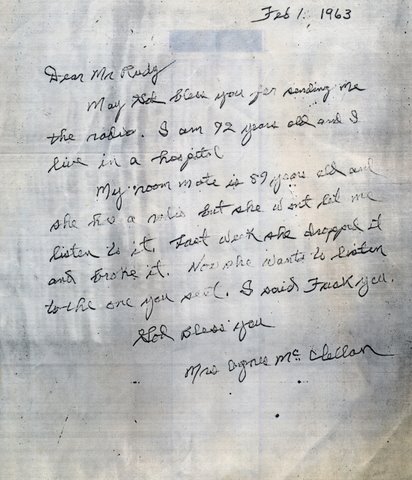
Fan letter

I had heard this story over the years but always assumed it was apocryphal. Too good to be true. Rudy Pylant (“Mister Rudy”) was a local radio personality in my hometown. His fans were legion and he got lots of letters. Like this one his daughter recently discovered and shares.

“The Internet is over”

The Guardian sent Oliver Burkeman to SxSW where he realized the Internet is over:

“If Web 2.0 was the moment when the collaborative promise of the internet seemed finally to be realized – with ordinary users creating instead of just consuming, on sites from Flickr to Facebook to Wikipedia – Web 3.0 is the moment they forget they’re doing it. When the GPS system in your phone or iPad can relay your location to any site or device you like, when Facebook uses facial recognition on photographs posted there, when your financial transactions are tracked, and when the location of your car can influence a constantly changing, sensor-driven congestion-charging scheme, all in real time, something has qualitatively changed.”

We can probably stop saying “digital” media since all media is digital. Same for “online identity.” We only have one identity and unless you’re hunkered down in a Montana cabin, it’s online.

As long predicted, the Internet/Net/Web is woven in to all that we do. Like electricity and indoor plumbing. We don’t think about it. It has become invisible. We’ll stop saying (as I did above) “online” because we’ll never be “off line.” (Yes, I realize there are lots of people in the world for whom this is not the case. It will be.)

I wonder if I will miss the Internet when it is no longer an identifiable thing? Something I can “get on?” A place to go.

“The Net is the new TV & radio”

“Smartphones and other portable Net-connected devices are now the closest things we have to universal receivers and transmitters of live news. Not many of us carry radios in our pockets any more. Small portable TVs became passé decades ago. Smartphones and tablets are replacing radios and TVs in our pockets, purses and carry-bags.”

“Television has also become almost entirely an entertainment system, rather than a news one. News matters to TV networks, but it’s gravy. Mostly they’re entertainment businesses that also do news.”

“…emergencies such as wars and earthquakes demonstrate a simple and permanent fact of media life: that the Net is the new TV and the new radio, because it has subsumed both. It would be best for both TV and radio to normalize to the Net and quit protecting their old distribution systems.”

— From a post by Doc Searls, co-author of The Cluetrain Manifesto.

“The world has moved on”

“One has only to watch US TV for 10 minutes to conclude that America’s communicators no longer have the intellectual resources and political literacy to mount successful, well-informed propaganda. The Fox Channel is for home-turf idiots. And besides, what would the state-subsidized propagandists be able to boast about? Predator raids in Afghanistan? Guantanamo? Thirty million on part-time work or jobless in the Homeland? America is not the sell it once was, when the economic growth rate was headed up and capitalism seemed capable of delivering on its promises.”

From a post at CounterPunch.org on the growing influence of Al Jazeera

“New media landscape”

Clay Shirky thinks the media has failed to appreciate the full significance of WikiLeaks:

“WikiLeaks allows leakers transnational escape from national controls. Now, and from now on, a leaker with domestic secrets has no need of the domestic press, and indeed will avoid leaking directly to them if possible, to escape national pressure on national publishers to keep national secrets.

WikiLeaks has not been a series of unfortunate events, and Assange is not a magician – he is simply an early and brilliant executor of what is being revealed as a much more general pattern, now spreading.

The state will fight back, of course. They will improve their controls on secrets, raise surveillance and punishment of possible leakers, try to negotiate multilateral media controls. But even then, the net change is likely to be advantageous to the leakers – less free than today, perhaps, but more free than prior to 2006. Assange has claimed, when the history of statecraft of the era is written, that it will be divided into pre- and post-WikiLeaks periods. This claim is grandiose and premature; it is not, however, obviously wrong.”

Bruce Sterling on mobile phones and revolution

“… we’re in the midst of a massive global reinvention. Not just a shift from analog to digital, but a shift from centralized control to distributed systems. From isolated single user experiences to a global social fabric. These mobile devices are the of Gutenberg presses of our generation. This is not a bubble, this is a revolution.” – Blog post

“How to make trillions of dollars”

David Cain is (Raptitude) helping me (and many others) “get better at being human.” In this post he explains how television has been used by “very-high-level marketers” to create a nation of people who typically:

  • work almost all the time
  • absorb several hours of advertising every night, in their own homes
  • are tired and unhealthy and vaguely dissatisfied with their lives
  • respond to boredom, dissatisfaction, or anxiety only by buying and consuming things
  • have disposable income but can’t find a more fulfilling line of work without losing their health insurance
  • create health problems for themselves, which can be treated with drugs they can “ask their doctor about”
  • own far more items than they use, and believe they don’t have enough
  • are easily distracted from the unhealthy state of their lives and their culture by breaking news and celebrity gossip
  • perpetually convince themselves it is not the right time to make major lifestyle changes
  • happily buy stuff that breaks within a year, and which nobody knows how to fix
  • have learned, through the media’s culture of blame-mongering, that the key to solving public and private issues is to find the right people to hate

Wow. Sound like anyone you know?

I’m trying to stop watching the evening network news. A tough habit to break. It’s been part of my life since… well, since the beginning of network news. Thanks to DVR technology I can skip all the adds to which Mr. Cain refers.

My friend (and one of the 5 smartest guys I know) Henry has eliminated “news” completely. Or so he says. I’m not sure how one does that. But if anyone can, it’s Henry. He makes a compelling case that knowing the news adds nothing to his life. He’s very well (selectively?) informed, so…

The excerpts above don’t tell you much about “how to make trillions of dollars” so I encourage you to read the full post if that’s something you’d like to do.

    Sports franchises as media

    Ted Leonsis, owner of Washington Capitals (NHL) & Washington Wizards (NBA), at Tuesday’s Business of Sports Symposium:

    “…we’re our own media company. I announce things on my blog. I get 40 to 90,000 people coming to my blog, depending on the subject. I have a direct, unfiltered way to reach our audience now, and I think that harnessing that is what you have to do as ownership, because we are media brands. We’re in the subscription business. We call them season-ticket holders. We’re in the sponsorship business. We’re in the same business [as The Post]. When someone goes to find out something about me or a team or a player, and they go to Google and they type that in, I want to learn how to get the highest on the list, and I’ve done that. I don’t want The Washington Post to get the most clicks. I want the most clicks.”