
Category Archives: Media & Culture
Living in an Internet cafe
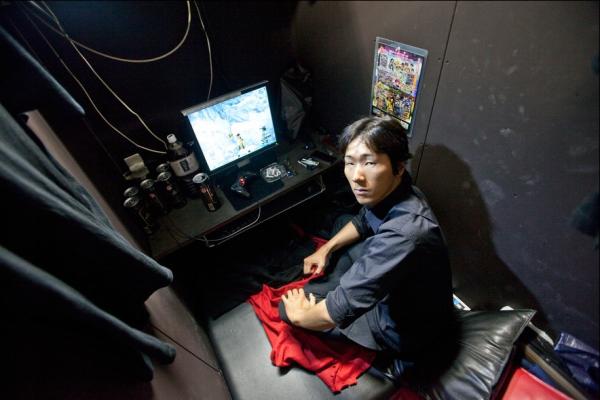
“Fumiya has learned to sleep with a blanket over his face to block out the fluorescent lights that stay on all night. Unable to afford an apartment in Tokyo, he has been living in an Internet cafe for nearly a year. At 26, he is part of Japan’s struggling working class. Temporary workers with little job security now make up more than a third of the country’s labor force, according to government statistics.”
“At a discounted monthly rate of about 1,920 yen ($21) a day, the 24-hour cafes offer private rooms with computers, reclining chairs, and an endless supply of coffee and soft drinks. Shared bathrooms and laundry service are also included.”
“According to a 2007 study from Japan’s Ministry of Health, Labor and Welfare, an average of 60,900 people spent the night in an Internet cafe on any given day. Of those, an estimated 5,400 were long-term residents.”
Give-A-Fuck-O-Meter

Animation about cell phone data mining
Network from Michael Rigley on Vimeo.
Why local TV is alive (if not well)
I avoid local TV like dog poop on the sidewalk but it seems to be alive and well, perhaps for the same reasons millions of people still use AOL. Here’s a couple of pulls from a commentary by Terry Heaton, a guy who seems to know a lot about TV
“The concept of network content distribution through local affiliates is what’s being challenged by the Web. Local broadcasters are middlemen in the delivery of network content to the masses, and that was fine in a world absent horizontal connectivity. My version of Gilmore’s Law is that “the net regards middlemen as failures and routes around them,” and I’m not alone in this thinking. The networks simply can do their thing far more efficiently — and thereby, profitably — by going directly to consumers.”
Oh, now I remember why I stopped watching local TV.
“Local television is still atop the heap in terms of delivering the goods for certain advertisers, most notably political candidates. Saturating the airwaves — especially in key states — with ads for those running, delivers incredible profits for local broadcasters. This is not going to change, and absent some major innovation that pushes campaign managers elsewhere — perhaps mobile? — the money is going to continue to support local broadcast companies.”
One less decision
For the past two weeks, breakfast has been cereal with fruit, OJ and (sometimes) toast. This didn’t seem like an important decision until I read David Cain’s post: Why the minimalists do what they do.
“After years of being confronted with a decision shortly after waking, I decided to be done with deciding what was for breakfast. My usual is now the only thing on the menu, and since I stopped deciding what’s for breakfast, mornings have had a significantly different feel. They are clearer and more spacious.”
And it’s about more than what we have for breakfast.
“When we’re faced with a number of options, we’re always going to assume that one of them is better than all the rest. This means the more options there are, the more likely we are to choose one that isn’t the best one. […] Our satisfaction with what we have shrinks as the number of things we don’t have — or could have — grows.”
This notion resonates with me. Even to having fewer shirts or pants to select from each morning.
Learn Guitar with David Brent (Ricky Gervais)
Shoebox Apartment
The Retirement Myth
“Only 58% of us are even saving for retirement in the first place. Of that group, 60% have less than $25,000 put away … a full 30% have less than $1,000.” According to Nielsen Claritas, Americans age 55 to 64 have a median net worth of $180,000 — less than they’ll likely need for health care spending alone during retirement. — According to ConvergEx Group
“The entire concept of retirement is unique to the late-20th century. Before World War II, most Americans worked until they died.”
“According to the Centers for Disease Control’s actuary tables, someone born in 1950 could expect to live to age 68.2, while someone born in 2010 could expect to live to 78.7.”
Who are your heros?
“If you tell me who your heroes are, I’ll tell you how you’ll turn out.”
I’m not as smart as Warren Buffett but I might be as lucky.
“When you work with people who are already rich, they’ll work because they choose to do so, ‘rather than being on a yacht somewhere.’ But you don’t have to be rich. Buffett says that while it make take a job or two to get there, you should do the work you love.”
“Just imagine you could be given 10 percent of the future earnings of one person you know,” Buffett says. Would you pick the smartest person? The fastest runner? No, Buffett says: “You’re going to pick the person that has the right habits.”