
iHeartMedia has revamped one of its AM radio stations to a podcast channel

“The conglomerate’s AM 1470 in Allentown, Penn., will now feature back-to-back podcast programming. The initial podcast selections for this change include several of the flagship shows from HowStuffWorks, which iHeartMedia acquired in September 2018.”

What about commercials?

“It was followed by a massive traditional block of radio commercials: the iHeartRadio app, Bank of America, “Best Fiends” mobile game app, an air conditioning company, Outback restaurants, Capital One bank, Curious Goods (a local store), the Home Depot, a pet store, My Computer Career training program, Walgreens, NAPA Auto Care Center, Choice hotels, AARP, Progressive insurance, and the iHeartRadio app again, this time emphasizing podcasts and introducing the next podcast.”

Radio and Internet News

I seem to recall this being tried back when podcasting first appeared. A San Francisco station? Not sure why I’d want to let this Allentown station pick the podcasts when I can do that myself. Maybe for people to lazy or stupid to do that? Is there an in-car angle?
65+

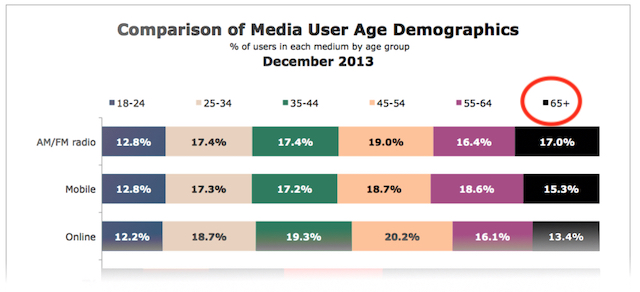
When people ask my age, I’ll tell them “65 Plus.” After 65, nobody cares how old you are. Media rating services like Arbitron and Nielson have nice, easy-to-remember categories…that stop at 65. So no more birthdays. I’m 65+. It’s really the last age that matters. (Medicare, Social Security, etc)

I’ve reached the age where contemporaries start dying. God’s mortar shells landing ever closer. John D. MacDonald described it best in Pale Gray for Guilt.

“Picture a very swift torrent, a river rushing down between rocky walls. There is a long, shallow bar of sand and gravel that runs right down the middle of the river. It is under water. You are born and you have to stand on that narrow, submerged bar, where everyone stands. The ones born before you, the ones older than you, are upriver from you. The younger one stand braced on the bar downriver. And the whole long bar is slowly moving down that river of time, washing away at the upstream end and building up downstream.

It’s hard to be part of the 65+ demo and not have a sense of your own mortality. I like Scott Adams’ take.

“…we’re a simulated (programmed) world left behind by advanced humanoids that shed their bodies billions of years ago. Our simulated world is the closest they could come to immortality. They were romantics, much like ourselves, and couldn’t stand the thought of being separated from their loved ones for eternity. So in our programmed little world, when we feel a special connection to another, it’s because we knew that person when we were real, and the program allows us to feel it again as if new. Thus, when you meet your soul mate, it is a reunion of sorts. And it will happen over and over, in each subsequent life the program provides for you.”

But Paul Simon said it best for my money.

If you care about your thoughts, keep them

From an article by Derek Sivers on the benefits of a daily diary:

“Years from now you might be looking back, wondering if you were as happy or as sad as you remember during this time. […] We so often make big decisions in life based on predictions of how we think we’ll feel in the future, or what we’ll want. Your past self is your best indicator of how you actually felt in similar situations. So it helps to have an accurate picture of your past. […] You can’t trust distant memories. But you can trust your daily diary. It’s the best indicator to your future self (and maybe descendants) of what was really going on in your life at this time.”

Truth in Advertising

Written by David Chiavegato and its director, Tim Hamilton, Truth In Advertising is a genuinely funny comedy that was nominated for a Palm d’Or in 2001. Colin Mochrie, best known as a regular on Whose Line Is It Anyway? in the US and UK, is the boss in an advertising agency where everybody tells the embarrassing truth about…advertising.

“Intelligent uniforms”

“Over 10 schools in the (China’s) southwestern Guizhou province and Guangxi Zhuang Autonomous Region have made students wear “intelligent uniforms” from Guanyu Technology in the name of improving attendance and safety. Each uniform has two chips that indicate when a student is entering or exiting school grounds, and automatically sends that data to both parents and teachers. Leave without permission and an automatic voice alarm will make it patently clear you’re a truant. […] Each uniform is linked to a given child’s face, and facial recognition at the school entrance will raise an alert if there’s a mismatch. The chips in the uniforms can survive 500 washing cycles and temperatures upward of 150C (302F), and they’re also useful for purchases.”

More »

Freedom Points

“Every time you generate data, in whatever form, you accrue more Freedom Points. Some data is more valuable than other, so points would be ranked accordingly: a trip to Moscow, say, would be worth a million times more points than your trip to the 7-Eleven. Well then, what do Freedom Points allow you to do? They would allow you to exercise your freedom, your rights and your citizenship in fresh modern ways: points could allow you to bring extra assault rifles to dinner at your local Olive Garden restaurant. A certain number of Freedom Points would allow you to erase portions of your criminal record — or you could use Freedom Points to remove hours from your community service. The thing about Freedom Points is that if you think about them for more than 12 seconds, you realise they have the magic ring of inevitability. The idea is basically too dumb to fail. The larger picture is that you have to keep generating more and more and more data in order to embed yourself ever more deeply into the global community. In a bold new equation, more data would convert into more personal freedom.”

Imaginary use of data from a 2015 article by Douglas Coupland

Trivia

“In the 1960s, nostalgic college students and others began to informally trade questions and answers about the popular culture of their youth. The first known documented labeling of this casual parlor game as “Trivia” was in a Columbia Daily Spectator column published on February 5, 1965.” (Wikipedia)

By the early 70’s “Trivia” had really caught on with my crowd. We prided ourselves on knowing the names of all of the actors in the Superman TV series and, initially, the only way to know this was to watch the credits and remember. No easy way to “look it up.” But by the early-to-mid 70’s trivia books were being published.

“The People’s Almanac was a series of three books published in 1975, 1978 and 1981 by David Wallechinsky and his father Irving Wallace, the novelist responsible for co-authoring the series The Book of Lists. The format of the almanac departs from a conventional almanac and included many obscure facts, lists and esoteric knowledge.” (Wikipedia)

In 1977 the first Book of Lists was published, one of a series of books compiled by David Wallechinsky, his father Irving Wallace and sister Amy Wallace. Each book contains hundreds of lists (many accompanied by textual explanations) on unusual or obscure topics, for example:

  • Famous people who died during sexual intercourse
  • The world’s greatest libel suits
  • People suspected of being Jack the Ripper
  • Worst places to hitchhike
  • People misquoted by Ronald Reagan
  • Breeds of dogs which bite people the most, and the least

Trivial Pursuit (the game) came out in 1979 but it never caught on with our crew. Too… structured. Our trivia sessions were more free-form, sort of nerd rap.

During my radio period I co-hosted a daily talk show and once a month we brought in a couple of other folks and opened up the phone lines for trivia questions from listeners (Trivia Bowl). I can’t imagine how trivia could still be a thing in a world of Google and mobile phones. But it was fun while it lasted.

On your radio dial

I have not listened to a radio station in years. Some of that is attributable to the iPod and the iPhone and some to the decline of local radio. But as a teenager in the 60s, radio was a huge part of my life. Great memories of WLS in Chicago and, later, WWL in New Orleans.

How familiar that radio dial with its five pre-set buttons. If your station wasn’t good enough to get one of the buttons, well, that car wasn’t listening.

The video clip above is from the pickup I recently purchased. Hadn’t bothered to turn the radio on and wondered if it worked. Don’t imagine I’ll do much listening in the truck but I kind of like having it there. For old time’s sake.