What did we do before computers?

It’s a question I silently ask myself from time to time, so I thought I’d try to reconstruct how I (and others) did my job when I first came to Learfield in 1984. (This photo was taken in 1985 and I’m including it with this post as a memory aid. Annotated version.)

It might be easier to to start with what we didn’t have. I’m going to say no computers even though there was a Lisa II (?) running VisiCalc. No fax machine. No mobile phones.

The bulk of my job was dealing with affiliate radio stations and there was only three ways to do that:

1. Call them on the phone
2. Send them a letter in the mail
3. Get in the car and go see them in person

Each week we would send stations a “log” showing which commercials would be airing in each of the news or farm programs we sent them via satellite. One of the secretaries had drawn a table (6 columns for M-Sa and 13 rows for the number of shows) using a ruler. This was copied (we had a copier) each week and the blank table was rolled into an IMB Selectric typewriter and the names of the sponsors typed in.

This had to be completed by Wednesday of each week in order to get them mailed and to the stations in time for their “traffic” person to insert those commercials into THEIR log for the coming week. And delay and the system fell apart.

The photo above reminds me I used a manual typewriter often enough to keep it close. The computer in the photos is a Zenith and I was the only person in the company with his own personal computer.

We also had a big IBM Displaywriter that allowed us to do mail-merge documents. Amazing tech for the time.

Next to my phone is a Rolodex with all of my contacts, each typed on the big Royal but continuously updated with scratch-throughs and margin notes. If you got fired, you wanted to have a copy of your Rolodex.

If –god forbid– we needed to get information to every network affiliate “fast,” someone had to call each station, one at at time.

One of the tools I relied upon most was my big map. You can’t see them but there is a pin showing the location of each radio station on the network. It was a thrill to add a new pin and agony to remove one.

Long before Google Docs, there was the bulletin board for all the important lists. (this was not portable)

Years later we got our first fax machines, even though most of our stations didn’t have them. We knew they would. Someone stood at the machine and keyed in the name and phone number of every radio station (or advertiser). When you wanted to blast a fax out to a “list,” you fed the document in and it called each number, transmitted the facsimile; printed a “receipt” and then called the next number on the list. It was wonderful. We didn’t have to wait 3 or 4 days for the USPS.

And it got better. As we got more computers and modems, programs like WinFax could do the job of a fax machine but with far less effort and with much greater speed. We could keep a station’s fax machine humming all day and all night, burning up expensive rolls of thermal paper. The term “spam” was years in the future.

Now we post information to our websites and stations download at their leisure. We communicate with them on Facebook and Twitter and all the rest. Email is instantaneous.

Will it get faster/better/easier still? Hard to imagine how but I assume it will

Living in the cloud

I’m no longer on the company computer network. My iMac is one of only a half dozen or so Macs in the building and I made very little use of the network anyway. And it’s something of an experiment.

I had one of the first personal computers in our company. I bought a Zenith back in the late 80’s and used it for word processing and for tracking affiliate stuff. It was connected to no thing and nobody (except my little dot matrix printer)

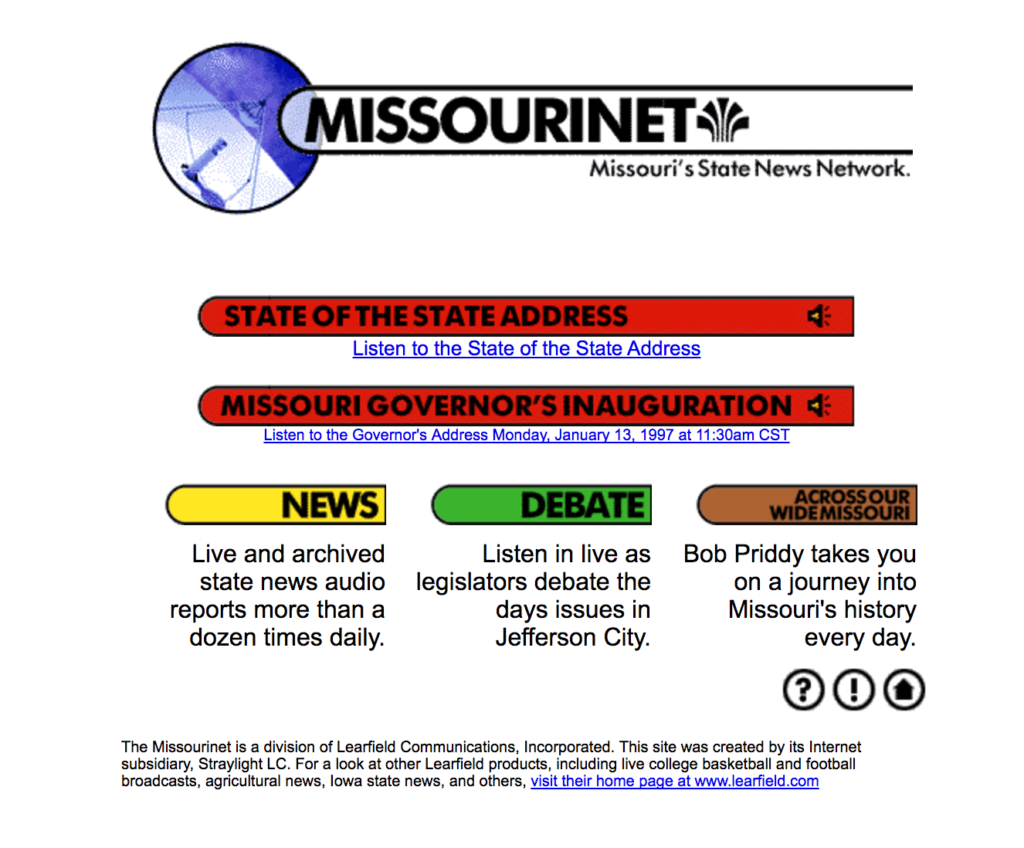
The first “network” in the company –as far as I can recall– was a peer-to-peer lash-up in the Missourinet newsroom. No network server, just individual PC’s (Compaq’s with 20 MEG hard-drives) talking to each other.

I don’t remember the exact evolution after that but before long the building was networked and as we added offices throughout the country, they came online. And we now have two full-time network administrators and the network has become critical to the operation of our company.

So why did I cut the cord?

As one of the “web guys,” most of my work has been taking place “in the cloud” for some time. I access company email from a web browser and can do just about everything I need to do, without being on the company grid.

Plus, anytime there was a software upgrade, I had to ask someone with admin privileges to do it for me. Sort of like having your mom come unzip your pants so you could pee. Unpleasant for everyone.

When coworkers need to send me a file that is too large to attach to an email, they drop it on one of the network drives I can no longer access from my iMac. I’m working around that and will eventually get them to put it up on my iDisk, Dropbox or drip.io. Which works in the other direction, too.

For me the Net has become the network. Lots of storage, nearly ubiquitous access, great tools. I feel like a dog that chewed through his leash. Woof!

Introducing the HP 6000 PRO

Our local HP rep brought a new computer by the office yesterday for our IT guys to check out. It’s the HP 6000 PRO. I couldn’t resisit teasing him a little about the revolutionary design breakthrough.

“Whoa! That is so COOL! Everything built right into the monitor? No separate box?! Damn!

This is just the sort of thing that makes PC’s hate Mac fanboys like me. But I couldn’t help myself. Apple introduced the iMac G5 in 2005. 5 years is a lifetime in hardware innovation.

And then Phil dug out the HP’s power supply and I felt so bad for the rep I wanted to give him a hug. This thing is literally the size of a brick. The only good thing about the monster is you can rest your feet on it.

There’s nothing wrong with seeing a good design and emulating it. Shit, Apple does this. But if you go that right, at least try to make your design a little better than the one you are copying. And there’s the rub. Just can’t do it and keep keep the price down.

Survey of radio newsrooms (1988)

A big part of my job during my early days at Learfield was affiate relations. Periodically, I would survey the stations to learn more about how they used our news and sports. Here’s a snapshot from 1988.

  • 2/3 of stations had a full-time news person (I’ll bet it’s not 1/3 today)
  • I was insensitive or stupid or both in asking about sex. It was a different time.
  • Almost half had a wire service?! Amazing. Can’t be more than 10% now.
  • “Cassette recorders” – Ah, my favorite. A world before digital recording.

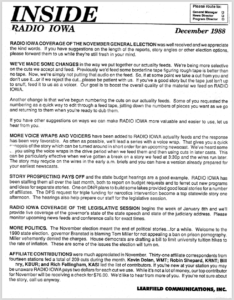
Back in those pre-web days, we also did a newsletter each month. One page, front and back. I typed it on a typewriter, made copies and put them in the mail. Example: Missourinet newsletter – Jan87

The whole process now seems … quaint. Typewriters and envelopes, once a month. But there was a simplicity that seems appealing in retrospect.

Murals by Rebecca


The brief (4 min) video above is with a co-worker who paints wall murals. She thought a video might help show-and-tell her art. I mention this here because it was just so easy to do with iMovie and the Comic Book theme added a little pizzazz. I need to check to see if there are more themes out there. I’m surprised that Apple only provide half a dozen.

Lesson learned from this mini-project: Edit out my questions wherever possible.

There is no 26 Year Pin

Today marks the beginning of my 27th year at Learfield, the company I work for. There’s not much to say that I haven’t shared here already. On my drive to the Coffee Zone, I made a mental list of those who have been with the company longer: Clyde, Clarice, Joyce, Roger, Greg, Charlie, Bob… that’s about it.

The nature of our business has changed a good bit but the culture is –remarkably– still pretty much intact. No small feat, given that we now have hundreds of employees in offices scattered throughout the company. But our senior managers make a real effort at sharing the best of who we are as a company with new employees.

So this is one of those “If you’re happy and you know it, grab your ass!” posts. And if pushed to finish with a bit of wisdom, it might be that the company you work for and the people you work with are as important as the work you are doing.

Video Affiliate Advisory


I love this idea. The head of affiliate relations for Learfield Sports (Keith Kowalski) posts a brief (60 sec) video, explaining a new text alert service for keeping radio affiliates up to the minute on changes to broadcast times due to weather. Nothing fancy here. Just pointed the Flip camera and popped the advisory up on YouTube. Our sports ops folks are making excellent use of their website (WordPress) which serves 40+ networks.

Performance Evaluation

I got mine today. More on that in a moment.

I think just about everybody dreads performance evaluations. Managers hate doing them and employees hate having their work “evaluated.”

All managers know this is something that should be happening on an ongoing basis. But it’s so uncomfortable (remember that scene in Office Space with the “Bobs”) it usually happens only once a year, usually at budget/raise time.

Employees don’t hear a single word of the evaluation (assuming there’s a face-to-face with the boss) because they’re just waiting to hear how much of a raise they got. They also question whether the boss has any idea of how they are really “performing.” At least that’s how I remember it, before I parachuted out of management, landing safely in Learfield’s Internal Services Group (accounting, engineering, IT).

A couple of of years ago the head of ISG asked for my ideas on how to evaluate what I do. (Huh. Why didn’t  I think of that?) I suggested he ask the people I worked with (and for) what they thought, keeping their responses anonymous, of course. He liked the idea and we’ve done it that way (for me) for the last two years.

Most of this year’s feedback was positive (modesty prevents me from sharing) but I do have some areas that still need improvement:

“…can be sarcastic but almost always in fun. Steve lives and breathes the web both at work and in his off time. The downside is whatever he is working with or reading at the time, you are going to hear about it at least as much as you want if not more.”

“Steve Has a tendency to be flippant and arrogant if you don’t agree with this assessment that the world revolves around the Web (and Apple). Sometimes we have clients that need something simple or have a need that he doesn’t agree with. Patience, and understanding that other points of view may be valid, would be appreciated in those instances.”

“Steve is very creative and talented. With that skill set comes a certain degree of “attitude” that isn’t always well-accepted/understood by others.”

Guilty as charged. I’m something of a smart-ass but I’m working on changing that. (Sharing this here is a small part of that effort).

But I like this kind of performance review. The anonymity makes it easy to get the cold hard truth. Every encounter with a co-worker or client is an opportunity to get right … or get it wrong. Keeps a boy on his toes.

First live video from capitol hearing room?

As far as I know, I did the first live video feed from a committee room at the Missouri state capitol. I know, you’re asking yourself why would anyone bother. You could ask that about a lot of important-but-not-too-interesting news.

We’ve been streaming audio of debate in the Missouri House and Senate for 8+ years and recorded audio of lots of hearings, but never video. Finally all of the pieces of the puzzle seemed to be in place: hardware, software, wifi.

I used a little Logitech webcam (on the tripod); the Casio Exilim for back-up (on the small tripod) and ran it (the LogiTech) through CamTwist up to USTEAM. I think I can skip CamTwist next time. You can sample a few seconds below.

It ain’t CBS but I didn’t have wait on the sat truck, either. Next time, I might just try this on the iPhone if I can get close enough.

WordPress, StudioPress, Thesis. FTW.

TS-thumbnailWe completed a make-over of one of Learfield’s websites yesterday. Like most companies, we’re watching our expenses, so I was pleased to bring it in for the $59 I paid for the theme (not counting my time and some IT help with site prep).

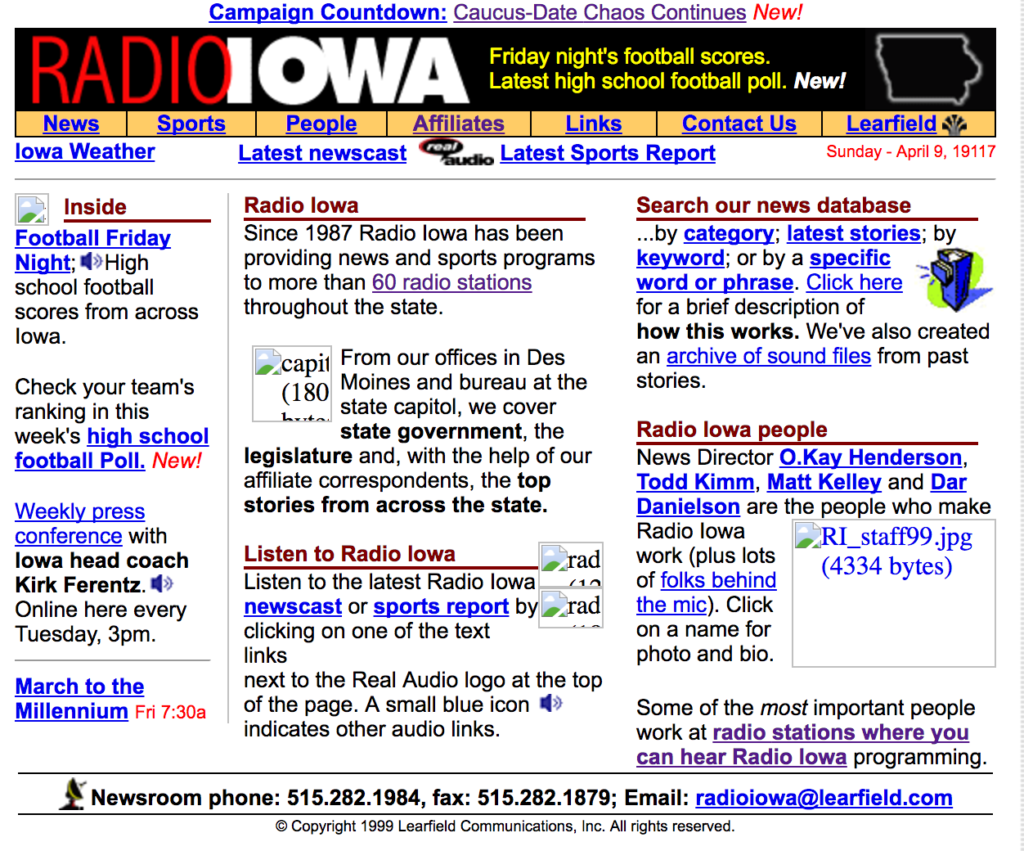
Since the beginning of the year, we’ve converted a dozen websites to WordPress and the process has gone very smoothly. With 50 users working in half a dozen offices, we needed a very friendly content management system and WordPress has delivered. Both for the people working in our newsrooms and for me.

There are literally thousands of plug-ins for every conceivable task. And they’re all free (or donor supported).

I’m not a designer but the variety of affordable WordPress themes is staggering. After a good bit of looking, I found myself coming back again and again to two providers:

StudioPress has great-looking themes that cost about $60 each. Use as-is or have one customized for a couple of hundred bucks.

Thesis is the theme I chose for our news networks. Out of the box, it’s a clean, minimalist design. We can add a coat of Candy Apple Glitter Flake paint later, but for now, I wanted something that was easy to manage under the hood.

thumbnails-three

Both of these developers have great support forums and documentation.

I’ve spent less than $2,000 on the refresh of ALL of our websites. Aside from some great help by our IT folks, and the day-to-day content posting by our news and sports staff, I support all of these by myself.

If quick turn-around is a requirement, StudioPress/Thesis + WordPress is a winning combination. If the content has been assembled, I can get a site up and running in a matter of a few hours.

Fast, inexpensive and fun. For the win.