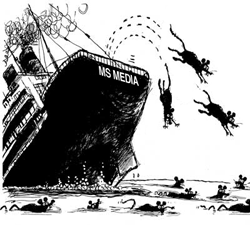
Newsroom transubstantiation

Some interesting posts on the Mothboard about the state of radio. Dale Forbis concluded his with a finger-wag at bloggers:

“Somebody truly needs to tell bloggers, the minute you express an opinion, you are no longer committing journalism. Journalism’s not better, or more valuable — but it also doesn’t include opinion expressed by the journalist. Or, it’s not supposed to. Not good, responsible journalism.”

Most bloggers I know and read don’t think of what they do as journalism. And I’m sure Dale’s scolding tone is unintentional. But I’ve been in many of the same newsrooms he has and I’ve heard reporters take strong, heated stands on controversial issues. Conservatives vs. Liberals. Pro-Life vs. Pro-Choice. Gun control. All the biggies. And then sit down and write a story on the same issue they were debating only moments before.

Are we to believe some sort of Miraculous Purge takes place and the reporters’ mind and heart are cleansed and the story he or she writes is untainted by the views expressed only moments before? A newsroom transubstantiation?

I don’t doubt that many reporters believe in this miracle, but it’s a faith not shared by their listeners/viewers/readers. Could it be that blogs are growing in popularity precisely because there is no pretense of objectivity? If we have an opinion, we flop it out there on the table.

I, for one, have no desire to commit journalism. And I hope there’s always someone around willing to do it. And if they can keep their political views and opinions out of their reporting, I’ll light a candle.

Update: When you’re wrong, you’re wrong. Dale took me to task on this post and upon reflection I confess to having too much tar on my brush and smearing it indiscriminately. I know and work with a lot of good reporters who work hard at –and, as far as I know, succeed in– keeping their personal views out of their reporting. To suggest otherwise was wrong.

Three groups of journalistic awareness of weblogs

Group 3, “growing smaller every day, is completely unaware of what has happened in the past few years. They don’t know what a blog is. They are still upset that the company started a website and they don’t believe they should have to write for it.”

From an article by Paul Conley (“Learning the basics of conversational editorial“) in which he describes three classes of journalistic awareness of weblogs. [via E-Meida Tidbits]

Journalists like control

“You’d think that all those years of probing, criticizing, attacking, and lampooning others would give them Teflon skin. But, no, like a schoolyard bad boy, if you confront them and criticize them back, they turn either weepy or prickly. Can give, can’t take. That is not so surprising, after all, when you realize that this is really an issue of control. In the closed worlds of the newsroom, the page, the show, and the media conference, journalists are in control. In the wide-open world of the web, they’re not. And that’s a tough adjustment for some.”

— Jeff Jarvis thinks journalists have thin skins and explains it as a matter of control

Merrill Brown on future of news

Editorial by Merrill Brown on, the founding editor in chief of MSNBC.com and is a former executive with RealNetworks:

The future course of news, the basic assumptions about how we consume news and information and make decisions in a democratic society, are being altered, perhaps irrevocably, by technologically savvy young people no longer wedded to traditional news outlets or even accessing news in traditional ways.

There’s an inescapable conclusion to be drawn from research I completed earlier this year for the Carnegie Corp. of New York about the news habits of 18- to 34-year-olds. In short, the future of the U.S. news industry is seriously threatened by the seemingly irrevocable move by young people away from traditional sources of news.

The thing that always chills my bones in pieces like this is the total absence of any mention of radio. Where are we?

Brian Williams’ blog

NBC news anchor Brian Williams has been blogging (The Daily Nightly) for a few months and seems to be doing a pretty good job of it. He’s careful not to “traffic in gossip or observations that might breach his journalistic objectivity” and tends to focus more on the deliberations among his colleagues at NBC Nightly News.

This is just the kind of peek behind the scenes I think would be good for our news networks but I don’t see it happening anytime soon (see previous post). Most reporters do not feel they need to explain or justify their reports or stories and the last thing they want to do is interact with their readers/listeners. Is Brian Williams less of a journalist now that he’s contributing to a blog? More on this at NYTIMES.com (you might need a password).

New Convergence program at MU J-School

Mike McKean heads up the new Convergence program at the University of Missouri School of Journalism. This fall he begins his 20th year teaching at the J-School. Once upon a time, he was a reporter for The Missourinet, one of the state news networks owned by the company I work for. Mike and I get together every few months to talk about radio and journalism and the Internet and stuff like that.

Today I took my recorder along and asked him about: Teaching journalism in 2005; podcasting; blogs; radio; advertising; newspapers; “citizen journalism” and some other stuff.

AUDIO: Interview with Mike McKean 20 min MP3

Execution journal: Donald Jones

In his capacity as news director for The Missourinet, Bob Priddy has witnessed 15 executions. The most recent was the April 27th execution of Donald Jones, for which Bob produced an “audio journal” that begins as he leaves his motel in Bonne Terre to go to the prison and ends as he prepares to leave the prison about two and a half hours later. Bob telescoped the audio down to about half an hour and some segments have been shifted for context purposes (the reading of the final statement of Donald Jones, for example).

Bob was not allowed to take his recorder to the execution witness area, so he summarizes the events that took place in that approximately 90-minute span. The main voices you will hear are those of Missourinet News Director Bob Priddy, Corrections Department spokesman John Fougere, and Corrections Director Larry Crawford. Voices of various other officers will be heard as part of the process.

Internet surpassed radio as source for political news

The Internet surpassed radio as a source for political news in the United States last year as more people went online to keep up with the presidential election campaign. So says a new report by the Pew Internet and American Life Project. Twenty-nine percent of U.S. adults used the Internet to get political news last year, up from 4 percent in 1996 and 18 percent in 2000. Television remained the dominant medium for most voters, but 18 percent said they got most of their political news from the Internet, compared with 17 percent who said they turned to the radio for their news.

Blogging, journalism and democracy

“The technology — that is, the software is democratic in and of itself. What were witnessing is a shift of power and prestige. Journalists have been accustomed to being powerful. Most people don’t like giving up power. It used to be cool and MEAN SOMETHING to be The Wall Street Journal or The New York Times or NBC or CBS or CNN … now it means less and less.”

Halley Suitt on blogging and journalism and democracy.