MU J-School requires iPhone/iPod Touch. Sort of.

Freshmen admitted into the University of Missouri School of Journalism (and pre-jounalsim students) will be “required” to have an iPhone or ilPod Touch beginning this fall. But not really. If the device is “required” it can be included in a financial need estimate.

According to the story in the Columbia Missourian, iPods and iPhones are “learning devices” used to record lectures. But student still have the option of using their laptops to record lectures.

People have already started bitching about this. Favoring one brand of computer or device; scamming the financial needs program, etc.

When I saw @georgekopp ‘s tweet on this, I thought it was a good idea but for a reason not mentioned in the story.

News is going (has gone?) mobile. A journalism student can’t begin to understand –and report on– that world without a moblie device and –for the moment– the iPhone and iPod Touch are the of breed. I can’t believe the J-school didn’t make that point.

It would be like coming to photography school without a camera.

[A few hours later]

This is another one of those fantasy courses that are easy to come up with if you’ve never taught a class and have no expectation of doing so.

iPhone Reporting would come somewhere in the middle of j-school, rather than at beginning or end. Might work something like this:

Students are equipped with the new iPhone we’re all hoping will come out this summer. It does still images; audio and video (including editing apps). And that’s it. No laptops, digital cameras recorders… just the iPhone.

Each picks a story to cover for the entire semester. Or maybe they pick one from a hat. Either way.

Students are encouraged to use any and all platforms: YouTube, Twitter, flickr, Facebook, Twitpic, etc. The professor follows along online, offering feedback and suggestions during class time.

For all I know the MU J-School might already offer such a course. Perhaps it’s time for another visit with my old pal Mike McKean. Last time we spoke (almost 4 years ago?!) he had been tapped to head up the school’s new “convergence” program. Four Internet years is a lifetime.

PS: I now see he is in charge of the school’s Futures Lab. This implies there is more than one future. Very quantum.

Scott Adams: “Super-local news”

“It’s not just news about your community, but also about your homeowner’s association, your apartment building, your kids’ classrooms, and the sports teams they belong to. Every family would have their own online local newspaper, assembled electronically every day based on that family’s log-in information. Your personal and super-local news would include everything from world events to school lunch menus for that day. Eventually it might even include your child’s report card. Obviously the schools have to be partners in this, and I think that could happen. Most school information is online already or heading in that direction. It just needs to feed to the newspaper’s site for aggregation.

The key is for the super-local information to come to the newspapers from volunteers. For example, every youth sport team would have a parent with a digital camera and the willingness to upload some pictures and write a few lines about the game. A simple user interface would make it easy to integrate the news about little Becky’s soccer game with news of the Lakers. They would have equal billing.”

Where do former newspaper reporters go?

Rebekah Denn has posted links to blogs “and other online works” from other staff members from the former Seattle Post-Intelligencer newspaper. The list included a number of photographers but the thing that caught my attention was the variety of “beats.”

  • Reporter, food writer, former restaurant critic
  • Features writer, children’s book reviewer
  • Art critic
  • Restaurant critic
  • Freelance classical music writer
  • Reporter, specializing in neighborhood sustainability
  • Lifestyles editor, former sports columnist and TV critic
  • Environmental reporter
  • Copy editor
  • Business reporter
  • Investigative reporter
  • Researcher and editor
  • Pop music critic
  • Photo Assignment Editor
  • Illustration, graphic artist
  • Aerospace reporter

And that’s probably not a complete list of the positions that went away when the paper folded. My guess is, these folks really knew their stuff. And are good reporters and writers. I hope they find good jobs.

Knowing absolutely nothing about the newspaper business, it’s difficult for me to imagine how any paper could afford have all these. Did the restaurant critic write one story/column a day? How can you make that math work? Is it heresy to suggest the “food writer” also be the “restaurant critic?”  Why do you need a “pop music critic” AND a “freelance classical music writer?” “Environmental reporter” and “neighborhood sustainability” reporter?

And I DO understand the same sort of analysis could be done of our business. Or any media business.

I suspect they had all of these niche positions because they could. When the ad dollars were flowing in, why not. Let’s cover everything. But those days are gone.

One final thought. Rebekah’s blog is “Eat All About It: Food, journalism and recipes from the great Northwest.” It’s okay but I’m not sure it’s any better than this one by a former co-worker of mine, Lane McConnell. I suppose Lane is technically an amateur since she doesn’t get paid. And there must be thousands of of these. Probably hundreds in Seattle alone.

When such a wealth of information is just a Google search away, how does a newspaper make the case, “We have the best food stories, read us.”

I think it only worked when they could say, “We are one of only two sources of stories about food in Seattle.”

Old growth media and the future of news

I’ve never been worried about the future of news but I couldn’t quite imagine what it will look like as old business models stop working. Steve Berlin Johnson –speaking at the South by Southwest Interactive Festival in Austin last week– sees today’s media as “…closer to a real-world ecosystem in the way it circulates information than it is like the old industrial, top-down models of mass media.”

“So this is what the old-growth forests tell us: there is going to be more content, not less; more information, more analysis, more precision, a wider range of niches covered. You can see the process happening already in most of the major sections of the paper: tech, politics, finance, sports. Now I suppose it’s possible that somehow investigative  or international reporting won’t thrive on its own in this new ecosystem, that we’ll look back in ten years and realize that most everything improved except for those two areas. But I think it’s just as possible that all this innovation elsewhere will free up the traditional media to focus on things like war reporting because they won’t need to pay for all the other content they’ve historically had to produce.”

And near the end of his speech, this warning:

“We’re going to spend so much time trying to figure out how to keep the old model on life support that we won’t be able to help invent a new model that actually might work better for everyone.”

Pew: State of News Media

TV consultant Terry Heaton offers his take on the latest “State of the News Media” report from Pew (Project for Excellence in Journalism) and offers a few predictions:

  1. It’s gone and it’s not coming back. Acceptance of this is the beginning of reinvention.
  2. Future revenue is about enabling commerce, not about serving advertising adjacent to or as an interruption of “content.”
  3. Journalism will survive the death of its institutions.
  4. Most journalists will be independent and work for whoever pays them the most, on a non-exclusive basis.
  5. Journalists will develop and exploit niche specialties.
  6. “The News” will be fast, transparent and authentic.
  7. Anchors will become mostly obsolete, like other middlemen that the Web routes around. I simply can read faster than I can have it read to me. Those that remain will be live hubs that filter multiple content inputs.

From the reports intro:

“There are growing doubts within the business, indeed, about whether the generation in charge has the vision and the boldness to reinvent the industry. It is unclear, say some, who the innovative leaders are, and a good many well-known figures have left the business. Reinvention does not usually come from managers prudently charting course. It tends to come from risk takers trying the unreasonable, seeing what others cannot, imagining what is not there and creating it.”

Claire McCaskill news conferences will never be the same

Good post by Post-Dispatch reporter Tony Messenger on how social networks like Twitter are changing the game.

“While covering the Democratic lovefest last weekend, I put a note on Twitter (I’m @tonymess, by the way) about how Republicans were exchanging nasty news releases about the Senate race in 2010 while the Democrats were uniting behind Robin Carnahan. Within minutes, the note had been passed around by countless Twitterites. The next day, Gov. Jay Nixon made the Republican infighting a central point in his speech to the group. Coincidence?”

Yeah, that must be it.

Man, all of this is SO painful for the old hands who can’t or won’t understand what’s happening and how to make it work for them. And so exciting for those do.

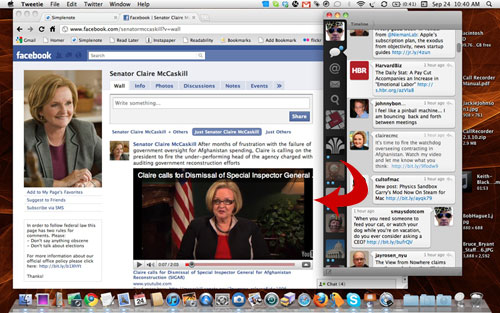
UPDATE: Here’s a screen grab of McCaskill’s most recent tweet. Call me naive, but I’ll be she gets some suggestions and I bet you reads them.

“If the old model is broken, what will work in its place?”

In a post titled “Newspapers and Thinking the Unthinkable,” Clay Shirky provides some insight –and historical perspective– on what’s happening to newspapers. He starts with the question often asked by those committed to saving newspapers

“If the old model is broken, what will work in its place?” To which the answer is: Nothing. Nothing will work. There is no general model for newspapers to replace the one the internet just broke.”

“With the old economics destroyed, organizational forms perfected for industrial production have to be replaced with structures optimized for digital data. It makes increasingly less sense even to talk about a publishing industry, because the core problem publishing solves — the incredible difficulty, complexity, and expense of making something available to the public — has stopped being a problem.”

“When someone demands to be told how we are going to replace newspapers, they are really demanding to be told that we are not living through a revolution. They are demanding to be told that old systems won’t break before new systems are in place. They are demanding to be told that ancient social bargains aren’t in peril, that core institutions will be spared, that new methods of spreading information will improve previous practice rather than upending it. They are demanding to be lied to. There are fewer and fewer people who can convincingly tell such a lie.”

I think this is the first time I’ve fully understood that old models can be broken before new ones are there to take their place.

Sen. McCaskill Flips and Twitters Missouri reporters

“After finishing a serious interview with a trio of reporters on various topics, Sen. Claire McCaskill suddenly whipped out her own mini-cam to turn the tables. McCaskill apparently wanted to put Tony Messenger, Jo Mannies and I in the uncommon role of answering questions. Then, I begin filming McCaskill’s experiment shooting us. The Senator asked for quick soundbites and hit me with a tough criticism about my own blog — that it’s video heavy.”

— Springfield TV reporter David Catanese


Tony Messenger (aka @tonymess)

I’m one of a few hundred (but growing fast) “followers” of Tony Mesenger’s Twitter feed. Tony’s a reporter and columnist for the St. Louis Post-Dispatch and covers the Missouri Legislature and state government. He clearly gets Twitter and blogging and makes great use of both.

Tony joined me at the Coffee Zone for an el grande mocha latte doodah where I got him to put down his cell phone for half an hour to talk about his life as a Twitter junkie.

AUDIO: Listen/Download interview MP3

Before going to work for the St. Louis Post-Dispatch, Tony was a metro columnist and city editor for the Columbia Daily Tribune and the editorial page editor at the Springfield News-Leader.