If someone can see you, mask up.

Katie Notopoulos, writing BuzzFeed’s How To Plague advice column:

“A good way to gauge the amount of distance where it’s OK to dangle your mask around your neck or off one ear is to imagine your mouth is your asshole. If you were completely alone, it would be fine to let your nude tushy hang out, but you’d want to pull on your pants as soon as you saw anyone coming, even from 100 feet away. Basically, if someone can see you, mask up.”

Custom mask by Tonya Lear.


Why you should wear a facemask

  1. If we all run around naked and someone pees on you, you get wet right away.
  2. If you are wearing pants, some pee will get through, but not as much. So you are better protected.
  3. But if the guy who pees also is wearing pants, the pee stays with him and you do not get wet.
 

Yuval Noah Harari: COVID-19’s Impact on Humankind


I’ve read all three of Yuval Noah Harari’s books and found them… interesting, to say the least. I’ve been eager to hear his take on COVID-19 and was a little surprised to get it from an interview by James Corden, who I think of as a late-late-night comedian. But his questions were brief and to the point and he allowed his guest to answer the questions without interrupting.

“ambulatory sacks of virus”

“Anyone else getting a bit … relaxed about all this? I say this as someone who washes his hands after reading about COVID-19, because all hypochondriacs know you can get something just by perusing a list of symptoms. But have we become, let’s say, slightly less alarmed? You keep your distance from the other ambulatory sacks of virus, previously known as “people,” and you don’t feel all that anxious.”

“Of course, that’s the last thing we should be. We should be determined to hunker as long as it takes.”

James Lileks

The same thing at the same time

“There’s never been a time in modern human history when every person is seriously worried about the same thing at the same time. And there’s never before been a ubiquitous threat that can be so instantly broadcast to a world of 7.8 billion people.”

— David Ropeik, consultant on risk management and former instructor in risk communication at the Harvard School of Public Health

MU Health Care using Zoom for “virtual care”

A couple of weeks ago Barb called the clinic where our GP practices (part of the MU Health Center) to report a persistent cough. None of the other symptoms but she wanted to play it safe. The nurse she spoke with explained they were using video visit for initial screening and sent her to the MU Health Care website. She was able to get online with a physician who quickly determined she wasn’t experiencing COVID-19 symptoms. (Even had her use the light on her iPhone to let the doc look at her throat.)

This service was provided by a third-party entity with whom the med center had contracted to take some of the load off their physicians. And it was well done, in Barb’s (former ICU nurse) opinion. Today we received a notice from MU Health Connect, the med center’s online portal:

“For patients who prefer to avoid public places or traveling during this time, we offer virtual care as a secure option. Using Zoom software, appointments can be completed from your phone, tablet or computer.”

Hmm. They were not using Zoom when Barb had her consultation. Since then, Barb has used Zoom almost daily, like a bunch of people. What’s going on? Are MU docs now doing “video visits?”

They are. According to my well-placed source, the feds modified their billing guidelines, so MU docs can do a zoom call and charge like a regular visit. That was a big barrier in the past. AND, all the other MUHC administrative friction disappeared quickly with COVID.

Washing your hands isn’t enough

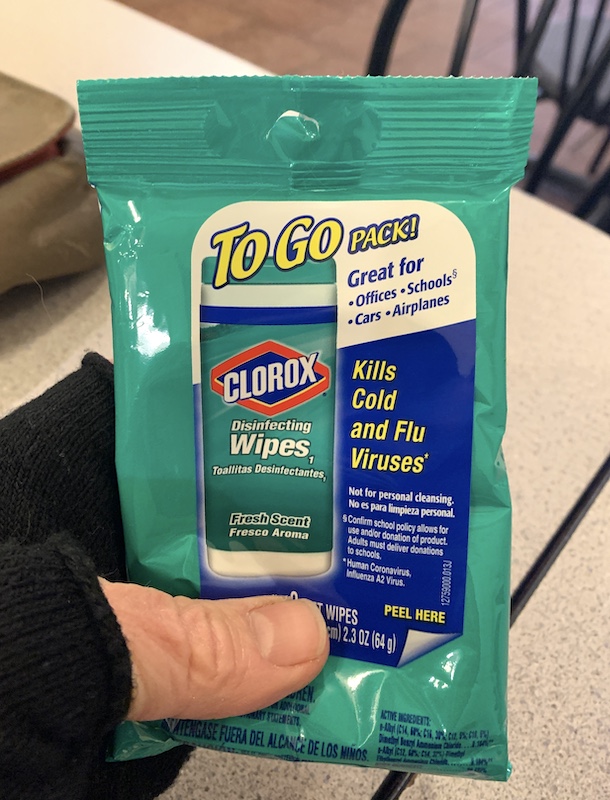
My brother’s work takes him to China and Southeast Asia seven or eight times a year. (The China travel has been halted for the foreseeable future) During our phone chat last night he mentioned he has not missed a day of work (for illness) in the last five years. A good trick considering how much time he spends in airplanes. The secret, he claims, is a combination of Clorox Disinfecting Wipes and small travel bottles of Lysol spray.

He immediately wipes down the seat-back tray, the seat arms, and other surfaces he’s likely to touch during his fifteen hour flights. Surfaces in the restroom get a wipe-down. And he never touches one of those blankets they give you. Surfaces that don’t lend themselves to a disinfectant wipe (in the plan or hotel room) get spritz of Lysol.

As I write this I’m sitting in my favorite coffee shop where the tables get a wipe (usually) between customers but I don’t see any disinfecting going on.

Washing your hands is always a good idea but my chat with my brother has me thinking about all the surfaces we touch in a day that were touched by hundreds of others. All those coughing, nose-wiping, hand-sneezers are not washing their hands.

“How many more people have to die?”

What a closed rural hospital tells us about US healthcare


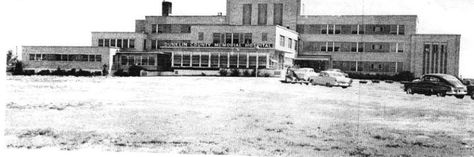
When I was growing up in Kennett, Missouri, in the ’50s and ’60s, the Dunklin County Memorial Hospital was… an institution. That’s where I had my tonsils removed and that’s where everybody went if you needed to be in the hospital. If you needed some kind of special treatment or care you probably went to one of the hospitals in Memphis, 100 miles away. The hospital closed last year, pushing the little town that much closer to… I’m not sure what.

“We’re having probably three to five more deaths a month without having the hospital here,” he said. “I had a 35-year-old patient who started having chest pain. He needed to get to an emergency room but died on the way to the hospital. There are multiple deaths due to not having emergency services, mostly from heart attacks and accidents. There’s nowhere to stabilise them. If they’re having a heart attack, they’re dying before they get to the hospital. Plus the infant mortality rate has increased since the hospital closed.”

It’s happening all over rural America. This article tells the story. As does RP.

UPDATE (5/15/20): Company announces plans to re-open hospital in Missouri’s poorest region. “Nine of the state’s ten poorest counties are in southeast Missouri, and the Bootheel is the state’s poorest region.”

High tech dentistry

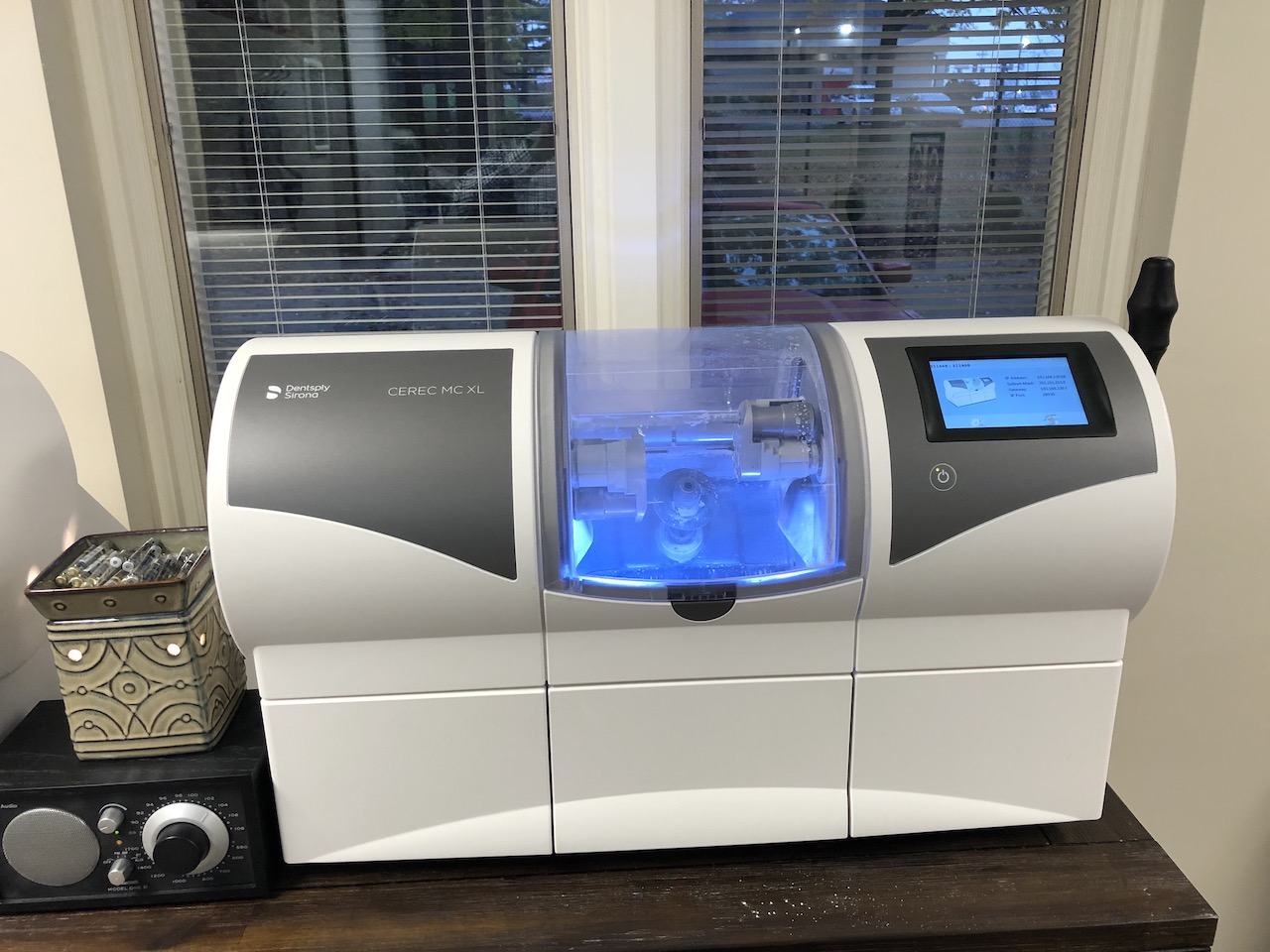
Following my semi-annual dental check-up yesterday my dentist showed me some amazing technology. Not so long ago getting a crown meant taking an impression; a temporary crown; and a long wait for a lab to make the permanent crown. No longer. Meet the Sirona Cerec MC XL Dental Milling Machine. Sort of a 3D printer in reverse.
The scanner creates a 3D image which is then recreated by the milling machine.  CAD/CAM technology has revolutionized dentistry.  My dentist has two milling machines, the original will do single crowns, veneers, etc.  The XL machine uses a bigger block so can do 3-4 unit bridges. The zirconium cube from which the crown is milled has a bar code that is read and stored so if the crown needs to be recreated they don’t have to start from scratch.

In my youth, going to the dentist was a little trip to hell. It has gotten so much better.