Why Doctors Hate Their Computers

This is a long article (like all New Yorker articles) but very interesting. A few nuggets:

More than ninety per cent of American hospitals have been computerized during the past decade, and more than half of Americans have their health information in the Epic system.

A 2016 study found that physicians spent about two hours doing computer work for every hour spent face to face with a patient—whatever the brand of medical software.

A team at the Mayo Clinic discovered that one of the strongest predictors of burnout was how much time an individual spent tied up doing computer documentation.

Thermometer tells company were to advertise

“This flu season, Clorox paid to license information from Kinsa, a tech start-up that sells internet-connected thermometers that are a far cry from the kind once made with mercury and glass. The thermometers sync up with a smartphone app that allows consumers to track their fevers and symptoms, making it especially attractive to parents of young children. The data showed Clorox which ZIP codes around the country had increases in fevers. The company then directed more ads to those areas, assuming that households there may be in the market for products like its disinfecting wipes.” (New York Times)

Hernia repair surgery

One morning three years ago I looked down while getting in the shower and noticed a bulge in my lower abdomen, about the size of a golf ball. Uh oh. My doctor informed me it was “just” an inguinal hernia, nothing to be concerned about. As long as it wasn’t giving me any problems I could put off having it surgically repaired.

So I’ve lived with the little guy for the last few years. About a year ago I started wearing a truss because being on my feet all day left me feeling a little achey “down there.” I thought about surgery from time to time but kept putting it off on the theory that if you can avoid surgery — any surgery — you should. But having a hernia seemed like an “old guy” thing to me. I’m not ready to be an old guy.

I finally got tired of looking at — and thinking about — the thing and went to see a surgeon who specializes in laparoscopic repair. Had it down this morning and was “under” for less than an hour. Three small incisions starting at the belly button and working down.

A little nausea from the anesthetic and some some soreness but an amazingly simple procedure. Should have had it done when it first showed up. Watch this space for post-op updates.

UPDATE: (October 2, 2018) Little soreness, moving slowly. Rented a car rather than try to drive the truck (manual brakes and steering).

Smart glasses

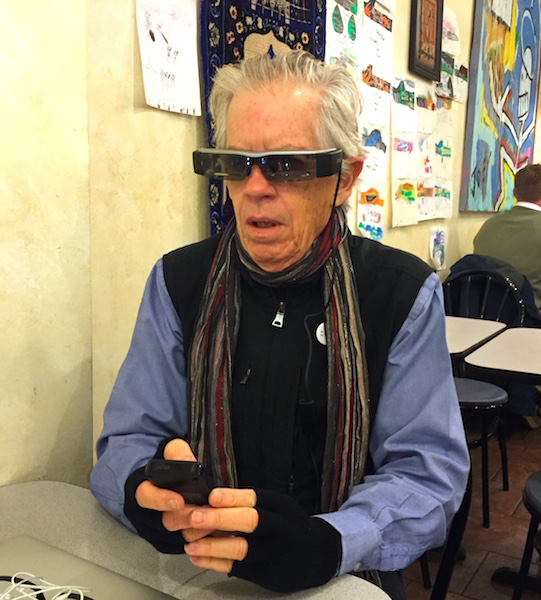
I’d pay $1,000 for really smart eyeglasses. People who have LASIK surgery tend to rave about how it changed their lives for the better. Fortunately I’ve been blessed with good vision because I just don’t think I could let someone cut on my eyes unless there was no option. These surgical (?) techniques will — I assume — get better and better. That’s a good but I’m counting on eye glasses getting smarter.

A lens that could monitor what’s happening with my eyes as well as my surroundings (light, motion, etc), and adjust on the fly. Reading a book, looking at a laptop screen or a mobile device; watching TV or a movie.

One more thing. A coating on the lens that is impervious to greasy fingerprints.

Why does it take so long to recover from pneumonia?

This article appeared on the Washington Post website in January of this year. It’s far and away the best (most useful) thing I’ve read about pneumonia. Couple of excerpts:

One reason is that the detritus from an infection of the lung is hard to clear. Antibiotics kill the bacteria, but all the weaponry your body produced to fight the bacteria — mucus, essentially, or sputum, as it’s called once you cough it up — is left behind. […] Cough is a primary way to clear the gunk. That’s why doctors advise pneumonia patients not to take cough suppressants. You want to get that stuff out.

The energy drain (your body fighting the infection) burns calories and proteins. When illness dampens appetite, that can exacerbate fatigue and weakness. He advises: “Eat good protein and take plenty of calories.”

The flu has been wicked bad this year. Neither Barb nor I have gotten it (so far). We both got flu shots. But my recollection of the flu was you felt like hell for a week (or two) and that was it. I’m here to tell you the aftereffects of pneumonia can drag on for months.

A Dying Town

The tagline for this story is: “Here in a corner of Missouri and across America, the lack of a college education has become a public-health crisis.”

1. This is a long-ish story. 2. This is not a happy story. Damned depressing, in fact. I share it because it’s about Kennett, Missouri, the small town where I grew up in the 50s and 60s and to which I returned as an adult in the 70s.

Kennett was a swell (yes, we used words like ‘swell’ back then) place to grow up. The good example of small town America in the mid-twentieth century. It was fraying around the edges by the time Barb and I left in the early 80s and these days I hardly recognize it on my infrequent trips back.

This story (from the Chronicle of Higher Education) paints a bleak picture of Kennett and thousands (?) of little towns like it across the country. The focus of the piece seems to be the link between education and health.

“People with less education are twice as likely, for instance, to die of lung cancer or COPD. Heart attacks and strokes are far more common for those without much schooling — one study found that heart-attack rates for middle-aged adults who hadn’t finished high school were double those with a college degree.”

Lots of well-documented factoids like this and while they’re hardly surprising, the author does a nice job of putting human faces on the data.

But for one fateful phone call back in ’84, I might still be living in Kennett, MO. Some of my lifelong friends still do. So this is a “what might have been” story for me in some ways.

Telemedicine

“A partnership between New York-Presbyterian (hospital) and Walgreens is pushing telemedicine further into the mainstream. NYP announced Monday that its physicians will be accessible remotely for non-life-threatening illnesses through Walgreens’ online portal and self-service kiosks at select Walgreen-owned Duane Reade locations in New York. The partnership is an expansion of NYP’s OnDemand platform for telehealth and mHealth services, which was launched in 2016. For $99 per session, patients can visit secure, private kiosks to be examined by doctors via video chat. The kiosks are also fitted with connected devices for examinations, including blood pressure cuffs, forehead thermometers, and dermatoscopes. Doctors can also send prescriptions to the patient’s preferred pharmacy.”

I’m a supporter of this tech trend. My docs for the last 7 or 8 years have been part of the University of Missouri Health Care system and at least half of my interaction has been on a secure online system (that includes all my records, lab reports, physician notes, etc). It’s been great. I still see my doc when necessary. I’ve been dealing with allergy and sinus issues for months and almost all of that has been online. No idea how much time that has saved me (travel, waiting room, etc) but more importantly, my physician.

The smart phone and teen mental health

From an article by Jean Twenge, a professor of psychology at San Diego State University, and author of a book on psychological changes across generations (Generation Me) and apparently has just published another (iGen).

“Around 2012, something started going wrong in the lives of teens. In just the five years between 2010 and 2015, the number of US teens who felt useless and joyless — classic symptoms of depression — surged 33 percent in large national surveys. Teen suicide attempts increased 23 percent. Even more troubling, the number of 13- to 18-year-olds who committed suicide jumped 31 percent.”

“In a new paper published in Clinical Psychological Science, my colleagues and I found that the increases in depression, suicide attempts and suicide appeared among teens from every background — more privileged and less privileged, across all races and ethnicities and in every region of the country. All told, our analysis found that the generation of teens I call ‘iGen’ — those born after 1995 — is much more likely to experience mental health issues than their millennial predecessors.”

“What happened so that so many more teens, in such a short period of time, would feel depressed, attempt suicide and commit suicide? After scouring several large surveys of teens for clues, I found that all of the possibilities traced back to a major change in teens’ lives: the sudden ascendance of the smartphone. All signs point to the screen.”

Meditation can ‘reverse’ DNA reactions

“Lead investigator Ivana Buric from the Brain, Belief and Behaviour Lab in Coventry University’s Centre for Psychology, Behaviour and Achievement said: “Millions of people around the world already enjoy the health benefits of mind-body interventions like yoga or meditation, but what they perhaps don’t realise is that these benefits begin at a molecular level and can change the way our genetic code goes about its business.

The research, published today in the journal Frontiers in Immunology, reviews over a decade of studies analysing how the behaviour of our genes is affected by different MBIs including mindfulness and yoga. […] When examined together, the 18 studies — featuring 846 participants over 11 years — reveal a pattern in the molecular changes which happen to the body as a result of MBIs, and how those changes benefit our mental and physical health.