Scott Adams: Facebook Killer

“Facebook is primarily a record of your past. Imagine a competing service that I will name Futureme for convenience. It’s an online system in which you post only your plans, both immediate and future. As with FaceBook, you decide who can see your plans. You might, for example, allow only specific family members to see your medical plans, but all of your friends can see your vacation plans, or your plans to buy a new couch.

The interface for Futureme is essentially a calendar, much like Outlook. But it would include extra layers for hopes and goals that don’t have specific dates attached.

For every entry to your Futureme calendar, you specify who can see it, including advertisers. If you allow advertisers a glimpse of a specific plan, it would be strictly anonymous. Advertisers could then feed you ads specific to your plan, while not knowing who they sent it to. The Futureme service would be the intermediary.

Now imagine that you never have to see any of the incoming ads except by choice. If you plan to buy a truck in a month, you would need to click on that entry to see which local truck advertisements have been matched to your plans. This model turns advertising from a nuisance into a tool. You‘d never see an ad on Furureme that wasn’t relevant to your specific plans.”

Looxcie wearable camera

“The Looxcie is not a high-definition camera. It records at a resolution of 480 x 320 pixels at 15″ frames a second. But it has a special button that makes it ideal for taking video of unexpected moments. When the camera is running in continuous-capture mode, and the wearer suddenly sees a goal scored at a hockey game, for instance, a quick push of the button will tell the camera to automatically save a clip of the preceding 30 seconds. The camera weighs about an ounce and stores up to five hours of video.”

Trackpad puts ambi in my dexterous

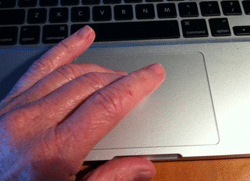
Since switching from PC to Mac a few years ago, I have turned into one of those annoying Apple Fanboys. And while the Apple Magic Mouse didn’t click for me (as it were) the trackpad did. Does.

I’m right-handed and –as a result of spending every waking moment online– developed a little soreness in my wrist this week.

Back in my old mouse days, no way could I have switched hands. My dexterous is not ambi.

To my delight, I find that I can manipulate my trackpad with the left hand, almost as well as the right. Good design.

iPads just what the doctor ordered

That clipboard your doctor used to carry around is getting replaced by the iPad. From the Chicago Sun-Times:

“Emergency room doctors are using iPads to order lab tests and medication. Plastic surgeons are using them to show patients what they might look like after surgery. And medical residents are using them as a quick reference to look up drug interactions and medical conditions.

Since Apple’s iPad hit the market in April, doctors at Chicago area hospitals are increasingly using the hot-selling tablet as a clinical tool.

Not only does the iPad allow doctors to view electronic medical records, wherever they are, it also gives them a way to show patients their X-rays, EKGs and other lab tests on an easy-to-read screen. Plus, it’s lighter and has a longer battery life than many laptops, making it convenient for doctors to take on rounds.

Within the next month, the University of Chicago Medical Center plans to provide iPads to all of its internal medicine residents, expanding on a pilot program launched earlier this year. Similarly, Loyola University Medical Center in Maywood has given iPads to all of its orthopedic residents as part of a pilot program.

Other doctors are buying their own iPads and using them to interact with patients. At U. of C., for instance, plastic surgeon Dr. Julie Park uses her iPad to show breast-cancer patients what they might look like after reconstructive surgery.

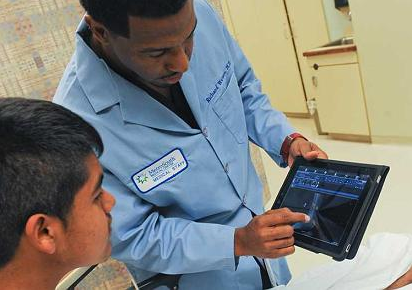
Another hospital that has embraced the iPad is MetroSouth Medical Center in Blue Island. Once doctors there learned that they could access the hospital’s electronic medical records with the iPad, “it went through here like wildfire,” said Dr. Richard Watson, an emergency room physician at MetroSouth. “At least half of our staff here in the emergency room has their own iPad and carries it and uses it.”

Though the iPad provides a portal to the hospital’s electronic record, patient information isn’t actually stored on the device. And both the iPad and the hospital server are password-protected, lowering the chances that sensitive data could be swiped from a lost or stolen iPad.

Dr. Eric Nussbaum, MetroSouth’s emergency room chief, said the iPad also solves one of the problems created by switching from a paper-based record system to an electronic one: having to go to a desktop computer to order lab tests or type in notes on a patient.

“With this, I’m back to the convenience of being in the patient’s room, talking to them and plugging in my orders right then and there,” he said.

If you’ve spotted the iPad in the medical wild, let us know in the comments.