“Falsely playing the race card”

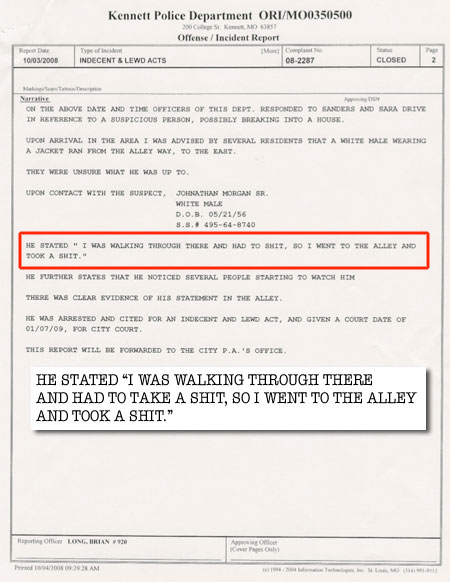
A few weeks back I posted a few times on the Heather Ellis trial in Kennett, MO, my home town. The trial and the incident that started the whole thing (3 years ago?) left Kennett with a black eye (so to speak). The local prosecutor recused himself and Morley Swingle –the prosecuting attorney for Cape Girardeau County– took over. In an op-ed piece (?) in today’s St. Louis Post-Dispatch, Mr. Swingle reflects on the trial and the incident that made it necessary:

“On a Saturday night in 2007 at the Wal-Mart in Kennett, Mo., Heather Ellis went into an angry tirade in the checkout line, grabbed another customer’s merchandise and pushed it away from the cash register, not just once, but four times.

When a manager told her to leave the store, she responded, “I’m not leaving and you can’t make me.” The police were called. They escorted her out of the store. Outside, she continued her angry rant. When an officer told her she would be arrested if she did not leave, she replied: “If you try to arrest me I’ll kick your [derriere].”

She was arrested. True to her word, she kicked the arresting officer and smacked another in the mouth, drawing blood.

Most people, after behaving so badly, would issue a few apologies and accept the prosecutor’s generous plea offer of probation to misdemeanor offenses. Instead, Ellis decided to claim to the national media that her arrest was based on “racism.”
Continue reading →

Anderson Cooper weighs in on race, justice and Kennett, MO

My friend John just called report the Dunklin County courthouse in Kennett, Missouri (where I grew up), is surrounded by TV satellite trucks covering the trial of Heather Ellis. I posted on this a couple of weeks ago and have no idea what what really happened at the local Wal-Mart. I guess that’s what the trial is deciding. It sounds like CNN’s Anderson Cooper might have already have a verdict:

“… Kennett, Missouri has created both a pattern and practice of disparate treatment toward people of color. According to the American Civil Liberties Union, the police of Kennett, Missouri search African Americans more than twice as often as whites (14% vs. 6%) even though they possess contraband at roughly the same rate (25% vs. 20%). Across the state of Missouri, African-Americans are searched almost twice as often as whites (12% vs. 7%), even though they are LESS likely to possess contraband (17% vs. 20%). Attorney General Eric Holder should get involved by conducting a thorough investigation of the entire Southeast Missouri judicial system.”

“My simple contention is this: Had Heather Ellis been a Duke Lacrosse player getting a little rowdy on spring break, I doubt very seriously that she would be facing this kind of prison time. America has a two-tiered justice system, where people of color are being given the bottom rung of the justice ladder. Our inability to let go of our racially horrific past is causing us to destroy our future. The Heather Ellis case is merely a symbol of a much larger problem.”

Story from yesterday on the Daily Dunklin Democrat website. I’ll update this with a verdict if and when there is one.

Missouri prison life in 1800’s

The Twin Hells, by John N. Reynolds, claims to be “A Thrilling Narrative of Life in the Kansas and Missouri Penitentiaries.” I haven’t read the entire account yet but will share this excerpt about the Missouri penitentiary:

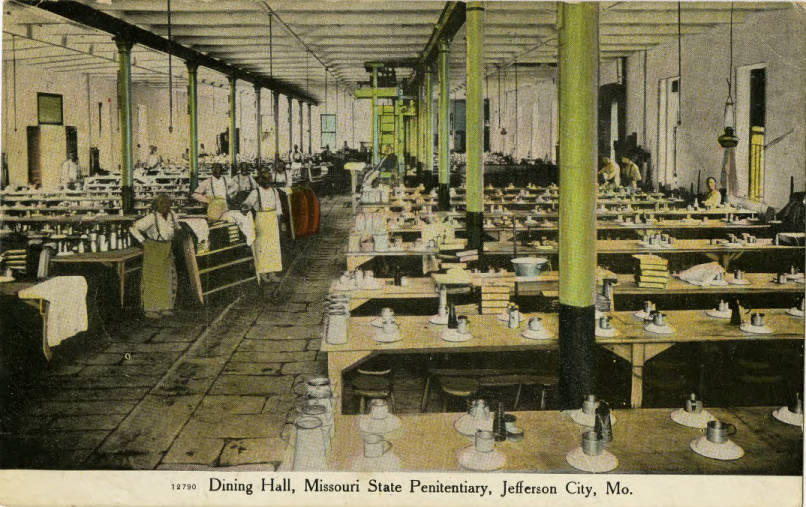
“The inmates of the Missouri penitentiary are well clothed. In this respect, this prison has no rival. All the prisoners presented the appearance of being cleanly, so far as their clothing is concerned. All are dressed in stripes. None are exempt. Here are nearly two thousand men on an equality. None of them can look down upon others, and say, I am more nicely dressed than you. I never saw a convict dude in the entire lot. The prisoners are well fed. For breakfast, the bill of fare consists of bread, coffee, without milk or sugar, and hash. There is no change to this bill of fare. If the prisoner has been there for ten years, if not in the hospital, he has feasted upon hash every morning. Boiled meat, corn bread, potatoes and water makes up the dinner, and for supper the convict has bread, molasses and coffee. The principal objection to this diet is its monotony. Whenever a change of diet becomes a strict necessity, the prisoner is permitted to take a few meals in the hospital dining-room. Here he receives a first-class meal. This is a capital idea. A great deal of sickness is prevented by thus permitting the convict to have an occasional change of diet. On holidays, such as Thanksgiving day, Christmas, etc., an extra dinner is given, which is keenly relished by all. I have before me a statement of the expenses for a Sunday breakfast and dinner. There are only two meals given on Sunday. The hash was made up of 612 pounds of beef, 90 pounds of bacon, and 30 bushels of potatoes. Fifty-one pounds of coffee were used, and four and a half barrels of flour. The entire meal cost $68.38.”

It appears the account above is from the late 1800’s. I have not idea of the time period represented by the postcard below (from Bob Priddy’s extensive collection of Missouri postcards)

Updating MissouriDeathRow.com

MissouriDeathRow.com was one of the first websites I did. And it looks like it. This was before flickr and Typepad and such. So I’m doing a little make-over. Hope to have it complete by the end of the year.

I’m starting with images and documents related to those executed in Missouri’s gas chamber. First time out, I just posted photos of the condemned. This time I’m posting the… not sure what to call it… the record or card for each inmate [flickr slideshow].

I scanned these from the state archives. For some reason, I find them fascinating.

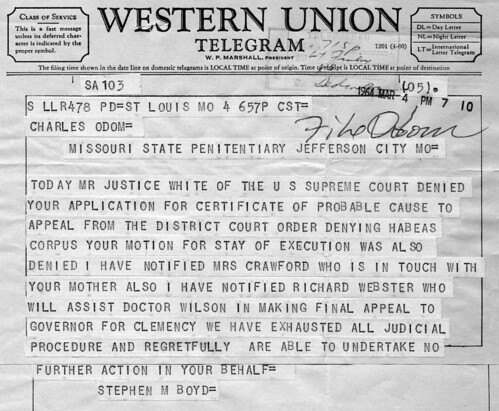
The state archive has a file on each of the inmates executed in the gas chamber. I spent a week going through these, scanning as much as time allowed. Letters, notes, telegrams…

On June 24, 1962, Odom and another Death Row inmate attempted an escape. Odom’s file contained a report by the guard on duty at the time. I’ve also included  (from his appeal to the Missouri Supreme Court) a description of the crime for which Odom was executed.