
Incognito – The Secret Lives of the Brain by David Eagleman

It’s easy to think of “me” has “having” a brain, but this book left me thinking my brain has me. If there is a me apart from my brain, I fear it’s mostly along for the ride. Here are some ideas that brought out my highlighter.

The brain generally does not need to know most things; it merely knows how to go out and retrieve the data. It computes on a need-to-know basis. pg 28

You’re not perceiving what’s out there. You’re perceiving whatever your brain tells you. pg 33

We have no access to the rapid and automatic machinery that gathers and estimates the statistics of the world. pg 34

Your brain is in the dark but your mind constructs light. pg 40

The difference between being awake and being asleep is merely that the data coming in from the eyes anchors the perception. Asleep vision (dreaming) is perception that is not tied down to anything in the real world; waking perception is something like dreaming with a little more commitment to what’s in front of you. pg 45

It’s easy to spot a hallucination only when it’s bizarre. For all we know, we hallucinate all the time. pg 46

Our expectations influence what we see. There has to be a match between your expectations and the incoming data for you to “see” anything. Awareness of your surroundings occurs only when sensory inputs violate expectations. pg 48, 50

The brain refines its model of the world by paying attention to its mistakes. pg 49

The brain tries to see the world only as well as it needs to. We are not conscious of most things until we ask ourselves questions about them. What we perceive in the outside world is generated by parts of the brain to which we do not have access. pg 54

Instead of reality being passively recorded by the brain, it is actively constructed by it. pg 82

There are thoughts you cannot think. pg 82

Evolution has carefully carved your eyes, internal organs,sexual organs, and so on — and also the character of your thoughts and beliefs. pg 82

“In general, we’re least aware of what our minds do best.” — Marvin Minsky, The Society of Mind

We are not able to see the instincts that are the very engines of our behavior. These programs are inaccessible to us not because they are unimportant, but because they’re critical. Conscious meddling would do nothing to improve them. pg88

Briefly glimpsed people are more beautiful. pg 92

We come to know our own attitudes and emotions, at least partially, by inferring them from observations of our own behavior. pg 134

David Eagleman is neuroscientist at Baylor College of Medicine, where he directs the Laboratory for Perception and Action.
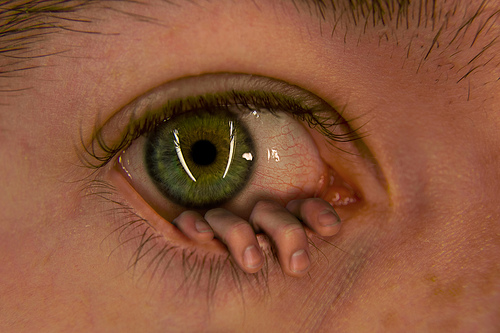
What you see is NOT what you get

A lot of my recent reading has dealt with consciousness and –by extensions– reality. It has completely changed the way I see my world. Literally.

“Your senses are your windows on the world, and you probably think they do a fair job at capturing an accurate depiction of reality. Don’t kid yourself. Sensory perception – especially vision – is a figment of your imagination. “What you’re experiencing is largely the product of what’s inside your head,” says psychologist Ron Rensink at the University of British Columbia in Vancouver, Canada. “It’s informed by what comes in through your eyes, but it’s not directly reflecting it.”

“In conjuring up this “now”, the visual system has to do something even more remarkable: predict the future. Information striking the fovea cannot be relayed instantaneously to conscious perception: first it has to travel down the optic nerve and be processed by the brain. This takes several hundred milliseconds, by which time the world has moved on. And so the brain makes a prediction about what the world will look like about 200 milliseconds into the future, and that is what you see. Without this future projection you would be unable to catch a ball, dodge moving objects or walk around without crashing into things.”

“The problem with attention is that it is a limited resource. For reasons that remain unknown, most people are unable to keep track of more than four or five moving objects at once. That can lead your visual system to be oblivious to things that are staring you in the face.”

My favorite line from this piece: “Essentially we experience the brain’s best guess about what is happening now.”

Memory is fiction

A recurring theme in some of my recent reading has been the nature of subjective time. Among other insights, that the past and the future are delusions, created by the mind. This is a little easier to grasp for the future. Any ideas we have about what is going to happen is clearly fiction. But the past feels more “real.” It happened. I remember it. But that’s fiction as well.

“A memory is only as real as the last time you remembered it. The more you remember something, the less accurate the memory becomes. The larger moral of the experiment is that memory is a ceaseless process, not a repository of inert information. It shows us that every time we remember anything, the neuronal structure of the memory is delicately transformed, or reconsolidated.” — The Frontal Cortex

This reminds me of the scene in Blade Runner when Rachel discovers her memories are implanted. A disturbing thought because (for most of us) we ARE our memories.

But if that’s not really so, if our memories are fiction, who are we? Probably not who we think.

Daniel Kahneman: Riddle of experience vs. memory

This talk runs 20 min and I realize most of you won’t invest that much time. And I’m not sure I can summarize, but let me try: There are the experiences in our lives… and our memories of those experiences. And they are not the same. Our “happiness” ( a word that no longer has much useful meaning) has more to do with the latter.

As for the future?  Kahneman  says “we think of our future as anticipated memories.”

My understanding (based on my reading on this topic): The past and the future are delusions, stories. Created by the mind to protect the ego. Only now -this moment- has any reality.

Neuromarketing

Blipverts from Max Headroom’s world (“20 minutes into the future”) grows more real every day. From The Ego Tunnel by Thomas Metzenger:

“Today, the advertisement and entertainment industries are attacking the very foundations of our capacity for experience, drawing us into the vast and confusing media jungle. They are trying to rob us of as much of our scarce resource (attention) as possible, and they are doing so in ever more persistent and intelligent ways. Of course, they are increasingly making use of the new insights into the human mind offered by cognitive and brain science to achieve their goals (“neuromarketing” is one of the ugly new buzzwords). We can see the probable result in the epidemic of attention-deficit disorder in children and young adults, in midlife burnout, in rising levels of anxiety in large parts of the population.

New medial environments may create a new form of waking consciousness that resembles weakly subjective states — a mixture of dreaming, dementia, intoxication, and infantilization.”