
“As an advertising medium, the Internet is already larger than radio. It will approach $34 billion this year and is on a trajectory to overtake newspaper advertising within five years. In virtually all markets, the largest local Web site (typically run by a newspaper company) is now grossing more ad revenue than the largest radio station in that market. In some markets, the largest site is grossing more than the largest cluster of stations.”
“Your radio reps have a bounty on their heads. We survey more than 3,000 local Web sites every year about their revenues, expenses, number of salespeople and other revenue-related topics. The ones with the greatest market share and revenue have an interesting characteristic in common: a star-performing “former radio rep” on the sales staff. The word has spread that radio salespeople know how to sell the Internet, and newspaper and TV Web site managers have been recruiting them left and right. Radio reps know how to cold-call, how to generate new business, and how to sell reach and frequency. That’s a perfect match for Internet sales.” — Gordon Borrell, writing in Inside Radio
Category Archives: Business & Marketing
Doc’s “story none dare tell”
Reply
Doc Searls says we need a new leadership narrative:
“…what’s “super” about U.S. superpower — a near-limitless ability to make high-technology war, backed by a fighting force of finite size with few allies — is an anachronism. I’m not sure the people of any Great Nation are ever ready to face the fact that the height of their military and economic powers has passed. Or that the leadership they most need to assert is no longer only a military and economic one.”
If we can no longer win every war we start and our economy isn’t Number One… is it possible for the U.S. to still be “super?” Let’s hope so.
This is a thoughtful and insightful post on America, leadership and journalism. Worth a read.
What you know, not what you sell
Sales trainer Chris Lytel points to a Wall Street Journal interview with Ram Charan, a business professor turned consultant and author (What the Customer Wants You to Know).
“It has become very hard to differentiate yourself in the eyes of the customer, for business to business sales. So salespeople should not sell the product anymore. They should find out what the customer needs, which will be a combination of products and services and thought leadership.”
“In the old game, one person could do the selling. In the new game, you need a team from your company. The reason you need a team is the solution you’re going to create is going to come form different parts of your company. That means salespeople have to be good leaders, to lead their team, and also persuade the customer team. Because customers also buy in teams.”
Thought leadership. Interesting concept. Increasingly, our “network radio” sales reps are finding that their clients want more than 30 second spots. I suppose you could say they always wanted more than spots… they wanted the sales or mind-share those “spots” could bring.
These days, it’s rare that the prospect doesn’t bring up the subject of the web as part of their marketing strategy. Knowing a little something about blogging and podcasting has been very useful.
Philips Simplicity Windows
“Big Brother” software knows if you’re happy
Microsoft is developing what a British newspaper (TimesOnline) describes as “Big Brother” software that will allow employers remotely to monitor their workers’ productivity, competence and physical well-being to a degree never before seen.
Among other data, wireless sensors will provide employers with workers’ heart rates and stress level, and determine whether they are smiling or frowning.
“The systems work not only through desktop or laptop computers but even through mobile phones or handheld PCs, meaning that even out of the office the employee can still be monitored. In its most advanced format, the system will monitor users’ private interests.
The system works by recording and analyzing what words and numbers are used or websites visited, and by watching the user’s heart rate, breathing, body temperature, facial expressions and blood pressure. The patent application explains: “The system can also automatically detect frustrations or stress in the user via physiological and environmental sensors and then offer or provide some assistance accordingly.”
This just seems to far-out and scary to be true. For the record… I am happier than I appear.
“Instead of shouting the message, hide it”
Will we still get carpet bombed by mindless 30 second commercials in the future? (And by future I mean a couple of weeks from now.) Seems unlikely, but how will savvy marketers reach –and more importantly– engage us? How do you “reach people who are so media-saturated they block all attempts to get through.”
Perhaps with alternate reality games (ARG’s). That’s the subject of a fascinating article by Frank Rose in this month’s Wired Magazine (Issue 16.01).
“The initial clue was so subtle that for nearly two days nobody noticed it. On February 10, 2007, the first night of Nine Inch Nails’ European tour, T-shirts went on sale at a 19th-century Lisbon concert hall with what looked to be a printing error: Random letters in the tour schedule on the back seemed slightly boldfaced. Then a 27-year-old Lisbon photographer named Nuno Foros realized that, strung together, the boldface letters spelled “i am trying to believe.” Foros posted a photo of his T-shirt on the Spiral, the Nine Inch Nails fan forum. People started typing “iamtryingtobelieve.com” into their Web browsers. That led them to a site denouncing something called Parepin, a drug apparently introduced into the US water supply. Ostensibly, Parepin was an antidote to bioterror agents, but in reality, the page declared, it was part of a government plot to confuse and sedate citizens. Email sent to the site’s contact link generated a cryptic auto-response: “I’m drinking the water. So should you.” Online, fans worldwide debated what this had to do with Nine Inch Nails. A setup for the next album? Some kind of interactive game? Or what?”
I’m not a gamer. At all. But I love shit like this. Reminds me of the viral video snippets in William Gibson’s Pattern Recognition. The Wired article is well worth the read.
Advertiser Optimism by Medium
From Terry Heaton’s PoMo Blog:
"Advertiser Perceptions latest survey of 2,047 ad executives (published twice yearly) — as published by Online Media Daily — reveals growing pessimism among ad buyers about traditional forms of advertising. I view this study as significant, because it speaks directly with people who are making decisions about spending money."
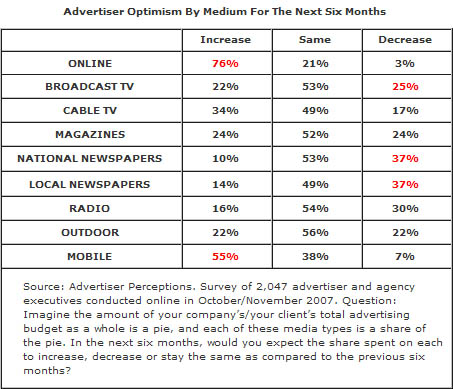
Only newspapers face a smaller increase and larger decrease than radio? [Emphasis/red from original post]
Learfield 2nd best place to work
Google has been ranked No.1 in Forbes business magazine’s 2007 list of the 100 Best Companies to Work For in America, following a poll 100,000 employees from 446 companies. Check out some of the perks for Google employees.
Blogging as marketing tool
Good story in the NYT Small Business section on blogging as a marketing tool:
“…while blogs may be useful to many more small businesses, even blogging experts do not recommend it for the majority.
Guy Kawasaki, a serial entrepreneur, managing partner of Garage Technology Ventures and a prolific blogger, put it this way: “If you’re a clothing manufacturer or a restaurant, blogging is probably not as high on your list as making good food or good clothes.”
Blogging requires a large time commitment and some writing skills, which not every small business has on hand.”
New blogging rules from the NCAA
It seems pretty clear that the NCAA wants to prohibit anything approaching real-time coverage of the event. Companies –like the one I work for— pay millions for the exclusive broadcast rights to collegiate sporting events. A reporter (or a dozen reporters) up in the press box live blogging the game –in theory– dilutes the value of the rights we purchased.
“The NCAA this week announced a formal program limiting how often bloggers with media credentials can update their blog while attending championship college events.
The sports governing body set blogging limits for each sport. For example, those at football games can update their blogs three times per quarter and once at halftime. For basketball, bloggers can post five times per half, once at halftime and twice per overtime period.
The policy even sets rules for water polo (three per quarter, once at halftime), bowling (10 blog posts per session) and fencing (10 per session).”
The phrase that caught my eye was “bloggers with media credentials.” If
I’m just a fan, can I blog at will? If your credentials are at stake,
you probably wouldn’t fight this. But if you’re a civilian, you could
tell the NCAA to piss off. Does this mean the NCAA thinks only bloggers
with some media connection can/will have a significant audience?