
- Biocentrism: How Life and Consciousness Are the Keys to Understanding the True Nature of the Universe
- The Chaos Scenario, Bob Garfield
- The Ultimate Happiness Prescription: 7 Keeys to Joy and Enlightenment, Deepak Chopra
- The Lost Symbol, Dan Brown
- The Girl with the Dragon Tattoo, Stieg Larsson
- Free: The Future of a Radical Price, Chris Anderson
- Life Inc: How the World Became a Corporation and How to Take It Back, Douglas Rushkoff
- Road Dogs, Elmore Leonard
- The Increment, David Ignatius
- Wicked Prey, John Sanford
- What Would Google Do?, Jeff Jarvis
- Jesus, Interrupted: Revealing the Hidden Contradictions in the Bible, Bart D. Ehrman
- Grown Up Digital: How the Net Generation is Changing Your World, DonTapscott
- God’s Debris: A Thought Experiment, Scott Adams
Category Archives: Books
Biocentrism
I’m reading a mind-stretching book. Biocentrism by Robert Lanza (with Bob Berman). I wouldn’t know where to begin describing what this book is about. Like John Sebastian said, “it’s like trying to tell a stranger ’bout rock and roll.”
The authors are very good at explaining the most complex concepts. Here’s a little riff on Time:
“Imagine that existance is like a sound recording. Listening to an old phonograph doesn’t alter the recording itself, and depending on wherethe needle is placed, you hear a certain piece of music. This is what we all the present. The music, before and after the song now being heard, is what we call the past and the future. Imagine, in like manner, ever moment and day enduring in nature always. The record does not go away. All nows (all the songs on the record) exist simultaneously, although we can only experience the world (or the record) piece by piece. We do not experience time in which “Stardust” often plays, because we experience time linearly.”
This book is not for everyone. If you have too much “reality” in you life to think about the possibility it’s all “in your head,” you can take a pass on Biocentrism. But it will get a spot on my nightstand as one of those books I’ll have to read again and again.
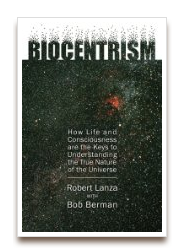 I’m reading a mind-stretching book. Biocentrism by Robert Lanza (with Bob Berman). I wouldn’t know where to begin describing what this book is about. Like John Sebastian said, “it’s like trying to tell a stranger ’bout rock and roll.”
The authors, however, are very good at explaining the most complex concepts. Here’s a little riff on Time:
“Imagine that existence is like a sound recording. Listening to an old phonograph doesn’t alter the recording itself, and depending on where the needle is placed, you hear a certain piece of music. This is what we call the present. The music, before and after the song now being heard, is what we call the past and the future. Imagine, in like manner, every moment and day enduring in nature always. The record does not go away. All nows (all the songs on the record) exist simultaneously, although we can only experience the world (or the record) piece by piece. We do not experience time in which “Stardust” often plays, because we experience time linearly.”
This book is not for everyone. If you have too much “reality” in you life to think about the possibility it’s all “in your head,” you can take a pass on Biocentrism. But it will get a spot on my nightstand as one of those books I’ll have to read again and again.
“The Bad Managment Stimulus”
The always brilliant Scott Adams on entrepreneurship:
“The Dilbert Principle observes that in the modern economy, the least capable people are promoted to management because companies need their smartest people to do the useful work. It’s hard to design software, but relatively easy to run staff meetings. This creates a situation where you have more geniuses reporting to morons than at any time in history. In that sort of environment you’d expect the geniuses to be looking for a way out, even if Plan B has a low chance of success.
Big companies with bad managers are the ideal breeding ground for entrepreneurs. Employees are exposed to a wide variety of business disciplines, and can avail themselves of excellent company-paid training and outside education. When you add broad skill development to the inevitability of eventually getting a moron for a boss, thanks to frequent internal reorganizations, it’s no wonder that big companies spray entrepreneurs into the environment like the fountains at Bellagio.”
Mr. Adams’ book, The Dilbert Principle is the last management book I read and gave me the courage to begin planning my escape from management.
The Chaos Scenario
About half-way through. This book is funny, smart and scary/exciting. I’ll post some excerpts tomorrow. If you’re counting on media and advertising (as we now know them) to be around in five years, do NOT read this book. (Amazon)
Scott Adams: The building blocks of God
“Humanity is developing a sort of global eyesight as millions of video cameras on satellites, desktops, and street corners are connected to the Internet. In your lifetime, it will be possible to see almost anything on the planet from any computer. And society’s intelligence is merging over the Internet, creating, in effect, a global mind that can do vastly more than any individual mind. Eventually everything that is known by one person will be available to all. A decision can be made by the collective mind of humanity and instantly communicated to the body of society.
A billion years from now, if a visitor from another dimension observed humanity, he might perceive it to be one large entity with a consciousness and purpose, and not a collection of relatively uninteresting individuals.”
“Are you saying we’re evolving into God?”
“I’m saying we’re the building blocks of God, in the early stages of reassembling.”
— From God’s Debris: A Thought Experiment, by Scott Adams