
Books: Analog and digital

I love books. I love to read but I also love books, the physical object. Hardback or paperback, I love the way they feel in my hands… the way they smell. I like scrawling notes in the margin and highlighting passages. Reading is a very tactile experience for me (and probably for most).

In a couple of days, I will join millions of others in pre-ordering the Apple iPad. I’m looking forward to using all of features and apps (current and future). I can’t imaging giving up my beloved books for a digital experience but I’m trying to keep an open mind. It is possible I will enjoy reading on the iPad.

With that in mind, I’ve been making a mental list of titles I plan to put on my virtual bookshelf.

  • Cryptonomicon, Neal Stephenson
  • Snow Crash, Neal Stephenson
  • Complete works of William Gibson
  • 1984, George Orwell (haven’t read since high school)
  • Life After Death, Book of Secrets by Deepak Chopra
  • Mac OS X, David Pogue
  • The Religion War by Scott Adams

Some of these are books that I have read several times (or expect to). I assume I will be able to highlight, annotate and search passages of my digital books. It might also be fun to link from the text of the book to a website. I haven’t heard or read anything about such a feature. We’ll see.
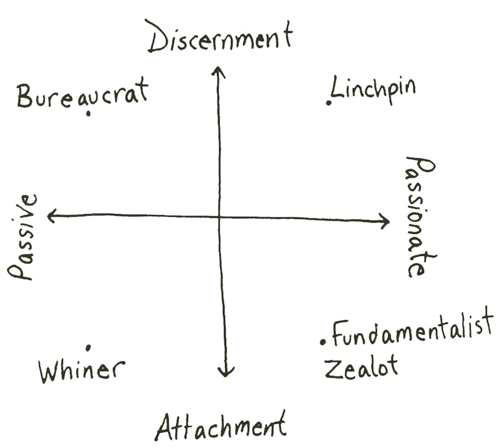
The Quadrants of Discernment

Passion is a frequent theme in Seth Godin’s latest book, Linchpin. He also spends a good bit of time on discernment. The ability to see things they way they really are. Each corner of the illustration below represents a different kind of per and the way he responds to situations at work.

“In the bottom right is the Fundamentalist Zealot. He is attached to the world as he sees it. There is no prajna her, no discernment. Change is a threat. Curiosity is a threat. Competition is a threat. As a result, it’s difficult for him to see the world as it is,because he insists on the the world being the way he imagines it. At the same time, he has huge reservoirs of effort to invest in maintaining his worldview. Fundamentalist zealots always manage to make the world smaller, poorer, and meaner.

The top left belongs to the Bureaucrat. He’s certainly not attached to the outcome of events, and he definitely won’t be exerting any additional effort,regardless. The bureaucrat is a passionless rules follower, indifferent to external events and gliding through the day. The clear at the post office and the exhausted VP at General Motors are both bureaucrats.

The bottom left is the corner for the Whiner. The whiner has no passion, but is extremely attached to the worldview he’s bought into. Living life in fear of change, the whiner can’t muster the effort to make things better,but is extremely focused on wishing that things stay as they are. I’d put most people int he newspaper industry in this corner. They stood by for years, watching the industry crumble while they resolutely did nothing except whine about unfairness. Almost all the positive change in this industry (like The Huffington Post and YouTube) is coming from outsiders.

And that leaves the top right, the quadrant of the Linchpin. The linchpin is enlightened enough to see the world as it is, to understand that this angry customer is not about me, that this change in government policy is not a personal attack,that this job is not guaranteed for life. At the same time, the linchpin brings passion to the job. She knows from experience that the right effort in the right place can change the outcome, and she reserves her effort for doing just that.

Here’s another way to describe the two axes: One asks, Can you see it? The other wonders, Do you care?

Lady Gaga meets Pattern Recognition?

Okay, this post is for William Gibson fans only. Specifically, fans of his novel, Pattern Recognition. Here’s a grossly over-simplified plot summary. Actually it’s not even that, but I had to provide some context, so…

“…a cult-like group of Internet obsessives strives to find meaning and patterns within a mysterious collection of video moments, merely called “the footage,” let loose onto the Internet by an unknown source.”

This morning on his Twitter feed, Gibson posted:

“That putative Lady Gaga virus is as seriously Footage-y as anything I’ve seen on YouTube.”

Curious, I found my way to this video:

UPDATE: There were a couple of videos on YouTube to which I had linked but they’ve been pulled. Very suspicious.

1984: “The true past”

I read George Orwell’s Nineteen Eighty-Four in high school. I need to read it again but it scared me back then and is sure to be even more frightening today. Nightly news reports on our distant wars in Iraq and Afghanastan feel an awful lot like the “telescreen” updates on the war between “Oceania” and “Eurasia.”

Wikipedia: “At the Minitrue (Ministry of Truth), Winston (Smith) is an editor responsible for the historical revisionism concording the past to the Party’s contemporary official version of the past; thus is the Oceania government omniscient. As such, he perpetually rewrites records and alters photographs, rendering the deleted people as unpersons; the original document is incinerated in a memory hole. Despite enjoying the intellectual challenge of historical revisionism, he is fascinated by the true past, and eagerly tries to learn more about it.”

“…fascinated by the true past.” Me too.

Blog. Book. Book Tour.

I’m pretty sure I’ve mentioned that my friend Henry turned his blog (Health Care Fine Art) into a book. He didn’t try to sell the book but gave it to the best customers of his art. Some call it “vanity press,” Henry calls it marketing.

A year later… Henry has been invited to give a talk about his book in New York. Last week he did a series of presentations in Boston. In a couple of week he’ll be in San Francisco and next month, San Diego.

It’s a beautiful book and nobody know more about this kind of art than Henry.

Welcome to the new normal.