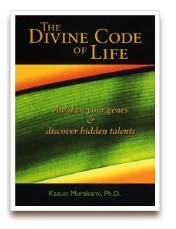
The Divine Code of Life

According to the back flap on his book, Dr. Kazuo Murakami is “one of the top geneticists in the world and Professor Emeritus at the University of Tsukuba, one of Japan’s leading research universities.”

In The Divine Code of Life, he makes his case for the idea that how we think can activate good dormant genes and switch off negative ones. Here are a few factoids that got some high-liter:

  • “For any one child, there are seventy trillion possible combinations of genes.”
  • “As far as we can tell, only about 5 to 10 percent of our genes are actually working; what the rest are doing remains unknown.”
  • “All living things use the same genetic code.”
  • “Imagine that you could collect all the DNA from the world’s population of six billion people. It would weigh only as much as a single grain of rice.”
  • “The information contained in our genes, if printed in book form, would amount to three thousand volumes each a thousand pages long.”

I can’t say that this was a fun read, but I like the idea that we can have some control over something as… basic? … as our genes. I suspect this is where some of the really big medical breakthroughs will happen. Are happening.

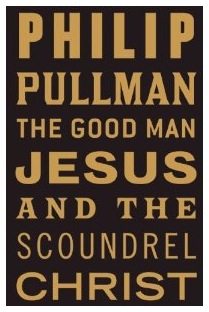
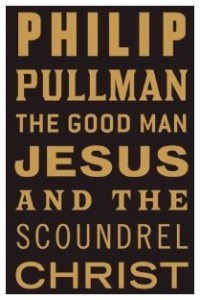
The Good Man Jesus and the Scoundrel Christ

Last week I read The Good Man Jesus and the Scoundrel Christ by Philip Pullman. I’ve been sorting out my thoughts about the book but I’m not there yet. I think it’s going to take a while. But I want to get something down here while the story (and my impressions) are still fresh in my mind. So, this will be one of those stream-of-consciousness posts (not a real review of the book).

GMJ&TSC is fiction. It is the story (a story) about the life and death of Jesus and his twin brother Christ (hardly a spoiler since it’s the title).

I found the style of the book very different from Pullman’s His Dark Materials trilogy. The book read very quickly. The chapters are very short with little or no character development.

To me it felt as though Pullman was trying to condense the stories most Christians grew up with to the bare “facts” (The Childhood of Jesus, Jesus Scandalises the Scribes, The Death of John, etc). Now that I think about it, each chapter read like a Cliffs Note.

Here’s how Pullman describes the book on the back of the dust cover:

“The story I tell comes out of the tension within the dual nature of Jesus Christ, but what I do with it is my responsibility alone. Parts of it read like a novel, parts like a history, and parts like a fairy tale; I wanted it to be like that because it is, among other things, a story about how stories become stories.”

TRUTH and HISTORY –and the relationship between the two– is a common theme throughout GMJ&TSC:

“If the way to the Kingdom of God is to be opened, we who know must be prepared to make history the handmaid of posterity and not its governor. What should have been is a better servant of the Kingdom than what was.” (pg 99)

Deeply “religious” people are often offended when someone takes liberties with their story. (Jesus Christ Superstar, the Dutch cartoonist’s depiction of Mohammed, etc) And if you happen to believe that every word of the King James Bible is literally true and an exact account of the life and death of Jesus, you probably won’t find this book a good read.

If on the other hand, you aren’t ready to stop thinking about such things, you might. I know that I did. Here are some questions it raised for me:

  • If you wanted to start a religion that would last thousands of years, how would you go about it?
  • How would Jesus feel about the religion that is based on his life and death?
  • Could Christianity have taken hold if Jesus had lived at any other time or place?
  • If the story of Jesus’ life/death –as we have known it for 2,000 years– was shown to be inaccurate, would it be better to know the truth, or to allow Christianity to continue to be based on events that never happened?

Continue reading →

Buddha’s Brain

Amazon: “Rick Hanson and Richard Mendius, a neuropsychologist and a neurologist and both practicing Buddhists, show us just how the brain programs us to experience the world a certain way by combining information from the external world with information held in neural pathways within the brain. These pathways operate in the background of our awareness, influencing our conscious mental activity.”

This book was a bit of a struggle for me so the following notes are intended for my own reference and make little sense outside the context of the book.

The self is like someone running behind a parade that is already well under way, continually calling out: “See what I created!” (pg 212)

In the brain, every manifestation of self is impermanent. The self is continually constructed, deconstructed, and constructed again. (pg 212)

We experience “now” not as a thin sliver of time in which each snapshot of experience appears sharply and ends abruptly, but as a moving interval roughly 1-3 seconds long that blurs and fades at each end. (pg 213)

At any moment, the parts of the self that are present depend on many factors, including genetic heritage, personal history, temperament, and situations. In particular, self depends on a lot of feeling tone of experience. When the feeling tone is neutral, the self tends to fade into the background. But as soon as something distinctly pleasant or unpleasant appears, the self quickly mobilizes. The self organizes around strong desires. Which comes first: Do “I” form a desire? Or does desire from and “I?” (pg 213)

The self has no inherent, unconditional, absolute existence apart from the network of causes it arises from, in, and as. (pg 213)

The self is truly a fictional character. (pg 214)

Scott Adams: Religion as road maps

“Religions are like different maps whose routes all lead to the collective good of society. Some maps take their followers over rugged terrain. Other maps have easier paths. Some of the travelers of each route will be assigned the job of being the protectors and interpreters of the map. They will teach the young to respect it and be suspicious of other maps.

“Okay,” I said, “but who made the maps in the first place?”

“The maps were made by the people who went first and didn’t die. The maps that survive are the ones that work,” he said.

At last, he had presented a target for me to attack. “Are you saying that all the religions work? What about all the people who have been killed in religious wars?”

“You can’t judge the value of a thing by looking only at costs. In many countries, more people die from hospital errors than religious wars, but no one accuses hospitals of being evil. Religious people are happier, they live longer, have fewer accidents, and stay out of trouble compared to nonreligious people. From society’s viewpoint, religion works.”

— From God’s Debris by Scott Adams

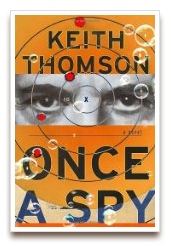
Once A Spy, by Keith Thompson

“(This) darkly satirical thriller, features an unlikely, if endearing, father-son spy duo: retired appliance salesman Drummond Clark, who at age 64 suffers from Alzheimer’s disease, and Charlie Clark, a down-on-his-luck gambler who owes $23,000 to Russian loan sharks. Soon after Charlie rescues Drummond from the Brooklyn streets, where he’d been wandering, the older man’s house blows up and the two barely escape with their lives. Clark and son begin an adrenaline-fueled cross-country flight in which they must evade ruthless CIA assassins long enough to understand why they’re being targeted. During rare moments of lucidity, Drummond hotwires a car and effortlessly kills multiple assailants, suggesting to Charlie he was once much more than just a washing machine salesman. Poignant themes of love and redemption underpin an action-packed story line that includes exotic locales, high-tech gadgetry, and international intrigue.”

A good read. Might even make a good movie. Recommended.