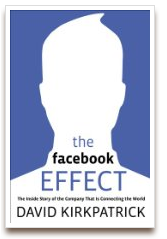
 The sub-title of David Kirkpatrick’s book is, “The Inside Story of the Company That Is Connecting the World.” I like the idea of connecting the world and I’m finding Kirkpatrick’s book a real page-turner. While I can’t seem to fit Facebook into my online life, I want to understand it’s brief history while watching it being made.
UPDATE: I’ve finished the book and rank it among the most interesting I have read this year. Or, in a long time. David Kirkpatrick had me on the edge of my seat from cover to cover. After the jump are some excerpts that got some highlighter.
The Facebook Effect happens when the service puts people in touch with each other, often unexpectedly, about a common experience, interest, problem or cause.” pg 7
As Facebook grows and grows past 500 million members,one has to ask if there may not be a macro version of the Facebook Effect.Could it become a factor in helping bring together a world filled with political and religious strife and in the middle of environmental and economic breakdown? A communications system that includes people of all countries, all races, all religions, could not be a bad thing, could it? pg 9
“The most important investment theme for the first half of the twenty-first center will be the question of how globalization happens. If globalization doesn’t happen, then there is no future for the world. The way it doesn’t happen is that you have escalating conflicts and wars, and given where technology is today, it blows up the world. There’s no way to invest in a world where globalization fails.” — Peter Thiel pg 9
Were the growth rates of both Facebook and the Internet to remain steady, by 2013 every single person online worldwide would be on Facebook. pg16
“I think what we’re doing is more interesting than what anyone else is doing, and that this is just a cool thing to be doing. I don’t spend my time thinking about (how to exit).” — Mark Zuckerberg pg 139
“The days of you having a different image for your work friends or co-workers and for the other people you know are probably coming to an end and pretty quickly.” — MZ pg 199
Facebook is founded on a radical social premise — that an inevitable enveloping transparency will overtake modern life. For better or worse, Facebook is causing a mass resetting of the boundaries of personal intimacy. pg 200
Facebook now sits squarely at the center of a fundamental realignment of capitalism. Marketing cannot be about companies shoving advertising in people’s faces, not because it’s wrong but because it doesn’t work anymore.” pg 263
In seventeen countries around the world, more than 30 percent of all citizens — not Internet users but citizens — are on Facebook. — Facebook Global Monitor pg 275
Imagine you’re at a football game and your mobile device shows you which of your friends are also in the stadium — perhaps even where they’re sitting. Maybe it could tell you who in your section of the stands has attended exactly the same games as you in the past. Or who is a fan of the same teams as you. This may seem cool to many users. To others it may feel Orwellian. pg 316
Facebook might even begin to function as a sort of auxiliary memory. As you walk down a street you could query your profile to learn when you were last there, and with whom. Or a location-aware mobile device could alert you to the proximity of people you’ve interacted with on Facebook, and remind you how. pg 317
(Mark Zuckerberg) wants to rule not only Facebook, but in some sense the evolving communications infrastructure of the planet. pg 31
The closer Facebook gets to achieving its vision of providing a universal identity system for everyone on the Internet, the more likely it is to attract government attention. Facebook could have more data about you that governments do. pg 328
“Facebook Connect is basically your passport — your online passport. The government issues passports. Now you have somebody else worldwide who is issuing passports for people. That is competitive, there’s no doubt about it. But who says issuing passports is government’s job? This will be global citizenship.” — Yuri Milner, Russian FB investor pg 328
The average age of (Facebook’s) 1,400 employees is thirty-one. pg 331
Facebook is changing our notion of community, both at the neighborhood level and the planetary one. It may help us to move back toward a kind of intimacy that the ever-quickening pace of modern life has drawn away from. pg 332
“Rapidly, we approach the final phase of the extensions of man — the technological simulation of consciousness, when the creative process of knowing will be collectively and corporately extended to the whole of society.” — Marshall McLuhan, Understanding Media: The Extensions of Man (1964) pg 332
Facebook aims to assemble a directory of the entire human race, or at least those parts of it that are connected to the Internet. pg 333