Race Against The Machine

Race Against the Machine: How the Digital Revolution is Accelerating Innovation, Driving Productivity, and Irreversibly Transforming Employment and the Economy, by Erik Brynjolfsson

“Terry Gou, the founder and chairman of the electronics manufacturer Foxconn, announced this year a plan to purchase 1 million robots over the next three years to replace much of his workforce. The robots will mke over routine jobs like spraying paint, welding, and basic assembly. Foxconn currently has 10,000 robots, with 300,000 expected to be in place by next year.”

“If technology exists for a single seller to cheaply replicate his or her services, then the top-quality provider can capture most—or all—of the market. The next-best provider might be almost as good yet get only a tiny fraction of the revenue.”

“…the top 0.01% of households in the United States—that is, the 14,588 families with income above $11,477,000 — saw their share of national income double from 3% to 6% between 1995 and 2007.”

“About 90% of Americans worked in agriculture in 1800; by 1900 it was 41%, and by 2000 it was just 2%.”

The Intention Economy

The Intention Economy: When Customers Take Charge by Doc Searls

I’m only about one-third of the way into the book but finding no shortage of notable and quotable nuggets. In no particular order:

“Likewise, rather than guessing what might get the attention of consumers —or what might “drive” them like cattle—vendors will respond to actual intentions of customers. Once customers’ expressions of intent become abundant and clear, the range of economic interplay between supply and demand will widen, and its sum will increase. The result we will call the Intention Economy.”

“This new economy will outperform the Attention Economy that has shaped marketing and sales since the dawn of advertising. Customer intentions, well expressed and understood, will improve marketing and sales, because both will work with better information, and both will be spared the cost and effort wasted on guesses about what customers might want, flooding media with messages that miss their marks. Advertising will also improve.”

“The volume, variety, and relevance of information coming from customers in the Intention Economy will strip the gears of systems built for controlling customer behavior or for limiting customer input. The quality of that information will also obsolete or repurpose the guesswork mills of marketing, fed by crumb trails of data shed by customers’ mobile gear and Web browsers. “Mining” of customer data will still be useful to vendors, though less so than intention-based data provided directly by customers.” — Page 2
…
“It’s an eyeball bubble. Investments in tracking-based advertising assume impossibly high values for customers attention.” — Pg 41
…
“Now imagine you’re back in 1982. Somebody tells you that in twelve years, the world will adopt a new communications system that nobody owns, everybody can use, and anybody can improve. The system will be all-digita and will provide ways for anybody ro communicate with anybody, anywhere in the world, and to copy and share anything that can be digitized—including mail, print publications, music, radio streams, TV programs, and movies at costs that approach zero. Would you believe it?” — Page 94
…
“Like the universe, there are no other examples of it (the Internet), and all our understandings of it are incomplete.” – pg 96
…
“To become totally personal, advertising needs to cross an existential bridge, to become a different corporate function. It must become sales – without the human sound or the human touch.” — pg 41
…
“We can’t ignore the huge numbers of people who live within our on the shores of the fast money river that flows through advertising, especially online. And it won’t stop until the bubble pops.” -pg 39
…
It’s easy to forget that the term branding was borrowed from the cattle industry. The idea was to burn the name of a company or product on to the brains of potential customers.”
…
“In the United States, the typical hour-long American TV drama runs forty-two minutes. The remaining eighteen minutes are for advertising. Half-hour shows are twenty-one minutes long, with nine left for advertising. That’s 30 percent in each case. The European Union sets a limit of twelve minutes per hour for advertising on TV, which comes to 20 percent. Ireland holds broadcasters to ten minutes per hour, or 16.7 percent.”
…

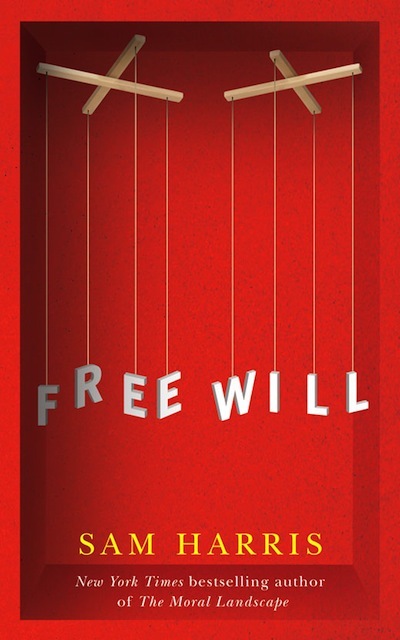
Free Will by Sam Harris

Sam Harris is the author of the New York Times bestsellers, The End of Faith, Letter to a Christian Nation, and The Moral Landscape. Mr. Harris is a Co-Founder and CEO of Project Reason, a nonprofit foundation devoted to spreading scientific knowledge and secular values in society. He received a degree in philosophy from Stanford University and a Ph.D. in neuroscience from UCLA.

A lot of my reading over the last few years has touched on the idea of free will. Real or illusory? I’ll confess that it sure feels as though I have free will. But the more I read about the subject… and think about it… the less certain I am.


The intention to do one thing and not another does not originate in consciousness — rather, it appears in consciousness, as does any thought or impulse that might oppose it.

Some moments before you are aware of what you will do next — a time in which you subjectively appear to have complete freedom to behave however you please — your brain has already determined what you will do. You then become conscious of this “decision” and believe that you are are in the process of making it.

I cannot decide what I will next think or intend until a thought or intention arises.

You are not controlling the storm, and you are not lost in it. You are the storm.

Unconscious neural events determine our thoughts and actions — and are themselves determined by prior causes of which we are subjectively unaware.

The next choice you make will come out of the darkness of prior causes that you, the conscious witness of your experience, did not bring into being.

You are no more responsible for the next thing you think (and therefor do) than you are for the fact that you were born into this world.

You can decide what you decide to do — but you cannot decide what you will decide to do.

My choices matter — and there are paths toward making wiser ones — but I cannot choose what I choose.

What I will do next, and why, remains, at bottom, a mystery — one that is fully determined by the prior state of the universe and the laws of nature (including the contributions of chance).

Take a moment to think about the context in which your next decision will occur: You did not pick your parents or the time and place of your birth. You didn’t choose your gender or most of your life experiences. You had no control whatsoever over your genome or the development of your brain. And now your brain is making choices on the basis of preferences and beliefs that have been hammered into it over a lifetime — by your genes, your physical development since the moment you were conceived, and the interactions you have had with other people, events, and ideas. Where is the freedom in this?

You will do whatever it is you do, and it is meaningless to assert that you could have done otherwise.


 

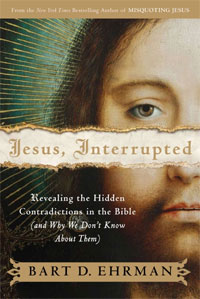
Jesus, Interrupted

The full title of the book is: Jesus, Interrupted: Revealing the Hidden Contradictions in the Bible (And Why We Don’t Know About Them). The author, Bart D. Ehrman, began studying the Bible and its original languages at the Moody Bible Institute and is a 1978 graduate of Wheaton College in Illinois. He received his PhD and M.Div. from Princeton Theological Seminary, where he studied under Bruce Metzger. He received magna cum laude for both his BA in 1978 and PhD in 1985.

I have not read the Bible and — before reading this book — knew almost nothing about it from an historical, scholarly perspective. Here are a few excerpts I highlighted:

The New Testament, consisting of twenty-seven books, was written by maybe sixteen or seventeen authors over a period of seventy years.
…
A Christianity dependent on the inerrancy of the Bible probably cannot survive the reality of the discrepancies.
…
Since the nineteenth century, scholars have recognized that Mark was the first Gospel to be written, around 65-70 CE. Continue reading →