
LibraryThing: Legacy Libraries

I started using BookBuddy this past July but still catalog my books in LibraryThing. While tweaking an entry today I noticed I had been given the Vigesimal Veteran badge (awarded to members who have been using the site for more than twenty years).

While I have more than 1,000 books in my LibraryThing catalog, I don’t use many of the features of the site. When I do poke around a bit, I usually discover something interesting, like Legacy Libraries.

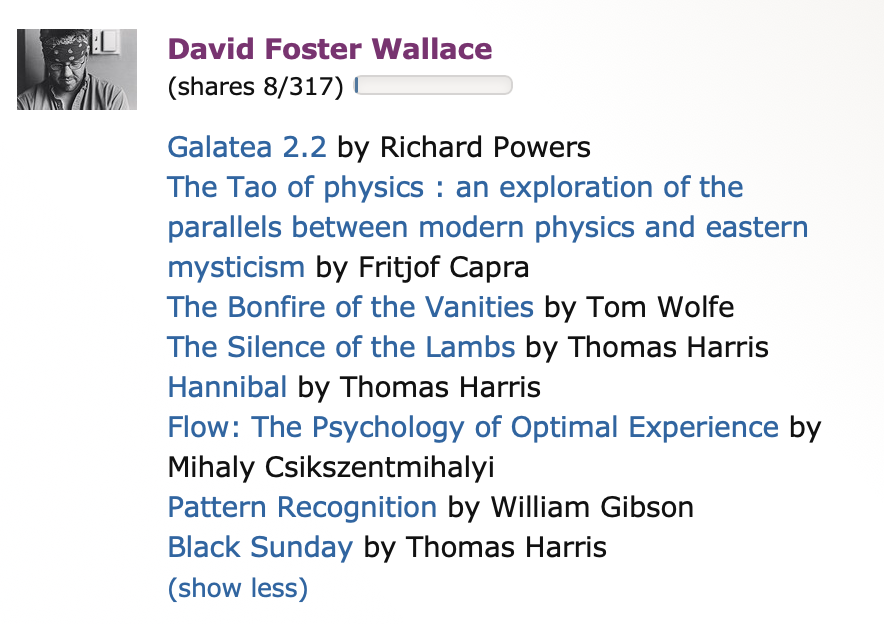
Legacy Libraries are the libraries of historical people (as well as a few institutions), entered into LibraryThing by dedicated members working from a variety of sources, including published bibliographies, auction catalogs, library holdings, manuscript lists, wills and probate inventories, and personal inspection of extant copies. The project began with Thomas Jefferson’s library, which a small group of volunteers began cataloging in September 2007.

It always pleases me to discover someone who shares my taste in books. Even more so if that person happens to be famous or noteworthy. Three examples: David Foster Wallace, Walker Percy and Terence McKenna.
Life is short—and life is long. But not in that order

aulasy – n. the sadness that there’s no way to convey a powerful memory to people who weren’t there at the time-driving past your childhood home to show it to a friend, or pointing at a picture of a loved one you lost, only to realize that to them it’s just another house, just another face.

enterhood – n. the set of living people who have known you all your life, all the way back to your infancy, before you had a clue who you were; a group that slowly shrinks as you get older, until the point when all of your closest confidants have only ever seen an abridged version of you, having joined your story somewhere in the middle of things, just as you did.

— The Dictionary of Obscure Sorrows by John Koenig

Reading changes the way your brain works

Watch this video on YouTube. And for those who insist reading on your phone is the same as reading a book. It’s not. “Reading on a phone or tablet is generally passive scrolling, often interrupted by messages and alerts. When we read on screens we tend to skim and when we skim, we’re more susceptible to misinformation.”

A few posts about reading »

“He’d never wanted kids”

“He’d never wanted kids. Outside of priority boarding on an airline, he couldn’t see the upside to them. They took over your life and filled you with terror and weariness and people acted like having one was a blessed event and talked about them in the reverent tones they once reserved for gods. When it came down to it, though, you had to remember that all those assholes cutting you off in traffic and walking the streets and shouting in bars and turning their music up too loud and mugging you and raping you and selling you lemon cars—-all those assholes were just children who’d aged. No miracle. Nothing sacred in that.”

—Mystic River (Dennis Lehane)

Books are humanity’s externalized memory

Books (or the absence of books) seems to be a common trope in science/speculative fiction. I’m thinking of The Book of Eli, Farenheit 451, Galatea 2.2, and —of course— Mockingbird. Once again, I asked ChatGPT for an analysis.


You’re onto something, Steve—books (or their absence) pop up again and again in speculative fiction, and it’s rarely just about reading material. They’re symbols of memory, knowledge, authority, even humanity itself. A few thoughts on the theme, with some examples to add to your list:

I think the reason this theme recurs is because books are humanity’s externalized memory. They’re more tangible than “data” or “cloud servers”—a simple, material symbol for knowledge itself. Remove them, and you get amnesia. Hoard them, and you get power. Forget how to use them, and you get a slow cultural death. In speculative fiction, messing with books is shorthand for messing with what it means to be human.

Continue reading →