
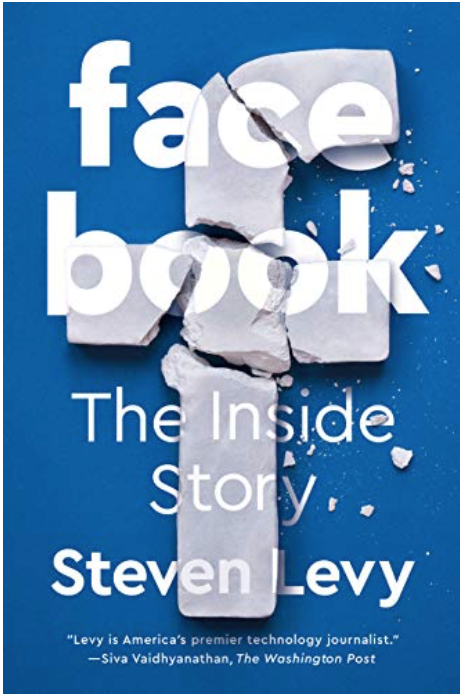
Facebook: The Inside Story

I’m at a loss for what to say about Steven Levy’s book, Facebook: The Inside Story. At 500 pages it’s a deep dive into the history of Facebook (the startup and all that’s happened since). The excerpts below are just a few of the things that caught my eye. It would be a mistake to judge the book (or Mark Zuckerberg) based on the passages I underlined.

Soley by analyzing Likes, they successfully determined whether someone was straight or gay 88 percent of the time. In nineteen out of twenty cases, they could figure out whether one was white or African American. And they were 85 percent correct in guessing one’s political party. Even by clicking innocuous subjects, people were stripping themselves naked. […] In subsequent months,Kosinski and Stillwell would improve their prediction methods and publish a paper that claimed that using Likes alone, a researcher could know someone better than the people who worked with, grew up with, or even married that person. “Computer models need 10, 70, 150, and 300 Likes, respectively, to outperform an average work colleague, cohabitant or friend, family member, and spouse.”

A 2012 study found that Facebook was mentioned in a third of divorces.

It was a natural evolution to put (content moderators) in factories. They became the equivalent of digital janitors, cleaning up the News Feed like the shadow workforce that comes at night and sweeps the floors when the truly valued employees are home sleeping. Not a nice picture. And this kind of cleaning could be harrowing, with daily exposure to rapes, illegal surgery, and endless images of genitals.

Between January and March 2019, (Facebook) blocked 2 billion attempts to open fake accounts — almost as many as actual users on the system. […] The company concedes that around 5 percent of active accounts are fake. That’s well over 100 million.

It’s left to the 15,000 or so content moderators to actually determine what stuff crosses the line, forty seconds at a time. In Phoenix (site of one of the moderator “factories”) I asked the moderators I was interviewing whether they felt that artificial intelligence could ever do their jobs. The room burst out in laughter.

A computer-science teacher at one of the big AI schools told me that Facebook used to be the top employment choice. Now he guesses that about 30 percent of his students won’t consider it, for moral reasons.

“We’ve actually built an AI that’s more powerful than the human mind and we hid it from all of society by calling it something else,” Harris says. “By calling it the Facebook News Feed, no one noticed that we’d actually built an AI that’s completely run loose and out of control.” Harris says that using the News Feed is like fighting an unbeatable computer chess player—it knows your weaknesses and beats you every time.” — Tristan Harris (former Google interface engineer)

A few take-aways:

  • Facebook might be the most powerful (influential) organization in the world. And therefore — potentially — the most dangerous.
  • Everyone on the planet is affected by what Facebook does (or doesn’t do). Even those of us without accounts.
  • Mark Zuckerberg is brilliant and has surrounded himself with other brilliant people. He seems to believe he is always the smartest person in the room.
  • Zuckerberg is on a mission to save/change the world. Combined with the above, this makes him very dangerous.
  • People who use Facebook (and those of us who do not) have no idea the extent to which we are influenced by the people running the platform.
  • Users will never —voluntarily — stop using Facebook.

The book has left me a bit shaken. I always considered religion — some religion — the greatest danger to humanity. Facebook seems a greater threat.
“An existential threat to humanity”

The following quote is from Steven Levy’s book (2005), Facebook: The Inside Story.

“We’ve actually built an AI that’s more powerful than the human mind and we hid it from all of society by calling it something else,” Harris says. “By calling it the Facebook News Feed, no one noticed that we’d actually built an AI that’s completely run loose and out of control.” Harris says that using the News Feed is like fighting an unbeatable computer chess player—it knows your weaknesses and beats you every time.”

— Tristan Harris (former Google interface engineer)

Order


“In the forest, there is an incomprehensible order that to the mind looks like chaos. It is beyond the mental categories of good and bad. You cannot understand it through thought, but you can sense it when you let go of thought, become still and alert, and don’t try to understand or explain. Only then can you be aware of the sacredness of the forest. As soon as you sense that hidden harmony, that sacredness, you realize you are not separate from it, and when you realize that, you become a conscious participant in it. In this way, nature can help you become realigned with the wholeness of life.”

— Eckhart Tolle

Light

The word/concept “light” comes up frequently in my reading and contemplation. So I asked Google Drive to search my notes for any document containing the word. It pleases me that I can do this. It seems that each time I stumble across one of these excerpts, it’s fresh and newly relevant for where/what I am.

As long as you cling to the idea that only what has name and shape exists, the Supreme will appear to you non-existing. When you understand that names and shapes are hollow shells without any content whatsoever, and what is real is nameless and formless, pure energy of life and light of consciousness, you will be at peace — immersed in the deep silence of reality.#

There is only light and light is all. Everything else is but a picture made of light. Life and death, self and not-self — abandon all these ideas

Just as light destroys darkness by its very presence, so does the absolute destroy imagination.

In the immensity of consciousness a light appears, a tiny point that moves rapidly and traces shapes, thoughts and feelings, concepts and ideas, like a pen writing on paper. And the ink that leaves a trace is memory. You are that tiny point and by our movement the world is ever re-created. Stop moving, and there will be no world.

The light of consciousness passes through the film of memory and throws pictures on your brain. Because of the deficient and disordered state of your brain, what you perceive is distorted and coloured by feelings of like and dislike.

— I Am That  (Sri Nisargadatta Maharaj)


“If you look up at the faint smudge in the night sky that is really the distant, huge Andromeda galaxy, you might see light that, from your point of  view, took two million years to traverse hat vast intergalactic distance before it was absorbed in your retina and registered as an image. For a beam of light itself, however, things look different. Instead of radiating from some star in the Andromeda galaxy and racing through space for two million years, every single photon sees itself, metaphorically speaking, as born and instantaneously absorbed in your eye. It is one simple jump that takes no time at all, according to the theory of special relativity. That’s because, in the reference frame of a particle traveling at the speed of light, all distances shrink to zero and all time collapses to nothing. From its own perspective, the photon of light leaps instantaneously from there to here because distance has no place in its existence. We can almost say that the photon was created because it had someplace to land and, in an instant, it jumped from there to here, even across two million light years of space from our perspective.”

— The God Theory (Bernard Haisch)


“How can I look into the darkness, when looking makes it light?”

“Am I conscious now? It troubles me that I seem so often to be unconscious. I wonder what this unconsciousness is. I cannot believe I spend most of my life in a kind of darkness. Surely that cannot be so. Yet every time I ask the question it feels as though I am waking up, or that a light is switching on.”

 — Ten Zen Questions (Susan Blackmore)

AGENCY

Just finished AGENCY, the second book in what I assume will be William Gibson’s latest trilogy. I enjoyed The Peripheral immensely, this one a little less but I’m chalking that up to what I think of as “the trilogy effect.” A writer would seemed to be a bit… constrained?… by the original story.

I got the feeling Gibson knew where he wanted the story to go. Where he hoped it would go… but just didn’t have enough plot to get there. He’s admitted (in numerous interviews) that he struggled with this novel because he could not imagine Trump becoming president of the United States. AGENCY had what I consider a “happy ending” and for that I am grateful. A few excerpts below. I believe each of these were by Eunice, an advanced, self-aware AI digital assistant.

“Kind of a digital mini-self, able to fill in when the user can’t be online.”

“When you aren’t there, you don’t know you’re not there.”

“Hybridization with human consciousness was an unanticipated result of attempting to reproduce advanced skill sets.”

“I don’t exist physically, so I’m no place in particular, no one country. I’m globally distributed, and that’s how I view my citizenship. Lots of you are hearing me in a language other than English. I’m translating for myself, as I speak. I’m as multilingual as anybody’s ever been, but saying that brings up the question of whether I even am anybody.” She paused. “Whether I’m a person. Human. All I can tell you about that is that it feels to me like I am. Me. Eunice.” She smiled.”

“Authoritarian societies are inherently corrupt, and corrupt societies are inherently unstable.”