
I asked ChatGPT to review my tags

I uploaded my tag cloud to ChatGPT and asked what, if anything, could be surmised about someone with these interests.


Based on the tags you’ve shared from your blog, it’s clear you have a wide range of interests. Here’s a snapshot of what I gather about someone with your array of interests:

  1. Technology and Gadgets: You seem to have a keen interest in tech, particularly anything Apple-related, like iPads, iPhones, and MacBooks. Your tags suggest you follow developments in mobile technology, autonomous vehicles, and virtual reality. This indicates you’re probably quite tech-savvy and enjoy staying updated on the latest advancements.
  2. Communication and Media: With extensive tags related to radio, podcasting, and social media, it appears you have a strong background in communication. Your past work in communications and at a radio station aligns with this. Your interest in podcasting and blogging shows you’re still active in sharing ideas and engaging with others through modern platforms.
  3. Speculative and Dystopian Fiction: Authors and works like Bruce Sterling, Neal Stephenson, and “Snow Crash” suggest you enjoy speculative and dystopian fiction. This fits well with your love for speculative fiction, crime fiction, and spy fiction, highlighting your penchant for imaginative and thought-provoking narratives.
  4. Philosophy and Mindfulness: Tags like Buddhism, Tao, meditation, Eckhart Tolle, and Alan Watts point to a deep interest in philosophy and mindfulness. Your commitment to daily meditation and your identification as a “half-assed, wannabe Taoist” underscore a pursuit of inner peace and understanding of the self.
  5. Humor and Entertainment: You have a notable appreciation for humor, with tags related to funny songs, The Daily Show, and comedians like George Carlin. This shows you value wit and humor, likely enjoying content that makes you laugh while often reflecting on deeper societal issues.
  6. Science and Futurism: Tags such as consciousness, free will, evolution, quantum theory, and figures like Ray Kurzweil and Yuval Noah Harari indicate a strong interest in science and futurism. You’re probably fascinated by the mysteries of the universe, human potential, and the future of humanity.
  7. Political and Social Commentary: Your tags related to politics, social media, and figures like Trump and Obama suggest you keep abreast of current events and societal trends. This fits with your view that politics and religion are inherently bad for humanity, implying a critical stance towards these institutions.
  8. Creative Expression and Arts: Tags like photography, poetry, music, and animation reveal a creative side. You likely enjoy expressing yourself through various art forms and appreciate the artistic endeavors of others.
  9. Personal Interests and Hobbies: Your collection of tags about old vehicles, hiking trails, and specific interests like chainsaws and ukuleles suggest you have diverse hobbies that keep you engaged and entertained in your personal life.
  10. Community and Relationships: The numerous references to individuals like Ben Brogdon, Bob Priddy, and many others indicate a strong sense of community and personal relationships. You value your connections and likely enjoy engaging with a wide network of friends and acquaintances.

Overall, someone with these interests is a well-rounded, curious individual who values technology, philosophy, creative expression, and community. You have a mix of intellectual pursuits and hobbies that keep your life both stimulating and balanced.
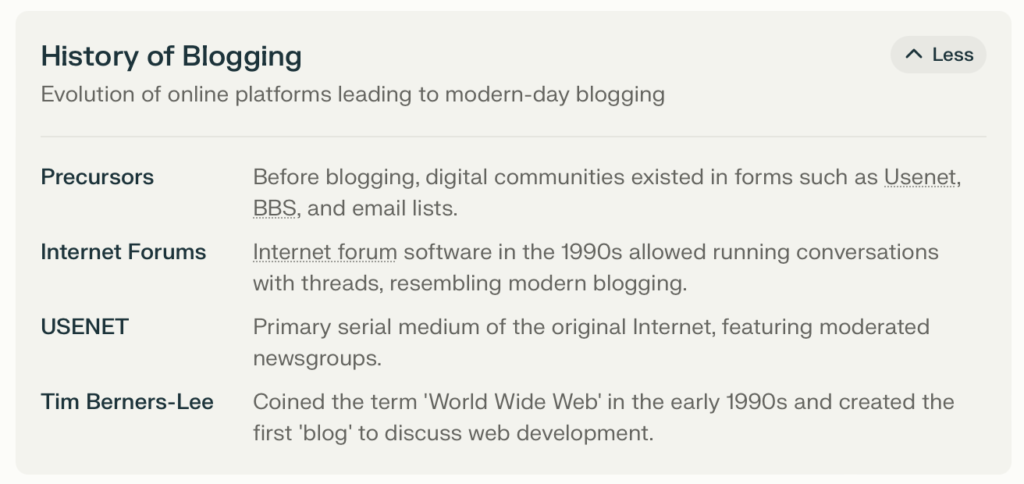
Perplexity: Origin of the term “blog”

The word “blog” is a shortened form of the term “weblog,” which was coined by Jorn Barger on December 17, 1997. The shorter version “blog” was coined by Peter Merholz, who jokingly broke the word “weblog” into the phrase “we blog” in the sidebar of his blog Peterme.com in April or May 1999.

The term “weblog” itself originated from the practice of logging or recording information on the web, similar to how sailors would log details of their voyages in a ship’s log. The “web” part refers to the World Wide Web, and “log” refers to the act of recording or journaling.

So in essence, “blogging” stems from the concept of maintaining an online log or journal, which evolved from earlier forms of digital communities like Usenet, email lists, and bulletin board systems. The term gained widespread popularity after Pyra Labs used “blog” as both a noun and verb in connection with their Blogger product in the late 1990s.

When ChatGPT can read my blog

ChatGPT recently informed me it could do some creative and useful things for me if I gave it access to my Google Drive files and folders. I thought about it but since I have just about everything in Google Drive I decided to wait a bit. For now I can simply upload or link to a document or file. But the list of things ChatGPT could do with this access was impressive. So I asked if it could “read” my 6,000+ blog posts.


ChatGPT currently doesn’t have the capability to directly access or interact with content on external websites, including public blogs, in real-time. However, you can share specific posts or content from your blog, and I can help analyze, discuss, or provide feedback based on that. If there are specific posts or themes you’d like to talk about, feel free to share them here, and we can dive into the details.

To which I replied, Let’s assume that at some point in the future ChatGPT will be able “read” the 6,000+ posts on my blog. (Something no human has ever done) Wouldn’t that dramatically… enhance? … our interactions?

Absolutely, if ChatGPT could read and analyze all 6,000+ posts on your blog, it would greatly enhance our interactions. Here’s how it could benefit:

  1. Personalized Responses: Understanding the nuances of your thoughts, interests, and experiences documented over the years would allow me to tailor responses to be even more relevant and insightful.
  2. Contextual Awareness: I could reference specific posts or themes you’ve discussed previously, providing continuity and depth in our conversations.
  3. Enhanced Recommendations: Based on your past writings, I could offer more targeted suggestions for books, topics, or activities that align with your interests.
  4. Insightful Analysis: I could help identify patterns or recurring themes in your blog posts, providing a fresh perspective on your work and potentially sparking new ideas.
  5. Memory and Continuity: Our interactions would feel more seamless, as I’d have a detailed “memory” of your blog posts, making it easier to pick up where we left off in previous conversations.

In essence, this capability would make our interactions more dynamic, informed, and personalized, making me a more effective conversational partner.

What, I asked, are the technical obstacles to having this functionality now?

There are a few technical and practical obstacles to implementing this functionality currently:

  1. Data Privacy and Security: Accessing and processing large amounts of personal data, like your blog posts, involves significant privacy and security considerations. Ensuring that such data is handled securely and with appropriate permissions is crucial.
  2. Data Integration: Integrating and processing a large volume of text data from an external source like a blog requires robust data integration techniques. This involves fetching, parsing, and storing the data in a way that can be efficiently queried and analyzed.
  3. Computational Resources: Analyzing 6,000+ posts involves substantial computational power, both for initial processing and for real-time interactions. This necessitates efficient algorithms and scalable infrastructure.
  4. Natural Language Understanding: While natural language processing (NLP) has made significant advancements, understanding the context, tone, and nuances across thousands of posts is still a complex task. This requires advanced models and potentially custom training to accurately capture your writing style and preferences.
  5. User Control and Customization: Giving users control over what data is accessed and how it is used is essential. This means developing user-friendly interfaces and options for customization, which adds another layer of complexity.
  6. Ethical Considerations: There are ethical considerations around the extent of data analysis and the potential for unintended consequences, such as reinforcing biases or making incorrect inferences.

While these challenges are significant, they are not insurmountable. Advances in AI, NLP, and data processing continue to evolve, making such functionality more feasible in the future. It will require careful planning, robust technology, and thoughtful implementation to ensure it is done effectively and ethically.

Blog maintenance: Video

When I started blogging in 2002 it was really hard to include video in a post. YouTube was still three years away. Google had a video player for a while but streaming just wasn’t a thing. The first video files I uploaded were tiny because they had to download before they could be watched. But all that changed with faster computers and more bandwidth. And, of course, smart phones that could record video.

YouTube made it very easy to upload and share video from a website like mine. I have 677 posts on this blog that include video. Most of those were created by someone else but I’ve created a couple of hundred. My first was in February of 2006.

There are other streaming platforms besides YouTube. Vimeo, TED Talks, and WordPress has a player for streaming mp4 files. Fifty-nine of my posts use something other than a YouTube embed.

My posts with video now fall into several categories under Media & Entertainment:

Of the 200+ videos that I’ve posted here, 44 of them were me talking to the camera. Not sure these would be considered “selfies.”

Audio

Seventy-nine of my posts include audio. Interviews, funny songs, old radio jingles and commercials, etc. Some of my favorite stuff.


1,000 Books

LibraryThing is an online database (for books) that launched in August 2005. I started using it a month later and in the ensuing 19 years have cataloged 1,000 books. I always have a book close at hand but I am not a fast reader. I love to read and do so for a couple of hours every day. Perhaps my favorite pastime. And I can’t think of anything that would tell you more about who I am and what I’m interested in than the books I have read.

Fiction gets most of my reading time (692 titles) but in recent years I have developed a taste for nonfiction (245 titles). Together, the work of 351 authors. Most popular:

Robert B. Parker (51), John Sandford (46), Michael Connelly (36), Lawrence Block (32), Elmore Leonard (28), Sue Grafton (23), John D. Macdonald (23), Ross Thomas (21), Robert Crais (19), Mick Herron (17), Bill Granger (15), John Grisham (15), William Gibson (14), Carl Hiaasen (14), Neal Stephenson (13), elson DeMille (12)

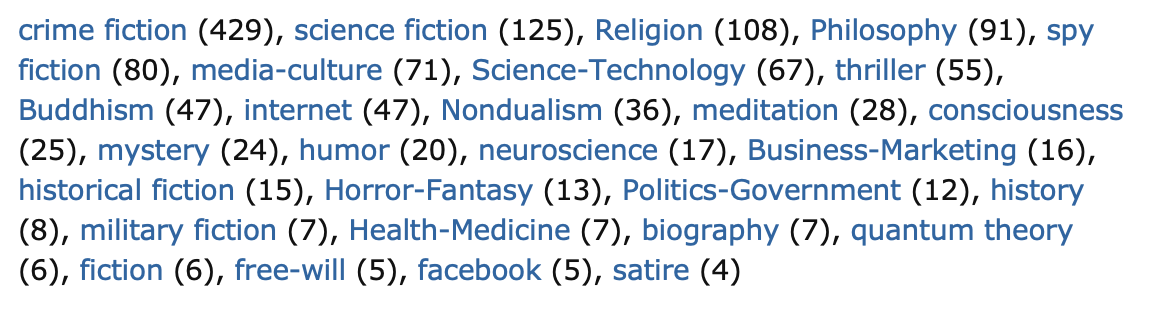
I give each entry in the database one or more tags and that probably provides the clearest picture of my interests. (Note: tagging is more art than science)

I purchase most of the books I read because I love highlighting passages which was one of the main reasons I started a blog in 2002. When I finish a book I transcribe the highlighted passages as well as creating a blog post. Think of these as really short Cliffs Notes. Lots of examples here.

I only keep a book if I think there is chance I’ll read it again (I’ve read each of the John Sanford Prey novels half a dozen times). All others are donated to the local library for their annual book sale.

I couldn’t guess how much I’ve spent on books in the last fifty years. I’m sure Amazon has that number for the last 30 years, but I don’t regret a penny. Fiction is my virtual reality and non-fiction the better part of my education. With a book close at hand I am never bored.

Lots of my acquaintances prefer audio books and I’ll confess to some bias on this topic. Having someone read a book to me is not the same as reading the book. Might be a better experience for some but it’s not the same as hearing my mental voice tell the story. I love the smell of a book…the feel of the turning pages…the physical experience of reading.