Sharpen your writing skills with “Stopwatch Challenge”

Stopwatchsmall
Dan Rieck suggest we can sharpen our copywriting skills with what he calls the "Stopwatch Challenge." The exercise is basically writing a radio spot that can be spoken aloud in exactly 60 seconds.

Brings back fond memories of my radio days. For a dozen years, about half of my 10 hour days were spent on the air and the other half writing and producing radio commercials. Let’s see… we’ll call it 50 spots a week. 200 spots a  month. 2,400 spots a year. Let’s round it down to 28,000 commercials.

We had to knock ’em out fast and get ’em on the air. And the client always gave you more stuff that you could fit in 30 or 60 seconds. So part of the challenge was boiling it down.

Sixty seconds is about 16 lines. But you have to spell out numbers (one-eight-hundred-five-five-five-sixty-four-hundred).

I’ve never considered myself a great writer. But writing radio spots was pretty good training for blogging. Or maybe any kind of writing. Fewer words always better than more words.

I often send emails with nothing but "see subject line" in the body. I try to put it all in the subject line. Try it on your next email.

And, yes, I know this post is longer than sixty seconds.

“They’re not talking to you”

Herecomes

“Who would want to be a publisher with only a dozen readers? It’s also easy to see why the audience for most user-generated content is so small, filled as it is with narrow, spelling-challenged observations about going to the mall and pick out clothes. And it’s easy to deride this sort of thing as self-absorbed publishing — why would anyone put such drivel out in public? It’s simple. They’re not talking to you. We misread these seemingly inane posts because we’re so unused to seeing written material in public that isn’t intended for us.”

From Clay Shirky’s “Here Comes Everybody: The Power of Organizing without Organizations” This is a fascinating book that takes an academic –but easy to read– look at social networking and how it’s changing society.

Blogs = Google Juice

In January I posted a video clip of a guy bouncing a nail on the head of a hammer. Actually, he was juggling the nail on the head of the hammer. Just watch the amazing video.

Yesterday I received notification of a comment on the post. It was from Scot Nery, the man in the video. The clip had been pulled from YouTube and he provided a permanent link to the video.

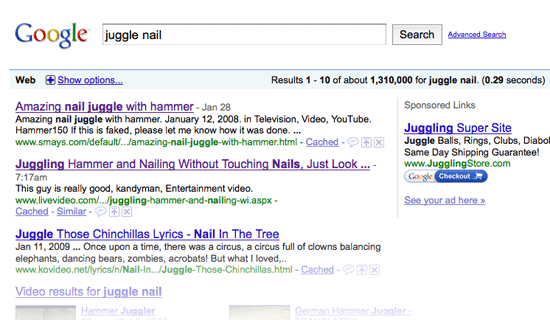
I assumed he found the post with a Google search but since it didn’t include his name or any identifying data, I wondered what he searched for. When I tried “nail juggle” (without the quotation marks), my post was number one out of 213,000 results. If I’m clear on how Google works, those two words would give you every hit with either “nail” or “juggle.”

Think about that. Those are two pretty common words. And a lot of the results pertained to Scot Nery doing the nail thing.

Just one more example of the sweet google juice generated by blogs.

Dave Winer podcasts “because I want to say something”

“There’s a mini-debate going on about whether podcasting is a success or worth it, or whatever, I’m not sure exactly what the issue is, but it’s framed this way –> if you can’t get advertisers to hitch a ride on your podcast then podcasting is not worth much if anything.

My phone doesn’t have a business model. Neither does my porch. I still like having a phone and a porch because they help me meet new people and communicate with people I know. Same with my blog and podcast.

I do a podcast from time to time because I want to say something. Whether I can run an ad on my podcast means nothing to me because I would never do it. … I would never burden my podcasting with the task of supporting me. It’s not why I podcast. … Blogging and podcasting exist independent of a professional’s ability to eek out a living using the tools of blogging and podcasting.”

You can read Mr. Winer’s full post here.

My colleague David is helping a number of clients with blogs and podcasts and none are ad supported. They exist solely to help tell the client’s story. Blogs and podcasts are inexpensive, effective, easy and fun.

For my part, nothing ruins a good hobby like trying to make money with it.

Unhappy Camper

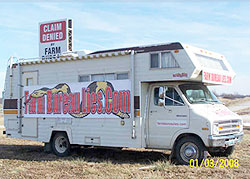
Fbl_motorhomeOur offices are just a couple of hundred feet from the headquarters of the Missouri Farm Bureau. As I headed out for lunch I noticed a motor home had pulled off the highway, just in front of FB building. I didn’t have my camera (I know, I know) so I didn’t get a shot but found this on the FarmBureauLies.com website.

This guy is not a happy camper. And I have no idea who is right in his dispute with Farm Bureau.

I’m just wondering how many people got back to their offices and did what I did… pulled up the website. And if you’re Farm Bureau (or any big company), what –if anything– is the proper response. I’m sure the lawyers would tell them they can’t say anything about a matter that’s being litigated.

As disgruntled customers take their grievances online, it would make sense for big companies (and small ones) to have a online strategy of their own (I looked for a FB blog but didn’t find one). Seems to me companies have to find some way to engage with their customers in this space.

If the sign on the camper read “Learfield Sucks” and was parked in front of our building, what would we do? If Clyde Lear had his way, he’d probably go and talk to the guy. Maybe record an interview with the guy, let him tell his story. And then post all or part of that on the company blog.

Would the guy be any less pissed? Who knows. Would we look more responsive or concerned as a company? To some.