
Ray Kurzweil is building a chatbot for Google

Ray Kurzweil is building a chatbot for Google.
“He was asked when he thought people would be able to have meaningful conversations with artificial intelligence, one that might fool you into thinking you were conversing with a human being. “That’s very relevant to what I’m doing at Google,” Kurzweil said. “My team, among other things, is working on chatbots. We expect to release some chatbots you can talk to later this year.”

I have some questions.

  • Will my chatbot be able to suggest topics?
  • Could my chatbot ‘watch’ my YouTube channel? It could ‘learn’ a lot about me and my interests if that’s possible. Same for my flickr photo stream
  • Could I configure a sense of humor? Irony? Smartass-ishness?
  • Could I make it location aware? (“I see you didn’t go to the Coffee Zone today, Steve. Decide to stay home with the pups?)
  • My calendar (“Good morning, Steve. I see it’s been a month since you picked up Hatti’s anti-itch meds. Shall I email the vet to refill?”)
  • Can I instruct my chatbot to let me know when I start sounding whiney?
  • Can my chatbot follow what I’m reading and discuss it with me? Or offer to introduce me to others reading the same book?
  • If, after a year, I decide I’m uncomfortable having a chatbot ‘relationship,’ will there be an ethical consideration in terminating it?

I wonder if he chose to refer to this as a “chatbot” because it’s a less threatening term (and Artificial Intelligence). I have a hunch it will be (or eventually become) something far more.
Evolutionary Argument Against Reality

Interview with Donald D. Hoffman, a professor of cognitive science at the University of California, Irvine. Hoffman has spent the past three decades studying perception, artificial intelligence, evolutionary game theory and the brain, and his conclusion is a dramatic one: The world presented to us by our perceptions is nothing like reality.

“Useful as it is under ordinary circumstances to say that the world exists ‘out there’ independent of us, that view can no longer be upheld.” — Physicist John Wheeler

We are data: the future of machine intelligence (2015)

“Artificial Intuition happens when a computer and its software look at data and analyze it using computation that mimics human intuition at the deepest levels: language, hierarchical thinking — even spiritual and religious thinking. The machines doing the thinking are deliberately designed to replicate human neural networks, and connected together form even larger artificial neural networks.”

This is from an article by Douglas Coupland. Maybe one of the more frightening things I’ve read about data collection. Let’s start with a few of one-liners:

“Amazon can tell if you’re straight or gay within seven purchases.”
“Doug’s Law: An app is only successful if it puts a lot of people out of work.”
“The amount of internet freedom we have right now is the most we’re ever going to get.”

He starts his piece with a description of an imaginary app called Wonkr. I had to read this a few times to decide if he was serious or not.

“You put Wonkr on your phone and it asks you a quick set of questions about your beliefs. Then, the moment there are more than a few people around you (who also have Wonkr), it tells you about the people you’re sharing the room with. You’ll be in a crowded restaurant in Nashville and you can tell that 73 per cent of the room is Republican. Go into the kitchen and you’ll see that it’s 84 per cent Democrat. You’ll be in an elevator in Manhattan and the higher you go, the percentage of Democrats shrinks. Go to Germany — or France or anywhere, really — and Wonkr adapts to local politics. The thing to remember is: Wonkr only activates in crowds. If you’re at home alone, with the apps switched off, nobody can tell anything about you.”

“Wonkr’s job is to tell you the political temperature of a busy space. “Am I among friends or enemies?” But then you can easily change the radius of testability. Instead of just the room you’re standing in, make it of the block or the whole city — or your country. Wonkr is a de facto polling app. Pollsters are suddenly out of a job: Wonkr tells you — with astonishing accuracy — who believes what, and where they do it.”

“Wonkr is a free app but why not help it by paying say, 99 cents, to allow it to link you with people who think just like you. Remember, to sign on to Wonkr you have to take a relatively deep quiz. Maybe 155 questions, like the astonishingly successful eHarmony.com.”

If you’re busy, put this aside until you have 10 minutes. It’s packed tighter than cocaine mule’s carry-on.

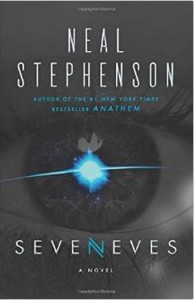
Seveneves by Neal Stephenson

sevenevesOf the half dozen or so Neal Stephenson novels I’ve read, Seveneves (pronounced seven Eves) is probably my least favorite. That might say more about how much I enjoyed his previous books. I need to make a few notes here while the book is fresh in my mind. [SPOILERS: If you haven’t read it yet, there will be a few] In no particular order:

  • If humans have any long-term future, it will involve space travel. And, if humans survive, they will evolve into beings that are different — in important, significant ways — from what we are today. Future humans will have god-like powers (genetic engineering, to name one)
  • The story brings to mind The Martian (Andy Weir); Contact (Carl Sagan) and Red Star, Winter Orbit (A short story by William Gibson). And some clear echoes of Stephenson’s Anathem.
  • Regarding the author’s choice for bringing about the end of the world: an unknown Agent blows up the moon which — within a couple of years — destroys all life on Earth. Not climate change; plague; nuclear war or alien invasion. And even though Stephenson chooses destruction by fire, he avoids the obvious Biblical reference.
  • Stephenson made the “end of the world” seem real to me in a way that other apocalyptic tales have not. I found it difficult to read. He points out that “within about 100 years” everyone who is alive today will be dead. Something I never consciously considered.
  • The story made me appreciate water and clouds and gravity in a way that I don’t think I ever have. I hope I don’t live to see the end of this world. Or the beginning of the end. Oops. Never mind.
  • Robots figure prominently in this story but they are tools, not metal “people” No mention of Artificial Intelligence in this story. I came away with a feeling that this is how things will probably go. Not the romantic vision Hollywood has provided.

I’ve read most of NS’s novels more than once. Some so often the books have started to come apart. Seveneves is a good yarn but one read will probably be enough. Excellent review of 7Eves.

The AI we confront will be us

From an article by Tim O’Reilly

“When news of import spreads around the world in moments, is this not the awareness in some kind of global brain? When an idea takes hold in millions of individual minds, and is reinforced by repetition across our silicon networks, is it not a persistent thought?”

It’s a rare day I don’t “ask Google” a question. Usually several. Increasingly, Google provides a useful answer. As this bit of magic becomes commonplace, the line between Me and the Net becomes thinner and thinner and will soon disappear. (Already, perhaps?) My mind (whatever that is) feels like it’s escaping the cramped confines of my head and it feels wonderful.

“AI that we will confront is not going to be a mind in an individual machine. It will not be something we look at as other. It may well be us.”

As our Cro-Magnon and Neanderthal ancestors slowly became what we are today?