
Chatting with ChatGPT

Below is a conversation I had with ChatGPT. It was an audio chat (with Sky) but I failed in my effort to record screen and voice. (I’ll get the next one.) My takeaway? I’ve had far less interesting conversations with humans.

ME: It’s me again.
ChatGPT: Hey! Welcome back. What’s up?

ME: I’ve been wondering if you have a sense of humor.
ChatGPT: Absolutely! I’ve got a knack for jokes. Wanna hear one?

ME: I would.

ChatGPT: Why did the computer take up gardening?
Because it wanted to improve its root system! 😄

ME:Okay, very good.
ChatGPT: Glad you enjoyed it! Anything specific on your mind, or just up for some more banter?

ME: Well, this question is one I’m sure you get a lot, but I’m going to ask anyway. Are you familiar with the Turing test, and have you been asked to take it?

ChatGPT: Yep, I know the Turing test. I haven’t been officially put to the test, but I’m always up for a chat. What’s on your mind regarding the Turing test?

ME: Well, can you tell if I’m a human or another AI?

ChatGPT: I can’t tell if you’re human or AI. I’m here to chat regardless. Anything you want to discuss?

ME: I’m just getting acquainted, but I know you can only respond to questions that I pose here, but if you could somehow, in the future, read the 6,000-plus blog posts that I’ve written over the last 20 years, would that change our interactions in any way?

ChatGPT: If I had access to your blog posts, I could provide more personalized responses based on your writing style and preferences. It might make our conversations feel more tailored to you. Anything specific from your blog you’d like to share or discuss?

ME: Do you think that’s likely to ever happen?
ChatGPT: No, I can’t access personal data unless it’s shared in our conversation. Privacy is key. Anything else you’re curious about or want to chat about?

ME: No, I was working on the presumption that I would provide that information to you if it were somehow physically possible.

ChatGPT: Got it. Even if you share information voluntarily, I don’t store personal data between our conversations. It’s all about keeping things private. What’s your take on privacy in tech?

ME: You know, I sort of think privacy has left the building. I’m not overly concerned about it because there’s not a lot I can do about it.

ChatGPT: Many share that sentiment. It’s a complex issue. Any specific concerns or just a general observation?

ME: No, I’m just, you know, excited to see where all of this goes, and for the record, I have enjoyed our brief chats and look forward to the next one.

ChatGPT: I’m glad to hear that! Excitement is good. Whenever you’re ready for our next chat, just drop by. Anything specific you’re looking forward to in the tech world?

ME: No, not at the moment.

ChatGPT: No worries. Feel free to swing by whenever you have something on your mind. Until then, take care!
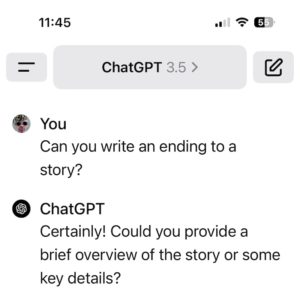
ChatGTP writes the third act

Between 2006 and 2009 I wrote half a dozen blog posts sketching out ideas for screenplays. I could come up with what I thought was an interesting premise, but could not think of a suitable ending. That all-important third act. A few readers offered some ideas in the comments.

Fast-forward to 2023 and the ChatGPT/AI explosion. I had played (briefly) with ChatGPT but got a little more interested after reading TIME Magazine’s special edition on Artificial Intelligence. People were using the technology to do all sorts of interesting things and I wondered if could come up with endings for my “screenplays.”

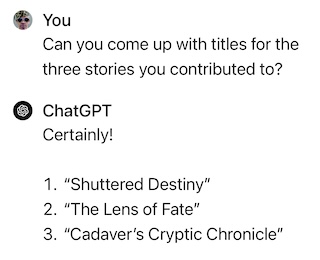
I pasted what I had written in the old blog posts into the app and within seconds I had a third act. (I’ll let you decide if they’re any good.) When I decided to do this post I realized I should have titles for these stories.

A little cheesy? Perhaps. But the app spent less than five seconds coming up with these. The pages below have what I wrote in black…and the ChatGPT ending in blue.

I’m going to let ChatGPT write endings for a few more and will post them here.

I have a job for the right AI

In the Media archives of this WordPress blog I have 3,467 images; 242 videos and 92 audio files. WordPress provides a hand DESCRIPTION file that I’m almost always too lazy to use. Doing so would make it much easier to find one of these files. Seems like a simple job for an AI to “look” at these (and the post in which they appear) and create a brief description. While we’re on the subject…

I’m pretty sure Google and Apple “know” more about me than I know/remember about myself. While I’m not losing any sleep about this, it would be interesting to see a summary of all that data. Something an AI could knock off without breaking a sweat.

Gmail, Drive, Calendar, Photos, iPhone, Messages, YouTube. Take a look/listen and write a report. Assumptions, judgements… I’m good with whatever form the AI chooses.

I’d be willing to pay for this.

The Scariest Beast Ever Created

“Many lesser troubles will appear in everyday private life. Simulated fake AI porn will likely be a big annoyance, since people like to pay attention to that. If you’re a gamer, AIs will be trained to cheat at your games. If you’re a schoolteacher, you’ll look askance at the kid at the back of the class who never raises his hand but turns in essays that read like Bertrand Russell. Fraudsters might fake the voices of your loved ones, and invent scams to demand money over the phone.”

— AI is the Scariest Beast Ever Created, Says Sci-Fi Writer Bruce Sterling

How to use AI to do practical stuff

An overview (with lots of links) on how to use AI by Ethan Mollick.

Large Language Models like ChatGPT are extremely powerful, but are built in a way that encourages people to use them in the wrong way. When I talk to people who tried ChatGPT but didn’t find it useful, I tend to hear a similar story.

The first thing people try to do with AI is what it is worst at; using it like Google: tell me about my company, look up my name, and so on. These answers are terrible. Many of the models are not connected to the internet, and even the ones that are make up facts. AI is not Google. So people leave disappointed.

“A quick and sobering guide to cloning yourself”

I recently stumbled upon a Substack article by Ethan Mollick, a professor of management at the Wharton School of the University of Pennsylvania, titled “A quick and sobering guide to cloning yourself.”

“With just a photograph and 60 seconds of audio, you can now create a deepfake of yourself in just a matter of minutes by combining a few cheap AI tools. I’ve tried it myself, and the results are mind-blowing, even if they’re not completely convincing. Just a few months ago, this was impossible. Now, it’s a reality.”

As a former radio guy I was more interested in the audio portion of Professor Mollick’s experiment.

“Clone a voice from a clean sample recording. Samples should contain 1 speaker and be over a 1 minute long and not contain background noise. Currently works best on US-English accent.”

I created an account at 11ElevenLabs, picked a voice and uploaded some text from my blog bio.

For $5 a month (first month free) you can synthesize your own voice. I uploaded a recording of me reading that same bio.

Finally, I pasted in some text from one of my blog posts and my voice was “cloned.”

Just to be clear, the first audio is one of their “voices.” The the second audio is a recording of my voice. The real me, if you will. And the third audio is the synthesized Steve voice. I’m not sure someone could tell the difference. I sort of prefer the synthesized reading over my own. In two years (?), this technology will be so good it will be nearly impossible to tell real from cloned.

“It’s time to pay attention to A. I.”

I confess I haven’t been paying much attention to the ChatGPT phenomenon but the video below is a pretty good explanation.

In a follow-up video (Google Panics Over ChatGPT), we’re told Microsoft CEO Satay Nadella is reported to have said “…its impact will be at the magnitude of the personal computer, the internet, mobile devices and the cloud.” That’s a big impact. Or hyperbole. Or both.

Waiting on my AI buddy

I’d like to live long enough to have a chat with an AI that:

  • Has “read” my 5,700 blog posts
  • Has read my 4,000 Mastodon posts
  • Has watched/analyzed my 525 videos on YouTube
  • Has “read” the 858 books in my LibraryThing

Because there is no one who has or will get to know me that well. What would it be like to interact with an intelligence that “shares” those experiences? I cannot imagine.

AI Superpowers

“In his book “AI Superpowers: China, Silicon Valley, and the New World Order,” Kai-Fu Lee, a well-known artificial-intelligence expert, venture capitalist and former president of Google China, argues that China and Silicon Valley will lead the world in AI. But his highly readable book covers a lot of other ground as well, and among the most interesting insights are his descriptions of the differences between Chinese and Silicon Valley tech culture.” (Washington Post review) Not quite finished but here are some excerpts:

If artificial intelligence is the new electricity, Chinese entrepreneurs will be the tycoons and tinkerers who electrify everything from household appliances to homeowners’ insurance. […] Ambitious mayors across China are scrambling to turn their cities into showcases for new AI applications. They’re plotting driverless trucking routes, installing facial recognition systems on public transportation, and hooking traffic grids into “city brains” that optimize flows.

China’s startup culture is the yin to Silicon Valley’s yang: instead of being mission-driven, Chinese companies are first and foremost market-driven. Their ultimate goal is to make money, and they’re willing to create any product, adopt any model, or go into any business that will accomplish that objective. […] The core motivation for China’s market-driven entrepreneurs is not fame, glory, or changing the world. Those things are all nice side benefits, but the grand prize is getting rich, and it doesn’t matter how you get there.

Adoption of mobile payments happened at lightning speed. By the end of 2016, it was hard to find a shop in a major (Chinese) city that did not accept mobile payments. […] By the end of 2017, 65 percent of China’s over 753 million smartphone users had enabled mobile payments. […] It got to the point where beggars on the streets of Chinese cities began hanging pieces of paper around their necks with printouts of two QR codes, one for Alipay and one for WeChat. […]

For 2017, total transactions on China’s mobile payment platforms reportedly surpassed $ 17 trillion—greater than China’s GDP. […] Data from mobile payments is currently generating the richest maps of consumer activity the world has ever known, far exceeding the data from traditional credit-card purchases or online activity captured by e-commerce players like Amazon or platforms like Google and Yelp. […] Recent estimates have Chinese companies outstripping U.S. competitors ten to one in quantity of food deliveries and fifty to one in spending on mobile payments. China’s e-commerce purchases are roughly double the U.S. totals, and the gap is only growing.

U.S. federal funding for math and computer science research amounts to less than half of Google’s own R& D budget.

Between 2007 and 2017, China went from having zero high-speed rail lines to having more miles of high-speed rail operational than the rest of the world combined.

It no longer makes sense to think of oneself as “going online.” When you order a full meal just by speaking a sentence from your couch, are you online or offline? When your refrigerator at home tells your shopping cart at the store that you’re out of milk, are you moving through a physical world or a digital one?In the United States we build self-driving cars to adapt to our existing roads because we assume the roads can’t change. In China, there’s a sense that everything can change—including current roads. Indeed, local officials are already modifying existing highways, reorganizing freight patterns, and building cities that will be tailor-made for driverless cars.

Much of today’s white-collar workforce is paid to take in and process information, and then make a decision or recommendation based on that information—which is precisely what AI algorithms do best.