Kennett’s Flying Bank Robber

In January of 1976 I was on the air (noon hour?) at KBOA in Kennett, MO, when the police scanner in the studio went nuts. Someone (dispatcher? patrolman?) was yelling that someone had robbed the bank and “took off in an airplane!”

I grabbed a cassette recorder and dashed out of the station, yelling for someone to go up and take over the live studio. I got to the small motor bank before the police and got a few minutes of audio with the teller who had been robbed.

Police showed almost immediately and made me get out. I was pumped because I had some good stuff. When I pulled the cassette from the recorder it was hopelessly wound around the roller and gears and shit. No way to salvage. I nearly wept. Instead, I hung around long enough to get a little more information and then headed back to the station where I did a quick ad lib report live and then started writing up the story.
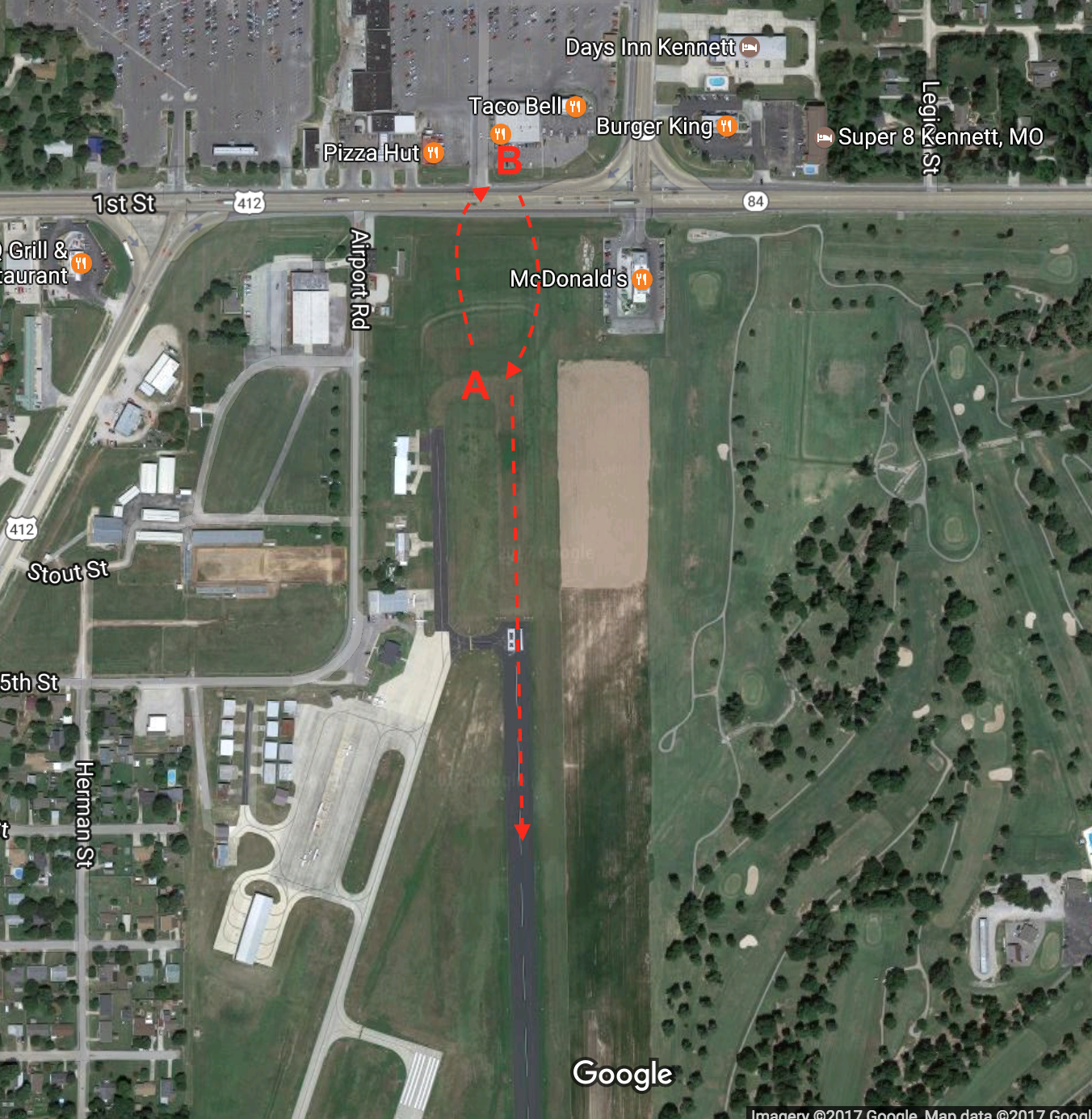
The satellite image above tells you most of what you need to know. The pilot taxied the small plane out to A where pilots always stopped to let their engines warm up before take off. He slipped out and ran across the highway to the small motor bank (Bank of Kennett). This was a tiny little facility. Room for maybe two tellers and a little lobby (6×10?) separated by glass and a door. The way I remember the story, he asked the teller for a chair and she opened the door to hand him one (he said he was waiting for a friend). He stuck a gun in her face, got the cash ($24K) and boogied back across highway (about 100 yards) and took off into the sunset. He was also charged with “interstate flight.” The FBI arrested 39 year old Dennis R. Holmes a few weeks later in Phoenix.

According to a story in the St. Louis Post-Dispatch, Joseph Appleyard, chief pilot at Dolphin Aviation in Sarasota, taught Holmes to fly a few months earlier. “He didn’t see like my average bank robber,” Appleyard said. Holmes rented the plane (in Sarasota) on the Thursday before the robbery, flew to Kennett on Saturday.

The plane was tracked on radar by the nearby Air Force base in Blytheville, AR, but lost him when it put it on the deck and disappeared. He had a range of about 700 miles.

Mr. Holmes was also arrested for holding up a bank in Arcata, CA in February. He fled in a car but quickly transferred to a small plane. He was also a suspect in a $55K stickup the previous October in Michigan. In that one the robber held up the bank just as the high school homecoming parade was about to begin, and he melted into the crowd.

If you’re out there, Dennis… if you’re reading this… how about an interview to make up for the one that got away?
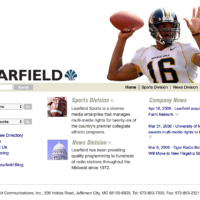
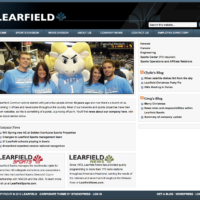
Wayback Machine: Learfield.com

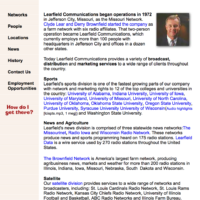
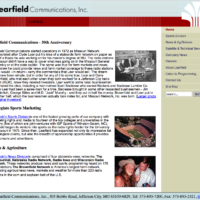
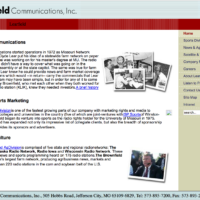
My little history project (Learfield and the Internet (1995-2005) took me to the Internet Archive Wayback Machine where I got a look at some of the websites I helped create and maintain during the early days of the Internet. The first sites we created were for our two news networks, Radio Iowa and The Missourinet, but we felt like we needed one for our corporate site and Learfield.com went up in 1997. It was designed and built by Dan Arnall and Allen Hammock. (The story is in the link above)

I’m pretty sure I’m responsible for the look of the page in 1999 and 2000. I had zero design training or skills and I also didn’t have a budget for those talents, so I took a whack at it. We did have some professional help eventually but today they all look, let’s just say, dated.

A “home page” on the Internet was a brand new thing in 1997. They became the public face of a company or organization and in those early days, little more than brochures. Everyone was trying to figure out how to make them useful. “Look and feel” was way more important than usability back then. We loaded our pages with text because space was not an issue. Or so we thought.

Images tended to be tiny because big ones too a long time to load on slow dial-up connections. As we added more and more pages to our sites, “navigation” became important. We gave our page links clever names that meant nothing to the people visiting our sites.

Looking at these are almost painful. Like looking at photos from your senior year in high school. Want more? Missourinet and Radio Iowa.

The Path

1. Becoming aware there is a Path (and watching for it)
2. Stumbling upon the Path and becoming aware of when one is on (or off) it
3. Understanding one was always on the Path
4. Realizing the Path does not come from or go anywhere has no beginning and no end

Mark Cuban and AudioNet

The following is an excerpt from Learfield and the Internet (1995-2005)

In September of 1995 we received a phone call from Mark Cuban. He and a partner (Todd Wagner) had recently acquired a company called Cameron Audio Networks, named after its founder Cameron Christopher Jaeb. The company had acquired rights to broadcast radio and professional sports games live on the Internet. Cuban wanted to listen to the basketball games of his alma mater, Indiana University. Learfield owned the media rights to IU (and eight other universities and colleges). Cuban renamed his company AudioNet.

From the AudioNet media kit, October 1995:

“AudioNet is one of the most popular destinations on the Internet. People around the world know that when they want their choice of realtime and on demand audio programming there is only one place to go, WWW.Audionet.Com, the world’s first Broadcast Network on the Internet!”

“We offer them realtime broadcasts of radio stations such as KLIF Dallas, KFI Los Angeles, KOA Denver, XTRA San Diego, WQAM Miami, WJFK Washington DC WCKY Cincinnati, with many more to come. The there is the realtime broadcasts of exciting sporting events such as Texas A&M, University of Southern California, Baylor, Southern Methodist University college football, a growing schedule of professional football, baseball, basketball ad hockey, and Indoor Soccer.”

“In addition to sports programming we offer a complete choice of entertaining programming (you) can’t get anywhere else, like the Janice Malone Show, The Mark Cuban Show, Jeffrey Lyons Movie Reviews and Hollywood Reports, Medical Matters, Tech Talk, NetRadio, Geek Free Radio, Legal Matters, NetRadio, Celebrity Interviews with Michelle Pfeiffer, Patrick Swayze, Dustin Hoffman, George Foreman, Gennifer Flowers and much more. What’s even more exciting is that AudioNet is doubling (its) content offerings every month, with new things being added every day. Listeners know to stop by and see what’s new, and they do!”

On November 10, 1995, we met with Mark in Kansas City to discuss how our two companies might work together. It was Clyde, Allen Hammock, Steve Mays and (maybe) Chief Engineer Charlie Peters.

Since Learfield owned the broadcast rights, we couldn’t see the value of what AudioNet brought to the table. At one point Mark walked over to the whiteboard and scrawled some numbers, offering to sell 10% of his new company to Learfield for half a million dollars (others recall the number as one million). Learfield didn’t have the money at the time and really couldn’t see the value of AudioNet in any event. (Cuban sold his company to Yahoo! on April 1, 1999 for $5.7 billion, making it the most expensive acquisition Yahoo! had made at the time.)

In December, 1995, Learfield and AudioNet signed a letter of agreement for Internet distribution of our live college sports programming (PDF – assorted docs). AudioNet provided a minimum of 10,000 RealAudio streams while Learfield provided audio of our football and basketball broadcasts. We were also responsible for development of all content for the websites. Any advertising sold by Learfield, the split was 80/20 (80% to Learfield). If AudioNet sold the ads, the split was 60/40 (60% to Learfield). The term of the agreement was two years.

At some point during our talks with Mark, someone at Learfield asked why we couldn’t just do this on our own. Why did we need AudioNet? I recall Mark explaining he had an arrangement with RealAudio for streaming licenses that no other company could get. That was his edge.