The Simulation Game

“Each individual believes that he or she is living in a world that really exists. The point of SG is to provide clues to the pieces that this is not so and see when they realize they are in a simulation. We considered inserting some obvious clues into their stream of experience, such as sky writing that says “This all a simulation—you are being fooled”, but that was deemed a bit too obvious, even taking into account the limited intelligence of the pieces. To make the game more interesting, and to net the greatest gambling revenues, we decided to make the clues subtler, though of course any of our species would recognize them immediately. We have therefore arranged it so that the world they experience is incoherent and unintelligible—quite literally impossible. This is not so clear on the surface, but in the game it is meant to be gradually revealed, as they apply their limited intelligence to the appearances.”

More about The Simulation Game »

What your tweets say about you

In my experience, people are about as quick to pee on Twitter as Facebook. But I’m a longtime user of Twitter and spend as much time following my finely curated list as I do hanging at on G+. And I’ve long suspected a person’s tweets say something about them. This essay by Maria Konnikova in the New Yorker seems to confirm that suspicion:

AnalyzeWords, one of the latest creations from James Pennebaker, a psychologist at the University of Texas who studies how language relates to well-being and personality. One of Pennebaker’s most famous projects is a computer program called Linguistic Inquiry and Word Count (L.I.W.C.), which looks at the words we use, and in what frequency and context, and uses this information to gauge our psychological states and various aspects of our personality. Since the creation of the L.I.W.C., in 1993, studies utilizing the program have suggested a close connection between our language, our state of mind, and our behavior.

So I plugged in my Twitter handle and you can see the results below. Additional nuggets from the essay:

For decades, Pennebaker’s studies have shown that when people keep a journal they tend to fare better emotionally, recover more quickly from negative experiences, and achieve more academically and professionally. Other recent work suggests that social media provides the same benefits, despite the fact that, unlike a journal, it’s inherently public.

And one more:

Counties where residents’ tweets included words related to hostility, aggression, hate, and, fatigue—words such as “asshole,” “jealous,” and “bored”—had significantly higher rates of death from atherosclerotic heart disease, including heart attacks and strokes. Conversely, where people’s tweets reflected more positive emotions and engagement, heart disease was less common. The tweet-based model even had more predictive power than other models based on traditional demographic, socioeconomic, and health-risk factors.

The SMAYS Award

smays-award

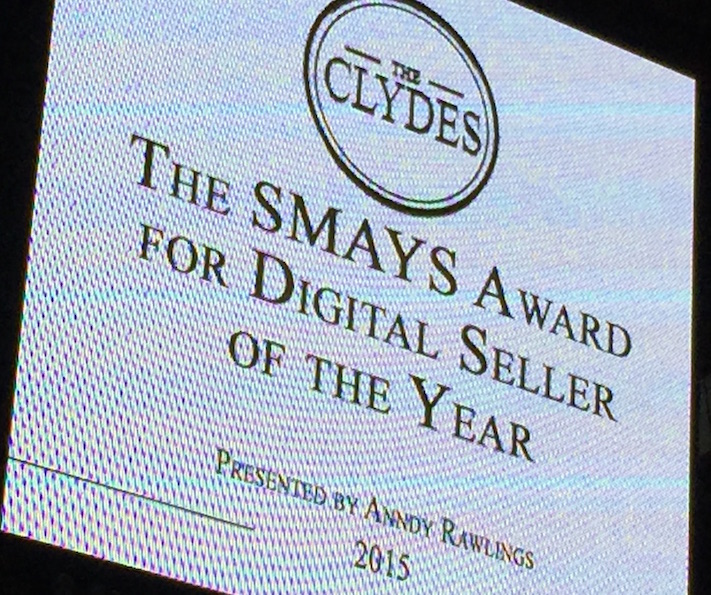
The company I worked for holds an annual meeting of their sales reps that includes an awards ceremony. The awards are called the Clydes in honor of the company founder (Clyde Lear). Sort of like the Oscars but, well, the Clydes. One of the categories — Digital Sales — is named after me. I was pretty annoying in the late 90’s and early 00’s on the subject of the Internet. Lots of eye rolling back then, big part of the company’s revenue today. This is, I’m convinced, a short-lived vanity. It already seems odd to refer to something as digital when everything is, and has been, digital for a long time.

Scott Adams: Robots

“The age of robotics could replace religion, at least for the young. We will come to see our bodies as moist robots working according to the rules of physics, not magical beings with invisible souls that guide our actions. In other words, when robots start acting exactly like humans, humans will feel more like robots at the same time. It probably works both ways. At some point in human history – and I think today’s kids will live to see it – humans and robots will be working together, living together, and probably dating.”