
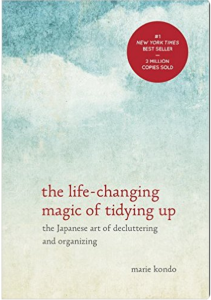
 The Life-Changing Magic of Tidying Up (“The Japanese Art of Decluttering and Organizing”) by Marie Kondo. If you really, really want to declutter your life (and most people do not), this is the only book you’ll need. More philosophy than how-to and that will turn off many. And here method only works if you do exactly what she says to do, and in the order she says to do it.
I’ve nearly completed her method, only photos remain and I’ll tackle those this afternoon. In the process, I have held in my hand every item I possess. That alone will frighten off most people. But I now see why she believes that is important.
If you’re tired of drowning in stuff, read this book. If not, keep swimming. A few excerpts:
Tidying: deciding whether or not to dispose of something and deciding where to put it.
When your room is clean and uncluttered, you have no choice but to examine your inner state.
Tidying is just a tool, not the final destination. Putting things away creates the illusion that the clutter problem has been solved. But sooner or later, all storage units are full. This is why tidying must start with discarding.
People who can’t stay tidy can be categorized into just three types: “can’t-throw-it-away” type; “can’t-put-it-back” type; and the “first-two-combined” type.
You only have to experience a state of perfect order once to be able to maintain it. Examine each item you own, decide whether you want to keep or discard it, and then choose where to put what you keep. […] You only have to decide where to put things once.
Discard things when they cease being functional. Discard things that are out of date.
Take each item in one’s hand and ask: “Does this spark joy?” If it does, keep it. If not, dispose of it. […] You must take each (item) in your hand.
Always think in terms of category, not place. (Don’t organize by room!)
In addition to the physical value of things, there are three other factors that add value to our belongings: function, information, and emotional attachment.
Start with clothes, then move on to books, papers, komono (miscellany), and finally things with sentimental value.
Put all your clothes in one heap, take them in your hand one by one, and ask yourself quietly, “Does this spark joy?”
There are two storage methods for cloths: one is to put them on hangers and hang from a rod and the other is to fold them and put them away in drawers.
Store things standing up rather than laid flat. […] Never ball up your socks.
Remove all books from your bookcases. You cannot judge whether or not a book really grabs you when it’s still on the shelf.
The problem with books that we intend to read sometime is that they are far harder to part with than the ones we have already read. […] “Sometime” never comes. You may have wanted to read it when you bought it, but if you haven’t read it by now, the book’s purpose was to teach you that you didn’t need it.
My basic principle for sorting papers is to throw them all away.
People never retrieve the boxes they send “home.” Once sent, they will never again be opened.
If you just stow things away in a drawer or cardboard box, before you realize it, your past will become a weight that holds you back and keep you from living in the here and now.
The reason every item must have a designated place is because the existence of an item without a home multiplies the chances that your space will become cluttered again. […] The essence of effective storage is this: designate a spot for every last thing you own.
There are only two ways of categorizing belongings: by type of item and by person. [page 138]
Clutter has only two possible causes: too much effort is required to put things away or it is unclear where things belong.
Keep everything out of the bath or shower. Whatever is used in the bath should be dried after use.
A deluge of information whenever you open a closet door makes a room feel “noisy.” […] By eliminating excess visual information that doesn’t inspire joy, you can make your space much more peaceful and comfortable.
At their core, the things we really like do not change over time. Putting your house in order is a great way to discover what they are.
When we really delve into the reasons for why we can’t let something go, there are only two: an attachment to the past or a fear for the future.
The question of what you want to own is actually the question of how you want to live your life. […] The best way to find out what we really need is to get rid of what we don’t. […] Selecting and discarding one’s possessions is a continuous process of making decisions based on one’s own values.