

Author Archives: Steve Mays
Augmented audio future?
These are the kinds of possibilities that moved me to buy AirPods.
“Maybe I’d hear updates about store hours or be able to identify places by looking in their direction. Or a museum audio tour could be triggered by your proximity to an exhibit. Maybe I’d get a smartly-tuned audio assistant that sounded like it was perched over my shoulder, perfectly blended to sound like it was in my world versus being delivered via headphones. Or, a universal translator. That’s exactly what the Waverly Labs’ Pilot is promising: the ability to hear a speaker of Spanish, French or Italian in English (or vice versa) in near real-time.”
Voice-to-text note using Siri via AirPods
I created a note on my iPhone using Siri and voice-to-text. (In a noisy coffee shop). Music is great on the AirPods but my primary reason for the purchase was to see if/how AirPods could change the way I interacted with the iPhone. Using Siri (far from perfect) to read messages and email; create and send messages and email; schedule reminders; etc. Without removing the phone from my pocket. [Video runs 20 sec]
Recording phone audio with ScreenFlow
During my working years I always had ready access to good recording equipment. This came in most handy when recording interviews by phone. Good telephone hybrids are expensive but make a big difference in quality.
Since retiring, I’ve used various tools for this task. I’ve mentioned Call Recorder for FaceTime which works well if both ends are using Mac gear. Years ago I tried Audio Hijack but found that glitchy. Probably a user issue.
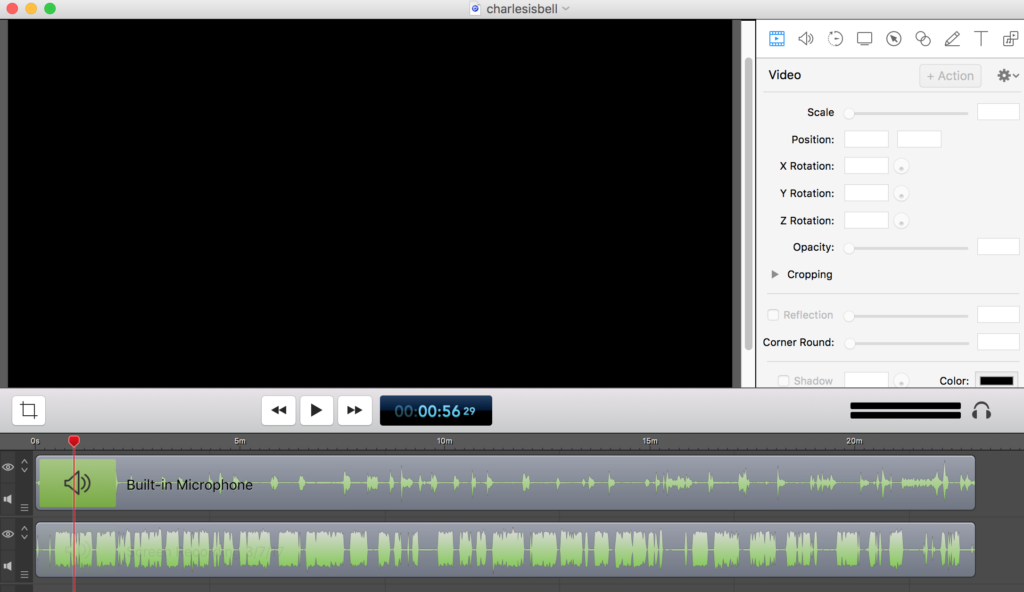
Yesterday I tried a different setup. I made the call via Google Hangout and recorded the audio with ScreenFlow. I use ScreenFlow to record screencasts but found I could simply turn off the camera and capture the audio. I was pleasantly surprised with the result. ScreenFlow captured the audio in two channels so it was easy to tweak the audio for each. There might be better ways to skin this cat but this is the best combination of easy and quality that I’ve found.
Apple AirPods
I was going to wait a few days before sharing any thoughts on my new Bluetooth headphones but I’ve been so impressed by the initial experience I’m going to share a few first impressions.
- I thought the regular Apple earbuds sounded fine but the audio quality of the AirPods is noticeably better. A lot better, IMO. Maybe a 25% improvement?
- Lots of folks complain about how earbuds and the new AirPods feel in their ears. Never a problem for me. I kept them in for an hour two last night and they were so comfortable I forgot they were in. I felt no movement when shaking my head vigorously or jumping up and down. I have no concern about them falling out. I have no doubt I’ll be wearing (?) these more than the wired earbuds.
- On that point, I was surprised by a new sense of freedom from the wire. (Like I said, this is my first experience with Bluetooth phones) Not having that little wire against my cheeks or snagging on a shirt button changes the experience far more than I would have expected. In a way that I can’t explain, the music feels like it’s in my head, instead of in my ears.
- Phone calls – Barb says I’m much easier to understand on a call (compared to just talking on the iPhone). I think this might be the result of ambient noise filters built into the system.
- Voice-to-text works great, even when speaking in lower-than-normal speaking level.
Still trying stuff (Siri commands/inquiries, etc) but these are keepers. Will it fundamentally change how I interact with the technology? To be determined.