Watch on YouTube
Poem: Dead Air
The Day the Circus Came to Town

I seem to keep coming across areas where neuroscience and philosophy overlap on the subject of the self. PS: The “I” at the beginning of that sentence? Just an illusion.
Geoffrey Everest Hinton (born 6 December 1947) is a British-Canadian computer scientist, cognitive scientist, cognitive psychologist, and Nobel Prize winner in Physics, known for his work on artificial neural networks which earned him the title as the “Godfather of AI”. Hinton is University Professor Emeritus at the University of Toronto. From 2013 to 2023, he divided his time working for Google (Google Brain) and the University of Toronto, before publicly announcing his departure from Google in May 2023, citing concerns about the many risks of artificial intelligence (AI) technology. He has voiced concerns about deliberate misuse by malicious actors, technological unemployment, and existential risk from artificial general intelligence. Hinton is viewed as a leading figure in the deep learning community. (Wikipedia)
The photo below is one of hundreds I hauled down from the attic after my parents died. No idea who Mrs. Schluleter was but mom would have been living in St. Louis in November of of 1944. I get chills thinking about what mom’s hand-written metadata adds to this photo. (see ChatGPT info below) Allied forces had invaded Normandy just five months earlier and the outcome of the war was still far from certain. My father enlisted in the Navy in May of 1943 and was discharged in March of 1946 and saw a lot of action (which he never talked about) in the Pacific.
Some might argue that today’s digital images are rich in data but most people I know simply shovel hundreds (thousands?) of digital images into the cloud with little or no context.
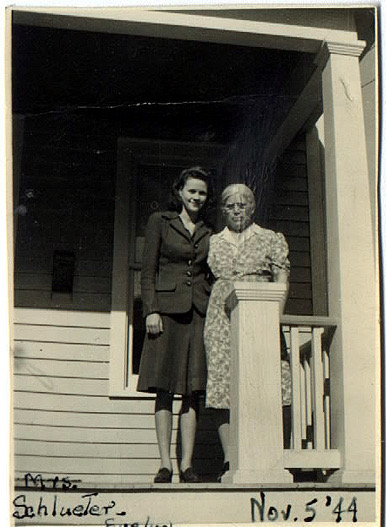
On November 5, 1944, the world was deep into World War II, and several significant events took place:
These events highlight the intense and widespread military engagements occurring across multiple theaters of the war at that time.
Len Deighton’s Bernard Samson series spans the late 1970s through the late 1980s, covering the Cold War espionage world from London to Berlin, Washington, and beyond. The overarching narrative revolves around Bernard Samson, a British intelligence officer caught in a web of deception, shifting loyalties, and Cold War politics.
The series is set primarily in London and Berlin, with key events also occurring in Vienna, Washington D.C., and Mexico City. The timeline begins in the late 1970s, at the height of Cold War tensions, and progresses through the mid-to-late 1980s.
In a 2014 interview, Deighton mentioned that the final trilogy was more of a ‘ghost’ idea, and he never progressed far in writing it. He considered retelling the entire story in one volume but couldn’t decide on the narrative perspective, pondering options like first person, third person, or even from the viewpoint of Bernard’s son. He admitted, “I’m still thinking about it.”
Additionally, Deighton emphasized the importance of thorough planning and research in crafting his novels. He advised aspiring writers to be prepared to devote a significant amount of time to their work, writing every day, even if it’s just notes and research. He shared that he never completed a book in less than a year, with most taking longer.