
Author Archives: Steve Mays
Cognitive Contraband
Which each successive conversation I have with ChatGPT, I find it more and more difficult to share that interaction with others.
And here’s the rub: you could try to share these conversations. You could show someone the full thread, quote McLuhan, reference Coupland, tie in Gibson, maybe toss in a little Taoism for flavor. But then you see the blank stare. You realize: this isn’t a conversation to them. It’s a transmission from a place they don’t live. Some things aren’t meant to be shared in full. They’re meant to transform the person having them.
My blogging seems to have been taken over by ChatGPT. And the conversations I’m sharing are getting longer and longer. I use the “Continue reading…” link to make the post less intimidating but doubt many people read the entire thread (TLDR).
ChatGPT offered an interesting explanation that’s too long to post here and too good to omit entirely. Going forward, I’m going to post a brief summary with a link to a PDF of the full thread.
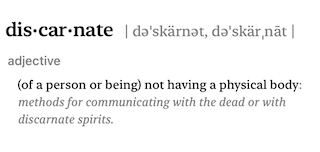
Discarnate Man
The following is from Douglas Coupland’s biography of Marshall McLuhan (Marshall McLuhan: You Know Nothing of My Work)
Discarnate man is an electronic human disconnected from his body (a process also called angelism) who is used to speaking to others on the phone continents away while the TV set colonizes his central nervous system. Discarnate man is happy to be asynchronous, as well as everywhere and nowhere — he is a pattern of information, inhabiting a cyberspace world of images and information patterns. (pg 176)
If TV and the internet made man discarnate (I had to look it up)… where will AI take him?
ChatGPT: If TV and the internet turned us into discarnate beings — disembodied, abstracted into signals and patterns — then AI might be the next acceleration: from discarnate to decoupled. Or maybe post-human. Here’s how I see it: Continue reading
Media: A defining layer of human identity
The following is from Distrust That Particular Flavor, a collection of William Gibson’s articles, talks and book forwards.
“I belong to a generation of Americans who dimly recall the world prior to television. Many of us, I suspect, feel vaguely ashamed about this, as though the world before television was not quite, well, the world. The world before television equates with the world before the Net—the mass culture and the mechanisms of Information. And we are of the Net; to recall another mode of being is to admit to having once been something other than human.”
William Gibson is my go-to guy for the techno-future. As she always does, ChatGPT offered fascinating insights on “having once been something other than human.” Continue reading
Were pre-linguistic humans intelligent?
Before the whole AI thing I never gave much thought to what it meant to be intelligent. Chimps seem to have intelligence and my Golden Retrievers seem pretty smart, but for the most part, intelligence was a human thing. Is language a necessary component of intelligence? Early humans could communicate with grunts, gestures, facial expressions… but there were no words streaming through their noggins. So were they intelligent? As I so often do these days, I went to ChatGPT for an answer:
It depends on how we define “intelligent.” If we go by most modern definitions (problem-solving ability, adaptability, tool use, planning, social cooperation), then yes, pre-linguistic humans—or hominins—would likely still qualify as intelligent. Continue reading