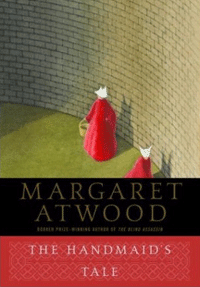
The Handmaid’s Tale by Margaret Atwood

I read The Handmaid’s Tale 25 years ago and it scared the crap out of me. It’s the story of “a future America under the violently oppressive rule of a far-right Christian sect. Women are back in the home and divided into domestic and reproductive functions, branded by coloured robes.”

If Tea Partiers read books this one would make them say “Hell yeah!” The rest of us cross our fingers and say, “It can’t happen here.” But it can, of course. We’re closer today than when the book was published.

BBC Interview »

The next thing

David Cain has soared to the top of my must-read list. His latest post has made my day richer and I hope it does the same for you. Here’s a taste:

“As I very slowly get a little better at managing the “stuff” in life, I am getting markedly better at being okay with everything’s eternally-half-done status. I’m getting better at coexisting peacefully with stuff that needs fixing, problems I don’t know how to handle, opportunities I am mismanaging, and even my anxious moods. Peace with anxiety. Anxiety, with peace. Somehow.

Now and then I can sit right in the middle of all of my uncertain and unfinished business and relax in the knowledge that everything really is in its right place. Strangely, the more I’m okay with everything being not quite okay, the better I am at moving the little things along to a place where they do feel okay. Make sense? Not really? That’s okay.”

I’m reminded of a trip from Des Moines to Jefferson City. Greg Brown (now our CEO) was at the wheel and working hard to pass slower cars on the two-lane highway. It dawned me that he was trying get to the “front of the line.” His face confirmed this when I mentioned it. Greg and I are older and wiser now.

A brief chat with Keith Povall

This is the first in what I hope will be a series of posts featuring brief interviews with some of the friends I have made online.

Keith Povall and I have never met but I know more about him (and he about me) than most of the people that live on our street. It’s a rare day that we do not exchange a few words.

Keith is a curry chef; raises carnivorous  plants and, of course, a blogger. He is also the curator of a cringe-inducing (for me) archive of photos of people wearing sandals and sox. Yes, he was a dry, biting sense of humor.

You also need to know that I am a shameless anglophile. I love all things British. The way they talk, their food, and their weather. So, my plan to to touch base with Keith every week or so and get his take on things happening in the world.

And when we run out of things to talk about, I’ll introduce you to some other lovely people.

AUDIO: Interview with Keith Povall (13 min)

Clay Shirky: The Shock of Inclusion

“If you were in the news business in the 20th century, you worked in a kind of pipeline, where reporters and editors would gather facts and observations and turn them into stories, which were then committed to ink on paper or waves in the air, and finally consumed, at the far end of those various modes of transport, by the audience.

What’s going away, from the pipeline model, isn’t the importance of news, or the importance of dedicated professionals. What’s going away is the linearity of the process, and the passivity of the audience. What’s going away is a world where the news was only made by professionals, and consumed by amateurs who couldn’t do much to produce news on their own, or to distribute it, or to act on it en masse.

We are living through a shock of inclusion, where the former audience is becoming increasingly intertwined with all aspects of news, as sources who can go public on their own, as groups that can both create and comb through data in ways the professionals can’t, as disseminators and syndicators and users of the news.”