Eagles concert

The Eagles provided the soundtrack for an important period in my life. Equally true, I assume, for others in the audience at last night’s Eagles concert. A lady sitting near us wasn’t born when the Eagles hit it big, but grew up listening with her parents.

The boys had to strain to hit a few of the notes but the memories were picture perfect. I like to think it’s more than Boomer nostalgia that keeps filling auditoriums for Stones and Eagles concerts. Which of today’s big artists will still be filling the seats in thirty years?

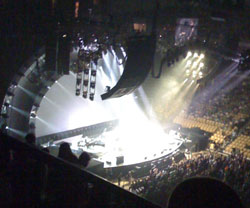
This photo was taken from the Cessna 350 as we flew over. But I’m not really complaining. We could see the jumbotron screens and music was loud enough, even from a couple of thousand feet.

It was a good show. The guitar licks alone would have been worth the price of the ticket.

Claire McCaskill’s blog

Watching MO Senator Claire McCaskill play with her new blog.

“These (photo) are the Generals and Admiral all testifying at our Armed Services hearing this am. I will ask questions shortly.”

The thought of a member of Congress “reporting on” a hearing she is covering is… is… sacrilege? Heresy? What word would be strong enough? The obvious problem is, the senator is –by definition– partisan. No way you could trust what she reports. Right?

So, how is this different from Sean Hannity? Or Chris Matthews? Or Rush? No doubt about which side of an issue they come down but they have thousands of viewers. Can we automatically assume every post by Senator McCaskill is tainted and unworthy? That every tweet by @joliejustus is designed to mislead and spin us?

Or can we mix it in with all the other “reporting” we get, factoring in her point of view? I don’t know the answer to that question but if there is one, every reader will come up with their own.

Tony Messenger on how social networks are changing the game

Good post by Post-Dispatch reporter Tony Messenger on how social networks like Twitter are changing the game.

“While covering the Democratic lovefest last weekend, I put a note on Twitter (I’m @tonymess, by the way) about how Republicans were exchanging nasty news releases about the Senate race in 2010 while the Democrats were uniting behind Robin Carnahan. Within minutes, the note had been passed around by countless Twitterites. The next day, Gov. Jay Nixon made the Republican infighting a central point in his speech to the group. Coincidence?”

Yeah, that must be it.

Man, all of this is SO painful for the old hands who can’t or won’t understand what’s happening and how to make it work for them. And so exciting for those do.

UPDATE: Here’s a screen grab of McCaskill’s most recent tweet. Call me naive, but I’ll be she gets some suggestions and I bet you reads them.

Clay Shirky on what’s happening to newspapers

In a post titled “Newspapers and Thinking the Unthinkable,” Clay Shirky provides some insight –and historical perspective– on what’s happening to newspapers. He starts with the question often asked by those committed to saving newspapers

“If the old model is broken, what will work in its place?” To which the answer is: Nothing. Nothing will work. There is no general model for newspapers to replace the one the internet just broke.”

“With the old economics destroyed, organizational forms perfected for industrial production have to be replaced with structures optimized for digital data. It makes increasingly less sense even to talk about a publishing industry, because the core problem publishing solves — the incredible difficulty, complexity, and expense of making something available to the public — has stopped being a problem.”

“When someone demands to be told how we are going to replace newspapers, they are really demanding to be told that we are not living through a revolution. They are demanding to be told that old systems won’t break before new systems are in place. They are demanding to be told that ancient social bargains aren’t in peril, that core institutions will be spared, that new methods of spreading information will improve previous practice rather than upending it. They are demanding to be lied to. There are fewer and fewer people who can convincingly tell such a lie.”

I think this is the first time I’ve fully understood that old models can be broken before new ones are there to take their place.