

Key to efficient blogging

Pick3This post at E-Meida Tidbits is aimed at journalists who worry about the additional time it takes to blog. But I think this is good advice for any blogger.

“…the key to blogging efficiently is this: DO NOT treat it like writing an article. That is, make blogging part of your ongoing processes for research, notetaking, and communication.

A blog post is not (or at least, it shouldn’t be) a writing assignment you must prep for and deliver as a finished package. Let go of the idea that you must have everything nailed down, organized, and edited before you publish.”

I’ve been stressing (just a little) about my light posting of late and had this idea for a T-shirt.
Time to rethink the AP model?

Cory Bergman at Lost Remote raises some interesting questions about the AP model in light of Google’s deal to host AP stories (rather than link back to newspaper websites).

He also points to a blog post on the "prickly issue of local broadcasters pulling local newspaper stories via the wire and posting them online (and occasionally vice-versa). Now that both mediums have expanded to the web, they’re direct competitors. And the local wire goes a long way to beef up the depth of content on a local TV site."

I’m pretty sure he’s talking about TV broadcasters. I’m afraid nobody is much concerned about radio stations getting their news from Google.

iPod Nano

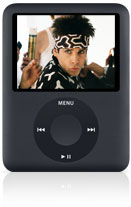
Ipodnano_2I love my sleek black nano iPod. Works great in every respect. Couldn’t be happier with it. And I didn’t like the new nanos, based on the speculative images I’d seen on the rumor blogs. But when Uncle Steve pulled the new nano out of his pocket and put it up on that big screen… I was done. New nano on the way.

Here’s my rationale: I’m playing with video more and more and, well, obviously I need a way to watch/share my little projects.

I admit to being tempted (but only a little) by the new iPod touch. But I’ve got the MacBook with me at all times, so…

More on the nano once we test drive. Watch the TV spot.

Spreadsheet fun

Only Apple could make spreadsheets fun. I only open Excel when someone sends me a file with some data and I have to take a look. But there are some tasks that really need a spreadsheet.

I had 5 minutes between tasks earlier this week, so I fired up Numbers, the new spreadsheet app in Apple iWork. I didn’t get far because as soon as I started playing with the chart tool, I was like a monkey with a piece of tin foil.

Yes, Excel can make charts and graphs but I always struggled with them and they didn’t look all that sexy when I did figure it out. I wish I could show you how much fun it was to swivel and turn and tweak this little chart (Ooh, ooh, ooh!)

I think the Apple folks would concede that Numbers is not for power users. More for math cripples like me that need a spreadsheet from time to time. I could list some of the neat features but don’t want to listen to MS Office vets tell me how easy it is to do the same thing in Excel.

Geek Marketers

Steve Rubel describes (in AdAge.com) a new kind of marketer: "Enter Geek Marketers. These cross-trained specialists are fluent in both worlds and bridge them. They are marketers by trade, yet they also have a hard-core interest in technology and social anthropology. As curious individuals, they are constantly studying how digital advances are changing our culture and media."

Call me a Geek Marketer wannabe. Companies are figuring this out. Until they do, there’s money to be made filling this void. [via AgWired]

Sunglasses with hidden video camera

Too pricey by a long shot but I confess I’d love have a pair of these.

“A very stylish pair of sunglasses with a colour camera brilliantly hidden within the frame to give colour pictures and exceptionally clear audio, all recorded on to a personal video recorder. This is a wired, but very discreet system, and the beauty of it is that you know that whatever you look at is what is being filmed. The personal video recorder includes a built-in colour monitor and speaker, 32MB internal memory, which can be expanded by inserting a more powerful SD/MMC card and the ability to time and date stamp all video recordings. This really is “state of the art” equipment which is ideal for investigative journalists, private investigators and “mystery” shoppers.

Game Day 09.01.07

One floor below my office is the Learfield Sports Operations Center. On Saturday, the place was hopping for the opening weekend of the college football season. Our guys produce 19 college sports broadcasts here (and some more off-site).

The play-by-play audio comes back to Jeff City where our producers and board operators mush it all together and send it back out –via satellite– to about 800 radio stations from coast to coast. Think shuttle launch but more people will be pissed if something goes wrong.

They start back in May and then work their asses off for the next four months. I won’t even try to mention everyone by name. And this short (6 min) video doesn’t begin to capture the energy (and sometimes tension) of “game day.” But Broadcast Operations Manager Tom Boman does a nice job of summarizing some of what it takes to get all these games out to stations.

Once again, shot with the Casio EX-S770 and edited in iMovie.

Email vs. F2F

“Some complain that e-mail is impersonal — that your contact with me, during the e-mail phase of our relationship, was mediated by wires and screens and cables. some would say that’s not as good as conversing face-to-face. And yet our seeing of things is always mediated by corneas, retinas, optic nerves, and some neural machinery that takes the information from the optic nerve and propagates it into our minds. So, is looking at words on a screen so very much inferior? I think not; at least then you are conscious of the distortions. Whereas, when you see someone with your eyes, you forget about the distortions and imagine you are experiencing them purely and immediately.” — Cryptonomicon, by Neal Stephenson (pg. 800)

Brad Sucks

Bradphoto200701
What was William Gibson listening to while writing Spook Country? Among others, a group called Brad Sucks. I never heard of ’em but if Mr. Gibson likes their music, I figured I’d take a listen. And liked what I heard. Brad Sucks invites you download their music for free but I clicked the iTunes link and bought the CD for ten bucks (after sampling each of the songs on the CD).

"In 2001, I started using the Internet (blogs, MP3s, P2P) to spread my music and not worrying so much about copyright violation. I’ve even been giving the source of my songs away for remixers to play with. I figured that spreading my music should be the number one goal and so far it’s worked out pretty well."

Does Brad Sucks get radio airplay? Comment if you know.

AP news on Google

“After a couple years of spirited negotiations, Google has signed agreements with the Associated Press and AFP that will reduce the amount of traffic Google News refers to news sites. First, Google News will start hosting full versions of AP stories instead of linking off to them. And second, Google will begin to filter out duplicates of the same AP story. So you won’t see multiple versions of an AP story from various newspapers, listed with the most recent at the top. Google said the end result is less duplication and a better variety of stories.” — Lost Remote

Do radio stations still subscribe to the AP? It’s been years since I was in radio stations, talking with managers about news and where/how they get it. But even back then, a lot of stations really only relied on AP for state news and high school football scores. Our company offers a “poor man’s wire service” that still has an amazing number of subscribers. [Yo, David. Can you give us an update on this?]

Perhaps the bigger question is… how much do listeners rely on their local radio station for news. I would think a lot. But what’s the order of importance? Local…state…national…world? What can/do I get from my local radio station (on air or online)… and what do I get from a Google search (perhaps on my mobile phone)?

These are interesting times.