Tweeting the execution (2017)

My Small History of Learfield and the Internet (1995-2005) is complete. Every drawer I open has some interesting new tidbit. Missourinet News Director Bob Priddy (now retired) share’s this gruesome bit of history:

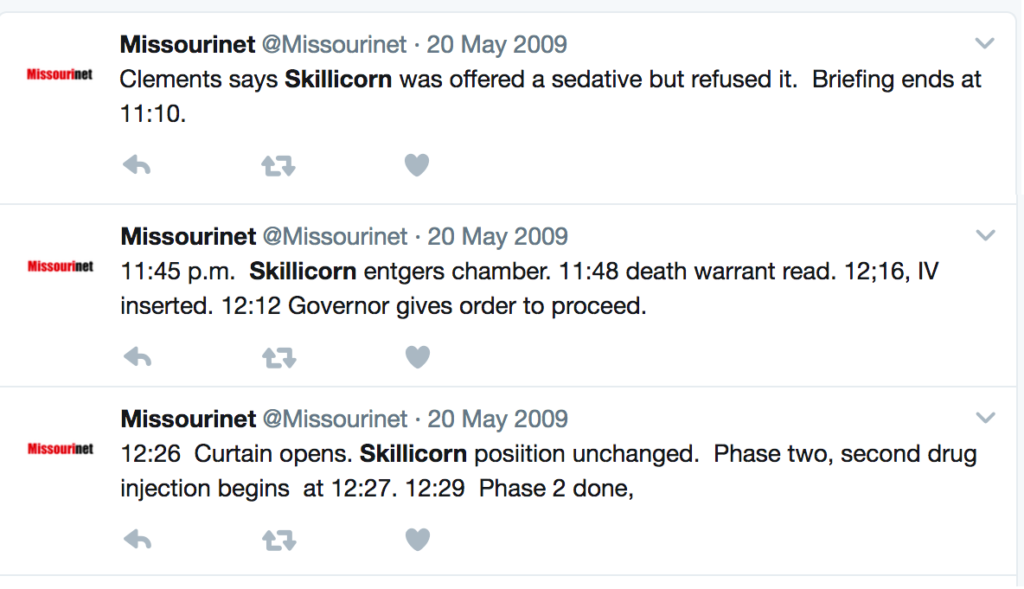
“One of the highlights of our coverage of executions was when I became ( I think) the first reporter in the world who tweeted an execution. Dennis Skillicorn was executed in May, 2009. I could not take anything into the witness room except my notebook and a pen, and the book I had been reading in the waiting room, but I kept a careful chronology and as soon as we came out, I posted tweets on a minute-by-minute basis describing the events.

I stopped using Twitter in November of 2016 because it had become toxic with politics.

William Gibson interview

William Gibson fans will want to read this short interview by Business Insider. Mr. Gibson talks about ‘The Peripheral,’ the power of Twitter, and his next book set in today’s Silicon Valley.

“I am able to wake up, open Twitter, and sort of glance across the psychic state of the planet.”

What does a writer do when the world gets weirder faster than you can write about it?

“…he world is already that much weirder than it was when I started writing the book. You know the level of freakiness we have experienced in 2016 is so far off the charts, I am having to go back and crank up the weirdness in parts of the book I have already written.”

And it’s only August. Worried about the Middle East? Don’t be.

“And then I see NASA’s climate projection for the Middle East in 2050 or so, when they say none of it will be livable by human beings who don’t have space suits.”

A word or two about how I use Twitter

Far and away my first source for news. I’ve been on Twitter since early 2007. The first place I look in the morning and last thing I check before hitting the hay.

The 140 character limit is still my favorite feature and I hope that never changes. I follow 145 people but am continuously pruning and tweaking that list. I follow a few friends but most of my favorite tweeters are authors, reporters and publications.

To the extent I am able to tell, I only follow people who appear to be composing their own tweets. I like links to useful and interesting stuff. I avoid anonymous accounts. Before adding an account, I take a look at their profile page and read some of their tweets. If they don’t tweet with some regularity, I don’t add. If their tweets are mean, racists or sexist… no add.

I keep hearing that Twitter is in trouble. If it ever goes away it will leave a big hole in the internet. For some of us. For a while at least. In conclusion, I’d say Twitter is only as good as the people you follow and the time you spend in curating that list.

What your tweets say about you

In my experience, people are about as quick to pee on Twitter as Facebook. But I’m a longtime user of Twitter and spend as much time following my finely curated list as I do hanging at on G+. And I’ve long suspected a person’s tweets say something about them. This essay by Maria Konnikova in the New Yorker seems to confirm that suspicion:

AnalyzeWords, one of the latest creations from James Pennebaker, a psychologist at the University of Texas who studies how language relates to well-being and personality. One of Pennebaker’s most famous projects is a computer program called Linguistic Inquiry and Word Count (L.I.W.C.), which looks at the words we use, and in what frequency and context, and uses this information to gauge our psychological states and various aspects of our personality. Since the creation of the L.I.W.C., in 1993, studies utilizing the program have suggested a close connection between our language, our state of mind, and our behavior.

So I plugged in my Twitter handle and you can see the results below. Additional nuggets from the essay:

For decades, Pennebaker’s studies have shown that when people keep a journal they tend to fare better emotionally, recover more quickly from negative experiences, and achieve more academically and professionally. Other recent work suggests that social media provides the same benefits, despite the fact that, unlike a journal, it’s inherently public.

And one more:

Counties where residents’ tweets included words related to hostility, aggression, hate, and, fatigue—words such as “asshole,” “jealous,” and “bored”—had significantly higher rates of death from atherosclerotic heart disease, including heart attacks and strokes. Conversely, where people’s tweets reflected more positive emotions and engagement, heart disease was less common. The tweet-based model even had more predictive power than other models based on traditional demographic, socioeconomic, and health-risk factors.

Why Twitter and Facebook users don’t get Google+

In this Computerworld article, Mike Elgan explains why Twitter and Facebook users don’t get Google+.

In general, Twitter is dominated by news, celebrities, pundits, professionals and narcissists. Facebook is mostly about family and friends. And narcissists. And each social network draws people who are seeking the type of engagement a particular network specializes in. That’s why Twitter and Facebook people don’t get Google+.

They’ve tried it. The Twitter people come to Google+ looking for Twitter type engagement, but they don’t find it. Likewise, the Facebook people come looking for Facebook-like engagement (family and friends) and don’t find it.

It’s like a Chinese tourist going to France looking for Chinese food and concluding that the food in France is terrible. Or a Hawaiian surfer bringing her surfboard to New York City and, finding no waves, concluding that there’s nothing to do in Manhattan.

I’m an active Twitter user but I don’t expect (or need) any engagement there. It’s a source for news. Don’t do Facebook because I don’t have much in common with “friends and family” other than they are friends and family. Most of my online time is now spent on Google+. I post here mostly for archival reasons.