
Diggnation in St. Louis

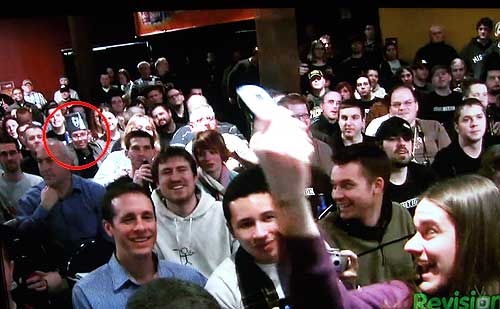
Me and a couple of pals drove over to St. Louis this week and stood in line in the bitter cold for most of an hour to watch a taping of Diggnation. If you’re not familiar with Diggnation, think Wayne’s World for the Internet with lots of beer. And in this case, a live audience of 300+ screaming, twenty-something fans. Almost all male. I’ve seen less rowdy hockey crowds.

I found this video of the pre-show (we had much better seats) on Digg (appropriately enough). As I watched the taping, I had the sense we were seeing a new kind of entertainment for a new audience. This is not your father’s TV. Freed from the constraints of networks and the FCC, the hosts can guzzle beer and say whatever comes to mind. And the crowd was very much part of the show.
Doc: “The only real social works are personal ones”

So says Doc Searls. I’ve been waiting for someone smarter than I to put into words my “issues” with social networks (Facebook, My Space, etc). The focus of this post is the effort by companies to use social networks for marketing.

“…today’s “social networks” look to me like yesterday’s online services. Remember AOL, Prodigy, Compuserve and the rest? Facebook to me is just AOL done right. Or done over, better. But it’s still a walled garden. It’s still somebody’s private space. Me, I’d rather take it outside, where the conversation is free and open to anybody.”

“…the thing companies need to do most is stop being all “strategic” about how their people communicate. Stop running all speech through official orifices. Some businesses have highly regulated speech, to be sure. Pharmaceuticals come to mind. But most companies would benefit from having their employees talk about what they do. Yet there are still too many companies where employees can’t say a damn thing without clearing it somehow. And in too many companies employees give up because the company’s communications policy is modeled on a fort, complete with firewalls that would put the average dictatorship to shame. If a company wants to get social, they should let their employees talk. And trust them.”

What he said. Truth be told, the company I work for has “highly regulated speech.” And no shortage of good reasons for it, but I agree (with Doc) that we would be stronger if our employees could “talk about what they do.” There’s more to the post than the graphs I pulled. Read it if you’re interested in social networks.

Podcast Audience Continues To Grow

The Diffusion Group reports that, based on their latest research, 11% of adult broadband users (some 12 million US consumers) listen to podcasts at least once per month. They also predict that the podcast audience will more than double in the next five years, to 24% of broadband users (38.5 million Americans) by 2012. [Podcasting News]

Clear Channel launches social networking sites

“Radio giant Clear Channel is getting into the social networking business. The company’s online music and radio division is introducing a dozen station-branded social networks in the coming months. Each social network will function essentially as mini-MySpace, but will be focused on the local community served by the station running it.

Not only can Clear Channel monetize the sites with targeted online spots from local advertisers, he says but also people using the networks have a better chance of making lasting connections with other users because they will share more regional affiliations. By contrast other social networks are focused on national and even international audiences.

Each social network will have a user experience similar to MySpace, Facebook, Bebo and others offer. Users can create profiles, customize them with HTML codes and widgets, upload photos, music and video, blog, and add friends. Users will also be able to customize their profile pages with videos from Clear Channel’s catalog of over 6,000 music videos licensed from major and independent labels.”

— Billboard

Why social media is important to marketers

I don’t know how old this info is (or how accurate) because I can’t find the original post, which is somewhere on the Church of the Customer Blog. Bart Cleveland includes these factoids in a recent post at Small Agency Diary (AdAge.com) to underscore why social media is important to marketers:

  • By March 2006, 84 million Americans had broadband at home, a 40% jump from 2005 figures
  • By March 2006, Pew estimated 48 million Americans were regular online content creators
  • By the end of 2005, 139 million people in the world had a DSL (broadband) connection
  • In 2005, $6.7 billion worth of digital cameras were sold in the U.S.
  • About 41% of all cell phone owners use them as content tools
  • By the end of 2005, just over 1 billion people were online — that’s 1/6th of the world
  • Asia represents the world’s most populous online segment
  • By July 2006, 50 million blogs had been created and their number was doubling every 6 months
  • About 7,200 new blogs are created every hour
  • By 2006, 10 million people were listening to podcasts in 2006; by 2010, it’s expected to be 50 million people
  • About 100 million videos are viewed every day on YouTube; about 65,000 videos uploaded every day
  • In 2006, MySpace had over 100 million registered members, most of them from the U.S.

Podcasting candidate endorsements

Just listened to the latest podcast from the Missouri State Teachers Association. They call it The Pulse. Co-hosts Todd Fuller Gail McCray broke a little digital ground (I’m guessing) by using the podcast to announce the canidates the MSTA is endorsing in the November election. They spent the first part of the podcast explaining how their endorsement process works. Then they mentioned a few specific endorsements and pointed the listener back to their website for the full list of candidates.

Why do I think this is worth a post? As I listened to Todd and Gail explain this process, I kept thinking they would NEVER get airtime (radio or TV) for that kind of “deep dive.” But it’s important to their audience (teachers, candidates). And by using their podcast to make the announcement, it raises awareness of their podcast. (You now know about it because you read this blog which has nothing to do with education or politics.)

If you want to see/hear how to do an “association podcast,” check out MSTA’s The Pulse.

9/11 and the Dawn of Video Citizen Journalism

I made a conscious –or unconscious– effort to not think about the attack on the World Trade Center Towers. I didn’t think I could stand to watch the video again. This evening I stumbled across never-before-seen video shot from 500 yards away and 36 floors up. I can’t think of any words to describe this video. I could not look away. It was somehow more horrible and more compelling without the mindless chatter of news goofs telling us what we are seeing.

Steve Rubel (I found this on his blog) says we should watch this that we never forget. There will be no forgetting the anguish in the voice of the woman shooting the video when the first building collapsed. I can understand why the couple never released the video. And why they finally did.

Forget all the news specials, docu-dramas and made-for-TV movies. This amazing account will sear your brain and break your heart. It’s a long download but, as Steve says, something you should see.

Seth Godin on comments

“I think comments are terrific, and they are the key attraction for some blogs and some bloggers. Not for me, though. First, I feel compelled to clarify or to answer every objection or to point out every flaw in reasoning. Second, it takes way too much of my time to even think about them, never mind curate them. And finally, and most important for you, it permanently changes the way I write. Instead of writing for everyone, I find myself writing in anticipation of the commenters.”

—  Seth Godin blog post


Robert Scoble: The value of “influencers”

“I’ll tell you what executives from big companies (like Kraft, Procter and Gamble, GM, and others) who were at MSN’s OWN ADVERTISING CONFERENCE told me. An influencer is worth THOUSANDS of times more than a non-influencer (influencer is someone who tells other people stuff, which is why blogging is getting so much advertising attention lately). That’s why Google is charging more per click than MSN is (Google has more influential users).”

— Robert Scoble via Gaping Void