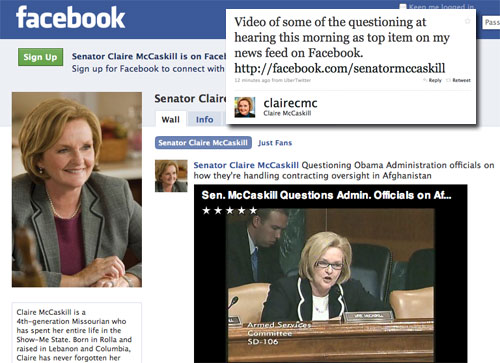
“My news feed on Facebook”

“Your honor, the defense will stipulate that Senator McCaskill’s Facebook page is in no way an act of journalism and might be self-serving and total horse shit.”

“So noted. The page will be entered as Exhibit F.”

facebook-twitter

Something about “my news feed on Facebook” made me stop. Politicians have been grinding out news releases since the dawn of time but same-day video news feeds? My natural instinct is to scoff at the idea of a “news feed” by a politician. But do I trust the senator more or less than Fox News? Hmm.

I’m old enough to remember when just being on TV meant you were honest and trust-worthy. Now whom do we trust?

My point here is that from now on, we’ll get the “news” from lots of people in lots of ways. Trust will trump the medium.

Social Media ROI

The one quote that jumped out at me was attributed to Alex Bogusky, Co-Chairman, CP&B:

“You can’t buy attention anymore. Having a huge budget doesn’t mean anything in social media… The old media paradigm was PAY to PLAY. Now you get back what you authentically put in. You’ve got to be willing to PLAY to PLAY.”

“How Twitter is changing the face of media”

This post by Soren Gordhamer (at Mashable.com) resonates for those of us who followed/participated in the “reporting” of “the hostage situation that wasn’t” here in Jefferson City.

“Sure, in the past, you could always email or call a friend to inform him or her of a quality news story or TV show; now, however, in a matter of seconds you can share this information on your broadcasting network via Twitter or Facebook, with tens, hundreds, or even thousands of people. It’s not my or your media anymore; it’s our media, and we can all broadcast it.” [Emphasis mine]

“In the past, what people thought of as “news” was what was reported that day in the New York Times or CNN. In an age where we all possess our own broadcasting network, though, smaller stations have greater power. Of course, a post on Twitter from CNN, which has over two million followers, will get more views than one from Joe Smith who has 20 followers will, but Joe Smith is at least in the game now, where he was not previously.”

“In the new media landscape, the task of defining what is the news that matters to people lies less with a few major media outlets, and much more with the millions of small outlets like you and I who each choose what to talk about. Increasingly, lots of littles, in aggregate, are becoming more powerful than a handful of bigs.” [Emphasis mine]

“Media is also becoming more personal. More and more people expect their broadcasting networks to be people with personalities, not simply sources of news. We want to know as much about the person reporting news as we do the news they are reporting. [Emphais mine] Broadcasting is more a personal act than ever, as users seek to have connections not just to content but to people.”

Mr. Gordhamer is the author of the book, Wisdom 2.0 and the organizer of the Wisdom 2.0 Conference.

Do you need a “website?

My pals at the local yoga center have been asking for my advice on re-doing their website. Since my advice is free, I don’t have to worry too much about it being good advice. But if I were doing this and didn’t have to answer to a committee (or Vishnu) I think I might go in this direction. (Nothing original here, BTW. Regular readers know who my influences are)

Don’t make people come to you (or your website). Take your information to where they are: Facebook, Twitter, YouTube, Flickr, etc.

I like posterous for feeding these social nodes. And it gives you a nice, clean, low-maintenance “place” to park your domain.

“All spokes and no hub”

Steve Rubel suggests the next big media company won’t have a website:

“Conceivably the next great media company will be all spokes and no hub. It will exist as a constellation of connected apps and widgets that live inside other sites and offer a full experience plus access to your social graph and robust community features. Each of these may interconnect too so that a media company’s community on Facebook can talk to the same on Twitter.

Facebook might be the first venue where this starts. It could become a mini news reader for millions who don’t care about RSS or Twitter. Over time this may obviate the need to create large news sites. It’s easier to create a rich interactive experience there than start a new news site and hope that people come to you. They won’t have time to find or visit.”

“The audience is being assembled by the audience”

NYU professor and Internet thinker Clay Shirky on the future of accountability journalism in a world of declining newspapers. On the advertising-based business model of journalism:

“Best Buy was not willing to support the Baghdad bureau because Best Buy cared about news from Baghdad. They just didn’t have any other good choices.”

On the death of the home page:

“The number of people who go to the Times’ homepage as a percentage of total readership falls every year — because you don’t go to the Times, you go to the story, because someone Twittered it or put it on Facebook or sent it to you in email. So the audience is now being assembled not by the paper, but by other members of the audience.”

You can listen to Professor Shirky’s talk here.

“Advertising Agencies and Social Media: A Culture Clash”

For some years I have sensed a fundamental shift in how we –the consuming public– feel about advertising. The following is from a post by Jason Falls. [Alas, the original post is gone.] I was tempted to just repost the piece in its entirety. He begins with the philosophical differences between advertising and social media:

“Social media is, in many ways, the antithesis of advertising. Advertising is one-way communications aimed at large groups of consumers. Social media is two-way communications that requires listening as well as speaking. It can also be said that social media is a multiple-way communications method as brands can speak and listen, but also watch other consumers talk to each other. An agency’s creatives and strategic planners suddenly having to factor in listening and observing to their communications process after decades of just shouting from the roof tops presents a seismic culture shift.

Social media is also about building relationships. Advertising is about driving people to a buying decision. In fact, I would propose that in most cases, advertising has nothing to do with a relationship. It’s all about persuading someone to take action, not discussing the decision-making process and becoming a trusted resource for the person choosing. As Chris Heuer says, good marketing today doesn’t try to sell the customer on something. It tries to help them buy it.

Similarly, it can be said that the essence of social media, in many ways, is good customer service. I would propose that, with exceptions certainly, advertising agencies have never cared about serving the customer. They care about making the sale. Advertising is most often used to drive customers to purchase, not care for them after the fact.

So, philosophically, advertising and social media are very different. Creatives, client services folks, account planners and the like are being asked to undertake a new method of communications that runs counter to everything they’ve ever been taught.”

A small shop within our company has been providing social media services to clients for a couple of years and it immediately became clear to us why advertising agencies weren’t keen on producing social media content for their clients. Again, Mr. Falls:

“Content creation also doesn’t scale well and is problematic for billing. Let’s say you have 20 brands producing social media content and you hire two people to produce that content. Depending upon the brand, audience and strategy, if they’re doing a good job, they’re producing an average of a blog post, Facebook content, several Tweets and perhaps video, images or some other type of content for each client every day. Can you write 10 blog posts in a day?

And how about this billing scenario: Let’s say a full-time agency employee producing content for a client is working 10 hours per week on that client’s social media efforts. They’re billed out at roughly $75 per hour. At that rate, which is conservative in price and volume, you’re billing $36,000 per year for their services as an agency. At the same time, you can go out and pay free-lance bloggers $25 per post (and that’s on the high end in most circumstances) and produce a similar volume of content for $6,500 per year (a blog post per day, five days per week, which is an aggressive clip for many agencies). How will you answer your client when they call you with a big, “WTF?”

If you are remotely involved in “old media” and/or advertising, I encourage you to read Mr. Fall’s complete post.

Seperating the Twitter wheat from the chaff

I think I mentioned trying TwitBlock.org, a website that scans your Twitter followers and ranks them for “spamminess.” Higher the score, more likely to be spam. Looks at things like how many people you foll0w, how many times you’ve tweeted, and so forth. It’s not perfect but it’s better than nothing. And my rule of thumb is, “When in doubt… block.”

I’ve heard from one acquaintance who wanted to know why I blocked him. I unblocked and the pot’s right now. But there are sure to be more. Just ping me.