War by Sebastian Junger

Sebastian Junger was recently a guest on The Daily Show but you really don’t get much of a feel for a book (or the author) from those segments. Not sure why I picked up War but it’s hard to put down.

The war in Afghanistan seems very… abstract to me. I know it’s going on and people are dying (although we see almost no images of that) but it doesn’t seem real. Junger’s book (and the documentary, I assume) makes it seem very real.

I can’t tell if Junger has any views about whether the war is right or wrong or if that’s even a relevant question from the perspective the people fighting it. But his account makes it difficult to imagine anything like “winning.”

“The fact that networks of highly mobile amateurs can confound –even defeat– a professional army is the only thing that has prevented empires from completely determining the course of history. You can’t predict the outcome of a war simply by looking at the numbers.” – page 83

“The moral basis of the war doesn’t seem to interest soldiers much, and its long-term success or failure has a relevance of almost zero. Soldiers worry about those things about as much as farmhands worry about the global economy, which is to say, they recognize stupidity when it’s right in front of them but they generally leave the big picture to others.” – page 25

“…at one mile out (an) aircraft carrier is the size of a pencil eraser held at arm’s length. The plane covers that distance in thirty-six seconds and must land on a section of flight deck measuring seven yards wide and forty-five yards long.” – page 34

“…he joined the Army because he was tired of partying and living at this mother’s house, and now he’s behind sandbags on a hilltop in Afghanistan getting absolutely rocked.” – page 67

“Once while leaning against some sandbags I was surprised to feel some dirt fly in my face. It didn’t make any sense until I heard the gunshots a second later. How close was that round? Six inches? A foot?” – page 71

“It certainly isn’t beautiful up there, but the fact that it might be the last place you’ll ever see does give it a kind of glow.” – page 71

“The problem with fear, though, is that it isn’t any one thing. Fear has a whole taxonomy — anxiety, dread, panic, foreboding — and you could be braced for one form and completely fall apart facing another.” – page 73

“If I had any illusions about personal courage, they dissolved in the days or hours before something big, dread accumulating in my blood like some kind of toxin until I felt too apathetic to even tie my boots properly.” – page 74

“There are different kinds of strength, and containing fear may be the most profound, the one without which armies couldn’t function and wars couldn’t be fought (God forbid).” – page 74

“…an enormous amount of war-fighting simply consists of carrying heavy loads uphill.” – page 75

“If you’re not prepared to walk for someone you’re certainly not prepared to die for them, and that goes to the heart of whether you should even be in the platoon.” – page 77

“(He) had some kind of crazy redneck strength that was more like hydraulics than musculature.” – page 75

“The fact that networks of highly mobile amateurs can confound –even defeat– a professional army is the only thing that has prevented empires from completely determining the course of history. You can’t predict the outcome of a war simply by looking at the numbers.” – page 83

A “Vietnam moment” was one in which you weren’t so much getting misled as getting asked to participate in a kind of collective wishful thinking.” – page 132

“…much of modern military tactics is geared toward maneuvering the enemy into a position where they can essentially be massacred from safety. It sounds dishonorable only if you imagine that modern war is about honor; it’s not. It’s about winning, which means killing the enemy on the most unequal terms possible. Anything less simply results in the loss of more of your own men.” – page 140

“The enemy now had a weapon that unnerved the Americans more than small-arms fire ever could: random luck. Every time you drove down the road you were engaged in a twisted existential exercise where each moment was the only proof you’d ever have that you hadn’t been blown up the moment before.” – page 142

“War is a lot of things and it’s useless to pretend exciting isn’t one of them. It’s insanely exciting. The machinery of war and the sound it makes and the urgency of its use and the consequences of almost everything about it are the most exciting things anyone engaged in war will ever know.”

“War is supposed to feel bad because undeniably bad things happen in it, but for a nineteen-year-old at the working end of a .50 cal during a firefight that everyone comes out of okay, war is life multiplied by some number that no one has ever heard of.” – page 144
“The moral basis of the war doesn’t seem to interest soldiers much, and its long-term success or failure has a relevance of almost zero. Soldiers worry about those things about as much as farmhands worry about the global economy, which is to say, they recognize stupidity when it’s right in front of them but they generally leave the big picture to others.” – page 25

“…at one mile out (an) aircraft carrier is the size of a pencil eraser held at arm’s length. The plane covers that distance in thirty-six seconds and must land on a section of flight deck measuring seven yards wide and forty-five yards long.” – page 34

“…he joined the Army because he was tired of partying and living at this mother’s house, and now he’s behind sandbags on a hilltop in Afghanistan getting absolutely rocked.” – page 67

“Once while leaning against some sandbags I was surprised to feel some dirt fly in my face. It didn’t make any sense until I heard the gunshots a second later. How close was that round? Six inches? A foot?” – page 71

“It certainly isn’t beautiful up there, but the fact that it might be the last place you’ll ever see does give it a kind of glow.” – page 71

“The problem with fear, though, is that it isn’t any one thing. Fear has a whole taxonomy — anxiety, dread, panic, foreboding — and you could be braced for one form and completely fall apart facing another.” – page 73

“If I had any illusions about personal courage, they dissolved in the days or hours before something big, dread accumulating in my blood like some kind of toxin until I felt too apathetic to even tie my boots properly.” – page 74

“There are different kinds of strength, and containing fear may be the most profound, the one without which armies couldn’t function and wars couldn’t be fought (God forbid).” – page 74

“…an enormous amount of war-fighting simply consists of carrying heavy loads uphill.” – page 75

“If you’re not prepared to walk for someone you’re certainly not prepared to die for them, and that goes to the heart of whether you should even be in the platoon.” – page 77

“(He) had some kind of crazy redneck strength that was more like hydraulics than musculature.” – page 75

“The fact that networks of highly mobile amateurs can confound –even defeat– a professional army is the only thing that has prevented empires from completely determining the course of history. You can’t predict the outcome of a war simply by looking at the numbers.” – page 83

A “Vietnam moment” was one in which you weren’t so much getting misled as getting asked to participate in a kind of collective wishful thinking.” – page 132

“…much of modern military tactics is geared toward maneuvering the enemy into a position where they can essentially be massacred from safety. It sounds dishonorable only if you imagine that modern war is about honor; it’s not. It’s about winning, which means killing the enemy on the most unequal terms possible. Anything less simply results in the loss of more of your own men.” – page 140

“The enemy now had a weapon that unnerved the Americans more than small-arms fire ever could: random luck. Every time you drove down the road you were engaged in a twisted existential exercise where each moment was the only proof you’d ever have that you hadn’t been blown up the moment before.” – page 142

“War is a lot of things and it’s useless to pretend exciting isn’t one of them. It’s insanely exciting. The machinery of war and the sound it makes and the urgency of its use and the consequences of almost everything about it are the most exciting things anyone engaged in war will ever know.”

“War is supposed to feel bad because undeniably bad things happen in it, but for a nineteen-year-old at the working end of a .50 cal during a firefight that everyone comes out of okay, war is life multiplied by some number that no one has ever heard of.” – page 144
Cognitive Surplus

From Amazon: “For decades, technology encouraged people to squander their time and intellect as passive consumers. Today, tech has finally caught up with human potential. In Cognitive Surplus, Internet guru Clay Shirky forecasts the thrilling changes we will all enjoy as new digital technology puts our untapped resources of talent and goodwill to use at last.”

A few of my highlighted excerpts from Cognitive Surplus by Clay Shirky (more after the jump).

“The postwar trends of emptying rural populations, urban growth, and increased suburban density, accompanied by rising educational attainment across almost all demographic groups, have marked a huge increase in the number of people paid to think or talk, rather than to produce or transport objects.” – page 4

“Someone born in 1960 has watched something like fifty thousand hours of TV already, and many watch another thirty thousand hours before she dies.” – page 6

“…in the whole of the developed world, the three most common activities are now work, sleep, and watching TV.” – page 6

“Americans watch roughly two hundred billion hours of TV every year. … We spend roughly a hundred million hours every weekend just watching commercials.” – page 10

“As long as the assumed purpose of media is to allow ordinary people to consume professionally created material, the proliferation of amateur-created stuff will seem incomprehensible.” – page 19

“Imagine that everything says 99 percent the same, that people continue to consume 99 percent of the television they used to, but 1 percent of that time gets carved out for producing and sharing. The connected population still watches well over a trillion hours of TV a year; 1 percent of that time is mor than one hundred Wikipedias’ worth of participation per year.” – page 23

“In 2010 the global internet-connected population will cross two billion people, and mobile hone accounts already number over three billion. Since there are something like 4.5 billion adults worldwide (roughly 30 percent of the global population is under fifteen), we live, for the first time in history, in a world where being part of a globally interconnected group is the normal case for most citizens.” – page 23

Continue reading

Fictional passwords : The Girl Who Kicked the Hornet’s Nest by Stieg Larsson

I’m reading The Girl Who Kicked The Hornet’s Nest by Stieg Larsson. The final book (Larsson died in 2004) featuring Lisbeth Salander, ” the best hacker in Sweden.” I’m not spoiling anything by sharing this passage of what has to be one of the more secure log-in’s:

“She started by going to a website that advertised rather uninteresting pictures by an unknown and not especially skilled amateur photographers named Gil Bates in Jobsville, Pennsylvania. Salander had once checked it out and confirmed that the town of Jobsvile did not exist. Nevertheless, Bates had taken more than 200 photographs of the community and created a gallery of small thumbnails. She scrolled down to image 167 and clicked to enlarge it. It showed the church in Jobsville. She put her cursor on the spire of the church tower and clicked. She instantly got a pop-up dialog box that asked for her ID and password. She took out her stylus and wrote the word Remarkable on the screen as her ID and A(89)Cx#magnolia as the password.

She got a dialog box with the text [Error–you have the wrong password] and a button that said [OK–try again]. Lisbeth knew that if she clicked on [OK–try again] and tried a different password, she would gt the same dialog box again–for years and years, for as long as she kept trying. Instead she clicked on the ‘o’ in Error.

The screen went blank. Then an animated door opened and a Lara Croft-like figure stepped out. A speech bubble materialized with the text [WHO GOES THERE?]. She clicked on the bubble and wrote Wasp. She got the instant reply [PROVE IT–OR ELSE…] as the animated Lara Croft unlocked the safety catch on her gun. Salander knew it was no empty threat. If she entered the wrong password three times in a row the site would shut down and the name Wasp would be struck from the membership list.”

Which reminded me of this password (to the CIA database) from the novel, Bangkok Tattoo:

AQ82860136574X-Halifax nineteen [lowercase] Oklahoma twenty-2 BLUE WHALE [all uppercase] Amerika stop 783

Decoding Reality: The Universe as Quantum Information

I confess the title of this book hooked me. I saw an interview with Oxford professor Vlatko Vedral and was intrigued by the idea that everything (me and the universe) can be reduced to bits of information. (Wikipedia)

But I can’t say I enjoyed (or understood) most of the book. I suspect he knows his stuff but just isn’t very good at explaining it to non-phyicists. Better reads: Quantum Enigma; Biocentrism.

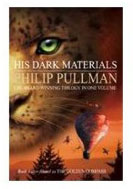
His Dark Materials

Just finished Northern Lights, the first book in the His Dark Materials trilogy by Phillip Pullman. As we used to say back in the sixties, “Heavy.”

I’ve caught parts of The Golden Compass (the book’s North American title) on cable and wanted to see how the movie compared to the novel. Very well, it turns out. I’m eager to get on to Books 2 and 3.

I enjoyed most of the Harry Potter books –and it’s probably unfair to compare the two– but Pullman challenges readers in a way that Ms. Rowling never did.

Definitely on the short list for the next church bonfire.

UPDATE: Finished the third book today and I’m a little numb. I read somewhere that Pullman wrote the book for “young adults.” I’m not sure what that means… teenagers? Younger? Whatever, I wish I had read the book in my teens, although I’m not sure how much I would have understood. Maybe that’s the point.

I thought it was a terrific story. Life and Death; Sin and Redemption; Good and Evil; Witches and Angles. And a less-than-attractive view of religion in general and the Catholic Church in particular. Easy to see why they weren’t keen on a sequel to The Golden Compass.

If you learned everything you needed to know in Sunday School, you can skip this book but I found the book to be very spiritual and mostly uplifting. A couple of quotes:

“I felt as if something they all passionately believed in depended on me carrying on with something I didn’t.” pg 954

“We’ll be alive again in a thousand blades of grass, and a million leaves, we’ll be falling in the raindrops and blowing in the fresh breeze, we’ll be glittering in the dew under the stars and moon out there in the physical world which is our true home and always was.” pg 854

“If you wanted to divert a mighty river into a different course, and all you had was a single pebble, you could do it as long as you put the pebble in the right place to send the first trickle of water that way instead of this.”

Cryptonomicon: Wisdom teeth

I don’t know when I read Neal Stephenson’s Cryptonomicon for the first time. My first post here was back in 2003. I linked to a horrifying (to me) passage that deserves an encore.

Wisdom. A few years ago, when Randy became tired of the ceaseless pressure in his lower jaw, he went out onto the north-central Californian oral-surgery market looking for someone to extract wisdom teeth. His health plan covered this, so price was not an obstacle. His dentist took one of those big cinemascopic wraparound X-rays of his entire lower head, the kind where they pack your mouth with half a roll of high-speed film and then clamp your head in a jig and the X-ray machine revolves around you spraying radiation through a slit, as the entire staff of the dentist’s office hits the deck behind a lead wall, resulting in a printed image that is a none-too-appetizing distortion of his jaw into a single flat plane. Looking at it, Randy eschewed cruder analogies like “head of a man run over several times by steamroller while lying flat on his back” and tried to think of it as a mapping transformation—just one more in mankind’s long history of ill-advisedly trying to represent three-D stuff on a flat plane. The corners of this coordinate plane were anchored by the wisdom teeth themselves, which even to the dentally unsophisticated Randy looked just a little disturbing in that each one was about the size of his thumb (though maybe this was just a distortion in the coordinate transform—like the famously swollen Greenland of Mercator) and they were pretty far away from any other teeth, which (logically) would seem to put them in parts of his body not normally considered to be within a dentist’s purview, and they were at the wrong angle—not just a little crooked, but verging on upside down and backwards. At first he just chalked all of this up to the Greenland phenomenon. With his Jaw-map in hand, he hit the streets of Three Siblings-land looking for an oral surgeon. It was already beginning to work on him psychologically. Those were some big-ass teeth! Brought into being by the workings of relict DNA strands from the hunter- gatherer epoch. Designed for reducing tree bark and mammoth gristle to easily digestible paste. Now these boulders of living enamel were horrifyingly adrift in a gracile cro-magnon head that simply did not have room for them. Think of the sheer extra weight he had been carrying around. Think of the use that priceless head-real-estate could have been put to. When they were gone, what would fill up the four giant molar—shaped voids in his melon? It was moot until he could find someone to get rid of them. But one oral surgeon after another turned him down. They would put the X-ray up on their light boxes, stare into it and blanch. Maybe it was just the pale light coining out of the light-boxes but Randy could have sworn they were blanching. Disingenuously—as if wisdom teeth normally grew someplace completely different—they all pointed out that the wisdom teeth were buried deep, deep, deep in Randy’s head. The lowers were so fir back in his jaw that removing them would practically break the jawbone in twain structurally; from there, one fuse move would send a surgical-steel demolition pick into his middle ear. The uppers were so deep in his skull that the roots were twined around the parts of his brain responsible for perceiving the color blue (on one side) and being able to suspend one’s disbelief in bad movies (on the other) and between these teeth and actual air, light and saliva lay many strata of skin, meat, cartilage, major nerve-cables, brain-feeding arteries, bulging caches of lymph nodes, girders and trusses of bone, rich marrow that was working just fine thank you, a few glands whose functions were unsettlingly poorly understood, and many of the other things that made Randy Randy, all of them definitely filing into the category of sleeping dogs.

Continue reading

Biocentrism

I’m reading a mind-stretching book. Biocentrism by Robert Lanza (with Bob Berman). I wouldn’t know where to begin describing what this book is about. Like John Sebastian said, “it’s like trying to tell a stranger ’bout rock and roll.”
The authors are very good at explaining the most complex concepts. Here’s a little riff on Time:
“Imagine that existance is like a sound recording. Listening to an old phonograph doesn’t alter the recording itself, and depending on wherethe needle is placed, you hear a certain piece of music. This is what we all the present. The music, before and after the song now being heard, is what we call the past and the future. Imagine, in like manner, ever moment and day enduring in nature always. The record does not go away. All nows (all the songs on the record) exist simultaneously, although we can only experience the world (or the record) piece by piece. We do not experience time in which “Stardust” often plays, because we experience time linearly.”
This book is not for everyone. If you have too much “reality” in you life to think about the possibility it’s all “in your head,” you can take a pass on Biocentrism. But it will get a spot on my nightstand as one of those books I’ll have to read again and again.

Screen shot 2009-12-14 at Mon, Dec 14, 8.15.12 PMI’m reading a mind-stretching book. Biocentrism by Robert Lanza (with Bob Berman). I wouldn’t know where to begin describing what this book is about. Like John Sebastian said, “it’s like trying to tell a stranger ’bout rock and roll.”

The authors, however, are very good at explaining the most complex concepts. Here’s a little riff on Time:

“Imagine that existence is like a sound recording. Listening to an old phonograph doesn’t alter the recording itself, and depending on where the needle is placed, you hear a certain piece of music. This is what we call the present. The music, before and after the song now being heard, is what we call the past and the future. Imagine, in like manner, every moment and day enduring in nature always. The record does not go away. All nows (all the songs on the record) exist simultaneously, although we can only experience the world (or the record) piece by piece. We do not experience time in which “Stardust” often plays, because we experience time linearly.”

This book is not for everyone. If you have too much “reality” in you life to think about the possibility it’s all “in your head,” you can take a pass on Biocentrism. But it will get a spot on my nightstand as one of those books I’ll have to read again and again.

Scott Adams: The building blocks of God

“Humanity is developing a sort of global eyesight as millions of video cameras on satellites, desktops, and street corners are connected to the Internet. In your lifetime, it will be possible to see almost anything on the planet from any computer. And society’s intelligence is merging over the Internet, creating, in effect, a global mind that can do vastly more than any individual mind. Eventually everything that is known by one person will be available to all. A decision can be made by the collective mind of humanity and instantly communicated to the body of society.

A billion years from now, if a visitor from another dimension observed humanity, he might perceive it to be one large entity with a consciousness and purpose, and not a collection of relatively uninteresting individuals.”

“Are you saying we’re evolving into God?”

“I’m saying we’re the building blocks of  God, in the early stages of reassembling.”

— From God’s Debris: A Thought Experiment, by Scott Adams

Scott Adams: Different Religions

I just finished listening to the audio version of Scott Adams’ first non-Dilbert, non-humor book (2004): God’s Debris: A Thought Experiment. In the introduction, Mr. Adams identifies the target audience as “people who enjoy having their brains spun around inside their skulls.

I’ve read this small book (132 pages) twice before checking out the audio version. And I know I will read this book many more times, trying to wrap my mind around ideas the human brain probably will never grasp. Like religion.

“Imagine that a group of curious bees lands on the outside of a church window. Each bee gazes upon he interior through a different stained glass pane. To one bee, the church interior is all red. To one bee, it is all yellow, and so on. The bees cannot experience the inside of the church directly; they can only see it. They can never touch the interior or smell it or interact with it in any way. If bees could talk they might argue over the color of the interior. Each bee would stick to his version, not capable of understanding that the other bees were looking through different pieces of stained glass. Nor would they understand the purpose of the church or how it got there or anything about it. The brain of a bee is not capable of such things.

“But these are curious bees. When they don’t understand something, they become unsettled and unhappy. In the long run the bees would have to choose between permanent curiosity—an uncomfortable mental state—and delusion. The bees don’t like those choices. They would prefer to know the true color of the church’s interior and its purpose, but bee brains are not designed for that level of understanding. They must choose from what is possible, either discomfort or self-deception. The bees that choose discomfort will be unpleasant to be around and they will be ostracized. The bees that choose self-deception will band together to reinforce their vision of a red-based interior or yellow-based interior and so on.”

“So you’re saying we’re like dumb bees?” I asked, trying to lighten the mood.

“Worse. We are curious.”

What Would Google Do

Jeff Jarvis’ new book, What Would Google Do looks like it might be a two highlighter read. I’ll be posting some of my favorite passages here but encourage you to buy and read the book.

“In retail, media, education, government, and health –everything– the link drives specialization, quality, and collaboration, and it changes old roles and creates new ones. The link changes the fundamental architecture of societies and industries the way steel girders and rails changed how cities and nations were built and how they operated. Google makes links work. Google is the U.S. Steel of our age.” – pg 27, What Would Google Do (Jeff Jarvis)