
Cryptonomicon: Wisdom teeth

I don’t know when I read Neal Stephenson’s Cryptonomicon for the first time. My first post here was back in 2003. I linked to a horrifying (to me) passage that deserves an encore.

Wisdom. A few years ago, when Randy became tired of the ceaseless pressure in his lower jaw, he went out onto the north-central Californian oral-surgery market looking for someone to extract wisdom teeth. His health plan covered this, so price was not an obstacle. His dentist took one of those big cinemascopic wraparound X-rays of his entire lower head, the kind where they pack your mouth with half a roll of high-speed film and then clamp your head in a jig and the X-ray machine revolves around you spraying radiation through a slit, as the entire staff of the dentist’s office hits the deck behind a lead wall, resulting in a printed image that is a none-too-appetizing distortion of his jaw into a single flat plane. Looking at it, Randy eschewed cruder analogies like “head of a man run over several times by steamroller while lying flat on his back” and tried to think of it as a mapping transformation—just one more in mankind’s long history of ill-advisedly trying to represent three-D stuff on a flat plane. The corners of this coordinate plane were anchored by the wisdom teeth themselves, which even to the dentally unsophisticated Randy looked just a little disturbing in that each one was about the size of his thumb (though maybe this was just a distortion in the coordinate transform—like the famously swollen Greenland of Mercator) and they were pretty far away from any other teeth, which (logically) would seem to put them in parts of his body not normally considered to be within a dentist’s purview, and they were at the wrong angle—not just a little crooked, but verging on upside down and backwards. At first he just chalked all of this up to the Greenland phenomenon. With his Jaw-map in hand, he hit the streets of Three Siblings-land looking for an oral surgeon. It was already beginning to work on him psychologically. Those were some big-ass teeth! Brought into being by the workings of relict DNA strands from the hunter- gatherer epoch. Designed for reducing tree bark and mammoth gristle to easily digestible paste. Now these boulders of living enamel were horrifyingly adrift in a gracile cro-magnon head that simply did not have room for them. Think of the sheer extra weight he had been carrying around. Think of the use that priceless head-real-estate could have been put to. When they were gone, what would fill up the four giant molar—shaped voids in his melon? It was moot until he could find someone to get rid of them. But one oral surgeon after another turned him down. They would put the X-ray up on their light boxes, stare into it and blanch. Maybe it was just the pale light coining out of the light-boxes but Randy could have sworn they were blanching. Disingenuously—as if wisdom teeth normally grew someplace completely different—they all pointed out that the wisdom teeth were buried deep, deep, deep in Randy’s head. The lowers were so fir back in his jaw that removing them would practically break the jawbone in twain structurally; from there, one fuse move would send a surgical-steel demolition pick into his middle ear. The uppers were so deep in his skull that the roots were twined around the parts of his brain responsible for perceiving the color blue (on one side) and being able to suspend one’s disbelief in bad movies (on the other) and between these teeth and actual air, light and saliva lay many strata of skin, meat, cartilage, major nerve-cables, brain-feeding arteries, bulging caches of lymph nodes, girders and trusses of bone, rich marrow that was working just fine thank you, a few glands whose functions were unsettlingly poorly understood, and many of the other things that made Randy Randy, all of them definitely filing into the category of sleeping dogs.
Continue reading →

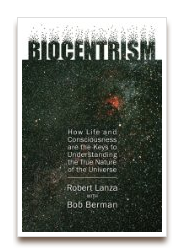
Biocentrism

I’m reading a mind-stretching book. Biocentrism by Robert Lanza (with Bob Berman). I wouldn’t know where to begin describing what this book is about. Like John Sebastian said, “it’s like trying to tell a stranger ’bout rock and roll.”
The authors are very good at explaining the most complex concepts. Here’s a little riff on Time:
“Imagine that existance is like a sound recording. Listening to an old phonograph doesn’t alter the recording itself, and depending on wherethe needle is placed, you hear a certain piece of music. This is what we all the present. The music, before and after the song now being heard, is what we call the past and the future. Imagine, in like manner, ever moment and day enduring in nature always. The record does not go away. All nows (all the songs on the record) exist simultaneously, although we can only experience the world (or the record) piece by piece. We do not experience time in which “Stardust” often plays, because we experience time linearly.”
This book is not for everyone. If you have too much “reality” in you life to think about the possibility it’s all “in your head,” you can take a pass on Biocentrism. But it will get a spot on my nightstand as one of those books I’ll have to read again and again.

Screen shot 2009-12-14 at Mon, Dec 14, 8.15.12 PMI’m reading a mind-stretching book. Biocentrism by Robert Lanza (with Bob Berman). I wouldn’t know where to begin describing what this book is about. Like John Sebastian said, “it’s like trying to tell a stranger ’bout rock and roll.”

The authors, however, are very good at explaining the most complex concepts. Here’s a little riff on Time:

“Imagine that existence is like a sound recording. Listening to an old phonograph doesn’t alter the recording itself, and depending on where the needle is placed, you hear a certain piece of music. This is what we call the present. The music, before and after the song now being heard, is what we call the past and the future. Imagine, in like manner, every moment and day enduring in nature always. The record does not go away. All nows (all the songs on the record) exist simultaneously, although we can only experience the world (or the record) piece by piece. We do not experience time in which “Stardust” often plays, because we experience time linearly.”

This book is not for everyone. If you have too much “reality” in you life to think about the possibility it’s all “in your head,” you can take a pass on Biocentrism. But it will get a spot on my nightstand as one of those books I’ll have to read again and again.

Scott Adams: The building blocks of God

“Humanity is developing a sort of global eyesight as millions of video cameras on satellites, desktops, and street corners are connected to the Internet. In your lifetime, it will be possible to see almost anything on the planet from any computer. And society’s intelligence is merging over the Internet, creating, in effect, a global mind that can do vastly more than any individual mind. Eventually everything that is known by one person will be available to all. A decision can be made by the collective mind of humanity and instantly communicated to the body of society.

A billion years from now, if a visitor from another dimension observed humanity, he might perceive it to be one large entity with a consciousness and purpose, and not a collection of relatively uninteresting individuals.”

“Are you saying we’re evolving into God?”

“I’m saying we’re the building blocks of  God, in the early stages of reassembling.”

— From God’s Debris: A Thought Experiment, by Scott Adams

Scott Adams: Different Religions

I just finished listening to the audio version of Scott Adams’ first non-Dilbert, non-humor book (2004): God’s Debris: A Thought Experiment. In the introduction, Mr. Adams identifies the target audience as “people who enjoy having their brains spun around inside their skulls.

I’ve read this small book (132 pages) twice before checking out the audio version. And I know I will read this book many more times, trying to wrap my mind around ideas the human brain probably will never grasp. Like religion.

“Imagine that a group of curious bees lands on the outside of a church window. Each bee gazes upon he interior through a different stained glass pane. To one bee, the church interior is all red. To one bee, it is all yellow, and so on. The bees cannot experience the inside of the church directly; they can only see it. They can never touch the interior or smell it or interact with it in any way. If bees could talk they might argue over the color of the interior. Each bee would stick to his version, not capable of understanding that the other bees were looking through different pieces of stained glass. Nor would they understand the purpose of the church or how it got there or anything about it. The brain of a bee is not capable of such things.

“But these are curious bees. When they don’t understand something, they become unsettled and unhappy. In the long run the bees would have to choose between permanent curiosity—an uncomfortable mental state—and delusion. The bees don’t like those choices. They would prefer to know the true color of the church’s interior and its purpose, but bee brains are not designed for that level of understanding. They must choose from what is possible, either discomfort or self-deception. The bees that choose discomfort will be unpleasant to be around and they will be ostracized. The bees that choose self-deception will band together to reinforce their vision of a red-based interior or yellow-based interior and so on.”

“So you’re saying we’re like dumb bees?” I asked, trying to lighten the mood.

“Worse. We are curious.”

Jeff Jarvis: What Would Google Do

Jeff Jarvis’ new book, What Would Google Do looks like it might be a two highlighter read. I’ll be posting some of my favorite passages here but encourage you to buy and read the book.

“In retail, media, education, government, and health –everything– the link drives specialization, quality, and collaboration, and it changes old roles and creates new ones. The link changes the fundamental architecture of societies and industries the way steel girders and rails changed how cities and nations were built and how they operated. Google makes links work. Google is the U.S. Steel of our age.” – pg 27, What Would Google Do (Jeff Jarvis)