
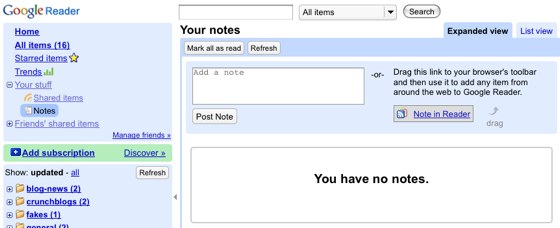
Google Reader ads nifty Notes feature

Google Reader is my RSS reader of choice. It makes it possible for me to keep up with about 100 blogs and websites. The “Share” feature (which I mention here from time to time) let’s me flag and post a story to my “shared stories” page. Just click the “more stories” link at the bottom of the little blue box on the right side of this page.

Google has added a Notes feature that let’s me share a story AND include a brief note about it. I can also highlight text on a web page, click the “Note” button in my browser toolbar and add the text… with my note… to my shared page.

I know, it’s a little confusing. But this is good shit. There’s a social networking aspect to this but let’s not go there right now.

If you use Google Reader, check out the notes feature. You can get a better explanation at Techcrunch and the Google Blog.
Blogs = Google Juice

In January I posted a video clip of a guy bouncing a nail on the head of a hammer. Actually, he was juggling the nail on the head of the hammer. Just watch the amazing video.

Yesterday I received notification of a comment on the post. It was from Scot Nery, the man in the video. The clip had been pulled from YouTube and he provided a permanent link to the video.

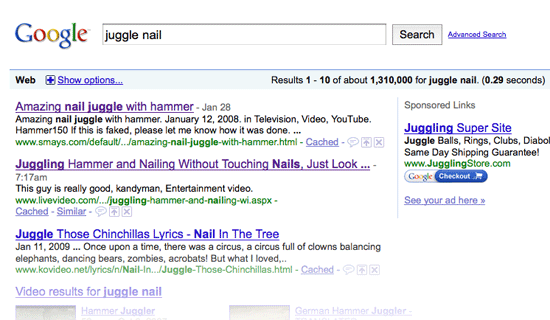
I assumed he found the post with a Google search but since it didn’t include his name or any identifying data, I wondered what he searched for. When I tried “nail juggle” (without the quotation marks), my post was number one out of 213,000 results. If I’m clear on how Google works, those two words would give you every hit with either “nail” or “juggle.”

Think about that. Those are two pretty common words. And a lot of the results pertained to Scot Nery doing the nail thing.

Just one more example of the sweet google juice generated by blogs.

Google gets into local news

Google News now allows you to localize a section of the stories. Scroll down just beneath the fold for the box to type in your city or zip code.

“This is pretty huge, folks, and it spotlights the need for everybody in the local news business to adopt best practices when it comes to unbundled distribution,” writes Terry Heaton. True enough, as Google News ranked #9 in Nielsen-Netratings for December — higher than USAToday.com and WashingtonPost.com.

If you’re a local news guy and look at this and say, “Ah, but they missed some stories!” … you’re missing the point.

Google yourself

Why? This from Seth Godin…

If you’re a salesperson, your prospects already do.
If you’re looking for a job, your prospective employers already do.
If you’ve got a job, your co-workers already do.

What do they see? Do you know?

…and this from Mindy McAdams (Teaching Online Journalism)…

“If you’re a journalist — or a journalism student who hopes to enter the field — this should concern you. First, what results do you get when you Google yourself (first name, last name, no quotation marks)? Most important, what are the top two or three links? I hope they do not go to pages about you that make you look like an idiot, a sex fiend, or a drunk.”

They both offer suggestions on how to improve your Google juice.

Buy $1,000 in radio spots, get $2,000 back

TechCrunch wonders if Google’s radio ad network –Google Audio– is in trouble:

“Google is offering $2,000 to any advertiser who spends $1,000 on a Google Audio ad campaign. The $2,000 comes in the form of a credit on future ad campaigns, but part of it still comes out of Google’s pocket since it needs to pay the radio stations who will run the ads. It amounts to a “buy one, get two free” offer and is good through the end of the year.

If (Google) truly has a better way of buying and selling radio ads, advertisers and radio stations will quickly figure that out on their own. It is not a good sign when Google has to resort to paying customers to try out a new product.”

Update 10/15/07: This from a reader (who prefers to remain anonymous) who works at a radio station that runs Google Audio ads:

“This week we ran on average 18 :60’s a day for Google. They just fill in avails that are on our schedule, so many of them are in the evening between 6p-11p. Some hours may have a Google Ad in each stop set.

I don’t see the checks but I’ve heard they range from $500-$2,000 a month. We do have the ability to block out any hours or programming we don’t want their stuff in.

To me it would just seem to be up to the station owner/company is the money worth tying up the time with these filler type ads.  I’ve yet to hear an ad I thought specifically targets to our region or even state… and no real big name company’s like Ford, GM, McDonald’s, JC Penney, Target or anything.”

Google Lunar X Prize

“Put a robotic lander on the moon, take a spin across the lunar landscape, and beam back visuals — with minimal or no government assistance. Pull that off before anyone else and the galaxy’s richest, most audacious Internet company (Google) will hand over $20 million.” [Wired]

After reading this story, the first thing that popped into my head was: I have more confidence in Google (and a few other companies for that matter) than I do in the U. S. government. My gut tells me Google is more efficient, less corrupt and possessing greater vision.

Time to rethink the AP model?

Cory Bergman at Lost Remote raises some interesting questions about the AP model in light of Google’s deal to host AP stories (rather than link back to newspaper websites).

He also points to a blog post on the "prickly issue of local broadcasters pulling local newspaper stories via the wire and posting them online (and occasionally vice-versa). Now that both mediums have expanded to the web, they’re direct competitors. And the local wire goes a long way to beef up the depth of content on a local TV site."

I’m pretty sure he’s talking about TV broadcasters. I’m afraid nobody is much concerned about radio stations getting their news from Google.

AP news on Google

“After a couple years of spirited negotiations, Google has signed agreements with the Associated Press and AFP that will reduce the amount of traffic Google News refers to news sites. First, Google News will start hosting full versions of AP stories instead of linking off to them. And second, Google will begin to filter out duplicates of the same AP story. So you won’t see multiple versions of an AP story from various newspapers, listed with the most recent at the top. Google said the end result is less duplication and a better variety of stories.” — Lost Remote

Do radio stations still subscribe to the AP? It’s been years since I was in radio stations, talking with managers about news and where/how they get it. But even back then, a lot of stations really only relied on AP for state news and high school football scores. Our company offers a “poor man’s wire service” that still has an amazing number of subscribers. [Yo, David. Can you give us an update on this?]

Perhaps the bigger question is… how much do listeners rely on their local radio station for news. I would think a lot. But what’s the order of importance? Local…state…national…world? What can/do I get from my local radio station (on air or online)… and what do I get from a Google search (perhaps on my mobile phone)?

These are interesting times.