dMarc founders leave Google

Looks like Google’s plans to reinvent the way radio ads are bought has hit a rough spot. Online Media Daily reports Chad and Ryan Steelberg, the founders of dMark, an automated radio ad placement company purchased by Google in January 2006, have left the company.

The brothers resigned amid reports of growing tension between dMarc, the company they founded, and Google over differing approaches to radio ad sales. There was also said to be tension over the limited remuneration dMarc could expect under the performance-based terms of its original deal with Google.

Google deal with CBS Radio imminent?

Merrill Lynch broadcast analyst Jessica Reif Cohen expects Google will team with a CBS Radio in a wide-ranging advertising deal. In a nutshell, Google would allow advertisers to bid for radio airtime using some of the same functionality as its online sales tool. But again, no deal has been announced.

Cohen estimated that a Google deal to sell 10% of CBS Radio’s advertising inventory would generate approximately $200 million in revenues and that the upside for CBS would be two-fold: “1) attracting new (likely smaller) advertisers to its platforms a la Google’s experience with search, and 2) creating a more efficient sales model that reduces the friction/cost of selling advertising.” [LostRemote]

“Why local media companies should fear Google”

This post by Terry Heaton made me flash on a Google search page with a “Pages from Missouri” button (or any of the states where we have networks):

“Google’s mission is to organize the world’s information and make it easily accessible to everyone. This ought to be the mission of every local media company, for one day we will find a similar button on Google regardless of the zip code from which we are logging in.”

Will Google be able to cover state news (with audio, video, stills,etc) better than our networks? Blasphemy I know, but it doesn’t seem wise to assume that our little corner of the news/media world will be untouched by the changes happening all around us.

Good look at the Google Ad Creation Marketplace

Can Google Audio Ads be as easy and effesctive as Google AdWords? That was the question Donna Bogatin (Digital Markets) put to André Bergeron, owner/operator of Babble-On Recording Studios. She wanted “a radio production talent insider take” on how the Google Ad Creation Marketplace will impact the radio advertising industry. Bergeron seems to know what he’s talking about.

“Dollar-A-Holler Radio ads have been around forever. The local Hi-Fi Store owner could always go into the local station and bark off a series of sale prices in shrill tones that would annoy anyone within earshot. This would be no different, really. There is so much more to effective messaging, to branding, to understanding how people listen to the radio than simply writing down “for all your underwear needs” and handing it off to Johnny promo voice to record.

Part of why people can’t stand listening to the radio is the quality of the ads, they’re, by most estimations, shouted, boring, and insultingly simplistic, and, if there are a lot of them, it just magnifies the mind-numbing nature of them.”

I think that sentence really sums it up. That reality will ultimately prove to be The Big Problem for radio going forward. Shitty commercials in an era when we no longer have to listen to them in order to hear the news and music we want.

Andre Bergeron emails an additional thought:

“Throughout a programming day, the station dresses itself with a carefully crafted image using music, personalities, promotions, etc – to create “a brand”, if you will. Then a stopset comes on and it’s like the advertisers are allowed to dress the station in clown’s clothes, leisure suites or horizontal stripes.”

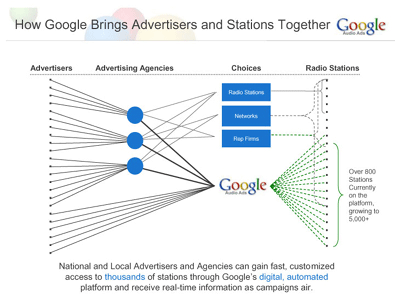
How Google Audio Ads work (PowerPoint slides)

The folks at ZDNet’s Digital Markets have some PowerPoint slides that illustrates how Google Audio Ads work. And this from Voices.com:

“Google has positioned the Audio Ads system to serve both top-level advertisers, as well as the advertising agencies themselves. The graphic also shows 75% of the transactions coming from the agencies, and only 25% from independent advertisers. This is likely because advertising agencies already have media planning and media buying personnel, not to mention existing relationships with local and regional radio stations.”

The lables in the little blue rectangles are: Radio Stations, Networks and Rep Firms. Which suggests that advertisers will simply have another option for placing their ads on radio stations. And if Google can make it easier or cheaper or more effective (i.e. feedback, reports, etc)… they’ve added value to the process.