
“Google is finding some friends. There are plenty of critics of Google’s foray into radio — but we’re slowly seeing some group heads come out and say there may be a place for the Internet giant in radio sales. Regent tested the service in two markets and CEO Bill Stakelin says they sold “a tremendous amount of inventory” and the results “far exceeded our expectations.” He says the issue that remains to be worked out is pricing.
While Emmis CEO Jeff Smulyan says “if Google has the advertiser that we’re never going to call on at rates that make sense … then it’s business that we want to take.” Smulyan says Google’s efforts are especially welcome in “transactional” markets like New York and L.A. where radio has done a “marginal job” at attracting new advertisers.
Meanwhile — Border Media Partners CEO Tom Castro says many folks are focusing on HD and streaming. But the real technological breakthrough will come on the sales side. Castro says “it’s not very sexy — but it’s where we are going to make a lot of money in the future.” — INSIDE RADIO report from the Kagan Radio-TV Summit:
Tag Archives: google
How to improve Google rank? Blog
Last night I posted about one of the speakers at a statewide child abuse conference that got underway here in Jefferson City on Wednesday.
Jan Hindman has served on the advisory board of the National Resource Center on Child Sexual Abuse, the National Network for Juvenile Sex Offenders, and she is currently a member of the Oregon Attorney General’s Sexual Assault Task Force. She is also the past president of the Association for the Treatment of Sexual Abusers, as well as being an author of numerous publications and a national trainer, lecturer, and consultant.
Today I had occasion to google “Jan Hindman” and came up with 551 results. As I scanned down the list, I discovered that my post here on smays.com was #48.
I am not all that knowledgable about Google ranking, but that a blog post (on a site with modest traffic) could could show up in the top 10% of the rankings in less than 24 hours says something about the power of blogs.
Update (3/17/07): For some reason my post is no longer showing up in that Google search. As Roseanne Roseannadana used to say, “Never mind.”
Correction courtesy of Bass (3/19/07): Emily Litella said, “Never Mind.” Roseanne Rosannadanna said, “What are you trying to do, make me sick?” Both played by Gilda Radner.
Google Audio Ads by the numbers
Mark Ramsey (Hear 2.0) offers still more insight on Google Audio Ads, including some screenshots of pages where you specify the demographic and geographic details of your buy. For businesses that don’t need an “advertising consultant” to show up with a media kit and a coverage map, this might be an effective way to buy radio ads.
Google Audio will raise ad rates
Reply
 That’s the prediction of Google Audio national director of sales Drew Hilles tells Inside Radio “Our main goal is to draw new advertisers to radio” and when they do that’ll put pressure on inventory and result in higher rates for all buyers. The onetime CBS Radio exec says “our goal is to raise rates” and return the sector to double-digit growth. He says one way they help preserve a station’s rate card integrity is by allowing buyers to pick markets — but not individual stations. And Hilles says “stations have control of the throttle of how much of the inventory they open up or not.” Hilles says Google is working to attract some of its existing 100,000 advertisers who have found radio too tough to buy. Hilles says what attracts them is the “more Googley way” they sell radio that affords buyers more accountability and trackability. Google says “a large amount” of the advertisers are new to radio. [INISIDE RADIO]
dMarc founders leave Google
Looks like Google’s plans to reinvent the way radio ads are bought has hit a rough spot. Online Media Daily reports Chad and Ryan Steelberg, the founders of dMark, an automated radio ad placement company purchased by Google in January 2006, have left the company.
The brothers resigned amid reports of growing tension between dMarc, the company they founded, and Google over differing approaches to radio ad sales. There was also said to be tension over the limited remuneration dMarc could expect under the performance-based terms of its original deal with Google.
Google deal with CBS Radio imminent?
Merrill Lynch broadcast analyst Jessica Reif Cohen expects Google will team with a CBS Radio in a wide-ranging advertising deal. In a nutshell, Google would allow advertisers to bid for radio airtime using some of the same functionality as its online sales tool. But again, no deal has been announced.
Cohen estimated that a Google deal to sell 10% of CBS Radio’s advertising inventory would generate approximately $200 million in revenues and that the upside for CBS would be two-fold: “1) attracting new (likely smaller) advertisers to its platforms a la Google’s experience with search, and 2) creating a more efficient sales model that reduces the friction/cost of selling advertising.” [LostRemote]
“Why local media companies should fear Google”
This post by Terry Heaton made me flash on a Google search page with a “Pages from Missouri” button (or any of the states where we have networks):
“Google’s mission is to organize the world’s information and make it easily accessible to everyone. This ought to be the mission of every local media company, for one day we will find a similar button on Google regardless of the zip code from which we are logging in.”
Will Google be able to cover state news (with audio, video, stills,etc) better than our networks? Blasphemy I know, but it doesn’t seem wise to assume that our little corner of the news/media world will be untouched by the changes happening all around us.
Good look at the Google Ad Creation Marketplace
Can Google Audio Ads be as easy and effesctive as Google AdWords? That was the question Donna Bogatin (Digital Markets) put to André Bergeron, owner/operator of Babble-On Recording Studios. She wanted “a radio production talent insider take” on how the Google Ad Creation Marketplace will impact the radio advertising industry. Bergeron seems to know what he’s talking about.
“Dollar-A-Holler Radio ads have been around forever. The local Hi-Fi Store owner could always go into the local station and bark off a series of sale prices in shrill tones that would annoy anyone within earshot. This would be no different, really. There is so much more to effective messaging, to branding, to understanding how people listen to the radio than simply writing down “for all your underwear needs” and handing it off to Johnny promo voice to record.
Part of why people can’t stand listening to the radio is the quality of the ads, they’re, by most estimations, shouted, boring, and insultingly simplistic, and, if there are a lot of them, it just magnifies the mind-numbing nature of them.”
I think that sentence really sums it up. That reality will ultimately prove to be The Big Problem for radio going forward. Shitty commercials in an era when we no longer have to listen to them in order to hear the news and music we want.
Andre Bergeron emails an additional thought:
“Throughout a programming day, the station dresses itself with a carefully crafted image using music, personalities, promotions, etc – to create “a brand”, if you will. Then a stopset comes on and it’s like the advertisers are allowed to dress the station in clown’s clothes, leisure suites or horizontal stripes.”
How Google Audio Ads work (PowerPoint slides)
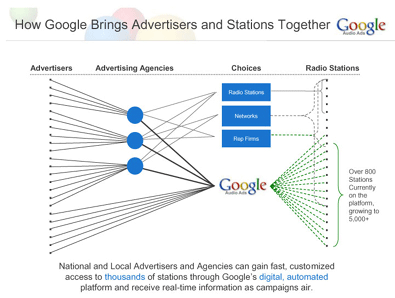
The folks at ZDNet’s Digital Markets have some PowerPoint slides that illustrates how Google Audio Ads work. And this from Voices.com:
“Google has positioned the Audio Ads system to serve both top-level advertisers, as well as the advertising agencies themselves. The graphic also shows 75% of the transactions coming from the agencies, and only 25% from independent advertisers. This is likely because advertising agencies already have media planning and media buying personnel, not to mention existing relationships with local and regional radio stations.”
The lables in the little blue rectangles are: Radio Stations, Networks and Rep Firms. Which suggests that advertisers will simply have another option for placing their ads on radio stations. And if Google can make it easier or cheaper or more effective (i.e. feedback, reports, etc)… they’ve added value to the process.
Update: Google Audio Ads
From Inside AdWords blog: “Over the last year, we’ve been working hard to integrate the dMarc advertising platform into Google AdWords. We’re happy to announce that the integration is now complete and we’ve recently begun a U.S. beta test of Google Audio Ads with a small group of AdWords advertisers.”
If you haven’t been keeping up, here’s how Google describes their Audio Ads:
“Google Audio Ads brings efficiency, accountability, and enhanced ROI to radio advertising by providing advertisers with an online interface for creating and launching radio campaigns. You’ll be able to target your customers by location, station type, day of the week, and time of day. After the radio ads are run, you will be able to view online reports that tell you exactly when your ad played.”
A couple of days ago, Mark Ramsey (Hear 2.0) pointed us to an application page on the Google website.
Ad Specialist Application — Thank you for your interest in joining the Google Ad Creation Marketplace. We’re looking for some of the top audio ad specialists to join our Ad Creation Marketplace – a searchable directory of talent to help AdWords advertisers to create radio advertisements. For advertisers new to the radio space, or who are starting a new campaign, the Marketplace provides an invaluable starting point for finding the talent they need.
So, I decide to buy some Google Audio Ads. I search the Google Ad Creation Marketplace database for someone to write and produce my spot. We agree on a price. I send some copy. They email back an MP3 file. I’m off to the races. Maybe. Mr. Ramsey is skeptical and I confess I am too. But if it works… it could have a profound change on how advertiser buy and place ads.
Update: According to News.com, the radio ads are running in more than 260 metropolitan markets, covering about 87 percent of the country