Scott Adams: Universe as computer simulation

Three of my favorite Smart People (Kevin Kelly, Ray Kurzweil and Scott Adams) have convinced me there will be a post-human stage in our evolution. And Scott Adams makes a compelling (to me) case for the computer simulation theory.

“The theory basically goes that any civilisation which could evolve to a ‘post-human’ stage would almost certainly learn to run simulations on the scale of a universe. And that given the size of reality – billions of worlds, around billions of suns – it is fairly likely that if this is possible, it has already happened. And if it has? Well, then the statistical likelihood is that we’re located somewhere in that chain of simulations within simulations. The alternative – that we’re the first civilisation, in the first universe – is virtually absurd.”

Before you dismiss this theory, compare it to this popular creation narrative:

“It is made up of two parts, roughly equivalent to the first two chapters of the Book of Genesis. In the first part, Genesis 1:1 through Genesis 2:3, Elohim, the generic Hebrew word for God, creates the world in six days, then rests on, blesses and sanctifies the seventh day. God creates by spoken command (“Let there be…”), suggesting a comparison with a king, who has only to speak for things to happen, and names the elements of the cosmos as he creates them, in keeping with the common ancient concept that things did not really exist until they had been named. In the second, Genesis 2:4–24, Yahweh, the personal name of God, shapes the first man from dust, places him in the Garden of Eden, and breathes his own breath into the man who thus becomes נֶפֶש nephesh, a living being; man shares nephesh with all creatures, but only of man is this life-giving act of God described. The man names the animals, signifying his authority within God’s creation, and God creates the first woman, Eve, from the man’s body.”

Mockingbird (Walter Tevis)

Plot summary from Wikipedia: “The novel begins hundreds of years in the future in Manhattan, where most of the buildings have been razed and its population, as with the world’s, is largely depleted. The surviving people are illiterate, and are drugged with pills that makes them apathetic and infertile. That has caused human life on the planet to gradually decline to the point of near-extinction. The surviving humans are survived by android robots, of which Spofforth is the most powerful and sophisticated. No humans have been born in many years and there are no children. Suicide by immolation is rampant, as people have nothing to live for.”


Mockingbird(1stEd)“In the vast and cluttered factory room where he was brought into awareness his dark eyes looked around him with excitement and life. He was on a stretcher when he first experienced the power of consciousness enveloping his nascent being like a wave, becoming his being. His constricted throat gagged and then cried out at the force of it — at the force of being in the world.”

“Spofforth had been designed to live forever, and he had been designed to forget nothing. Those who made the design had not paused to consider what a life like that might be like.”

“The idea of the sequence of events and circumstances — that things had not always been the same — was one of the strange and striking things that had occurred to me as I had become aware of what I can only call the past. […] I feel that I understand a good many things since I have begun to memorize my life. You get the sense that one thing comes after another and that there is change.”

“Then he removed my handcuffs, with a surprisingly gentle touch, and had me place my right hand in the Truth Hole that sat directly in front of me. He said quietly, “For each lie you tell, a finger will be severed. Answer the judge with care.”

“And they read, hearing the voices of the living and the dead speaking to them in eloquent silence, in toucnh with a babble of human talk that must have filled the mind in a manner that said: I am human, I talk and I listen and I read.”

“Sadness. Sadness. But I will embrace the sadness, and make it a part of this life I am memorizing.”

“When the drugs and the television were perfected by the computers that made and distributed them, the cars were no longer necessary.”

“I would like to know, before I die, what it was like to be the human being I have tried to be all my life.”

“I think now that they expected something miraculous to happen when they started to hear the words from the Bible read aloud, opening up that mystery to them—the message of an inscrutable book they had learned to revere. But no miracle occurred, and they soon lost any real interest. I think that to know what those words said required an attention and a devotion that none of them possessed. They were willing to accept their stringent piety, and silence, and sexual restraints, all unthinkingly, along with a few platitudes about Jesus and Moses and Noah; they were overwhelmed, however, at the effort it would require to understand the literature that was the real source of their religion.”

“I no longer wanted to keep my mind silent, or use it as a vehicle for disconnected pleasure; I wanted to read, and think and talk.”

“My mind racing with the realization that all my notions of decency were something programmed into my mind and my behavior by computers and by robots who themselves had been programmed by some long-dead social engineers or tyrants or fools.”

“Whatever may happen to me, thank God I can read, that I have truly touched the minds of other men.”

“All of those books — even the dull and nearly incomprehensible ones — have made me understand more clearly what it means to be a human being.”

“It (the Empire State Building) is only a marker, a mute testimoney to the human ability to make things that are too big.”

Wikipedia

I Am That by Sri Nisargadatta Maharaj

Excerpts from I Am That by Sri Nisargadatta Maharaj


All your problems are your body’s problems. All these lose their meaning the moment you realize that you may not be a mere body. You are nothing perceivable, or imaginable.#

Memory creates the illusion of continuity.

Time, space, causation are mental categories, arising and subsiding with the mind.

Nothing can happen unless the entire universe makes it happen. A thing is as it is, because the universe is as it is.

The world you can perceive is a very small world indeed. And it is entirely private. Take it to be a dream and be done with it.

Continue reading

Be As You Are by Sri Ramana Maharshi

Excerpts from The Teachings of Sri Ramana Maharshi (Edited by David Godman)


There is a single immanent reality, directly experienced by everyone, which is simultaneously the source, the substance and the real nature of everything that exists.

The Self is not an experience of individuality but a non-personal, all-inclusive awareness.

Sri Ramana’s God is not a personal God, he is the formless being which ustains the universe. He is not the creator of the univers, the universe is merely a manifestation of his inherent power; he is inseparable from it.

The mind turned inward is the Self; turned outwards, it becomes the ego and all the world.

The thoughts are the content of the mind and they shape the universe.

To make room, it is enough that objects be removed. Room is not brought in from elsewhere.

Bliss is not added to your nature, it merely revealed as your true natural state.

Trouble and pleasure are only for the ego.

The state free from thoughts is the only real state.

It is the mind that veils our happiness.

Self-realisation could be brought about merely by giving up the idea that there is an individual self which functions through the body and the mind.

The aim of self-enquiry is to discover, by direct experience, that the mind is non-existent.

The mind and the ego are one and the same.

When the mind unceasingly investigates its own nature, it transpires that there is no such thing as mind. The mind is merely thoughts. The mind is only they thought ‘I’

The ego functions as the knot between the Self which is pure consciousness and the physical body which is inert and insentient.

The essence of mind is only awareness or consciousness. When the ego, however, dominates it, it functions as the reasoning, thinking or sensing faculty.

Realisation is nothing new to be acquired. It is already there, but obstructed by a screen of thoughts.

Reality is simply the loss of ego.

As the practice develops the thought ‘I’ gives way to a subjectively experienced feeling of ‘I’, and when this feeling ceases to connect and identify with thoughts and objects, it completely vanishes. What remains is an experience of being in which the sense of individuality has temporarily ceased to operate.

It is not an exercise in concentration, nor does it aim at suppressing thoughts; it merely invokes awareness of the source from which the mind springs. … From then on it is more a process of being than doing, of effortless being rather than an effort to be. … Ultimately, the Self is not discovered as a result of doing anything, but only by being.

If you are vigilant and make a stern effort to reject every thought when it arises you will soon find that you are going deeper and deeper into your own inner self.

You have to ask yourself question “Who am I?’ This investigation will lead in the end to the discovery of something within you which is behind the mind. Solve that great problem and you will solve all other problems.

One must be completely free of the idea that there is an individual person who is capable of acting independently of God.

(The) final destruction of the ‘I’ takes place only if the self-surrender has been completely motiveless.

If one surrenders oneself there will be no one to ask questions or to be thought of.

You must be satisfied with whatever God gives you and that means having no desires of your own. You can have no likes or dislikes after your surrender.

It is the higher power that does everything, and man is only a tool.

The Self does not move, the world moves in it.

Pleasure or pain are aspects of the mind only. Our essential nature is happiness. But we have forgotten the Self and imagine that the body or the mind is the Self.

So long as there is thought there will be fear. #

The ego is the source of thought. #

Because you identify yourself with the body, you think that work is done by you.

We must play our parts on the stage of life, but we must not identify ourselves with those parts. #

Many a man would be only too glad to be rid of his diseased body and all the problems and inconveniences it creates for him if continued awareness were vouchsafed to him. It is the awareness, the consciousness, and not the body, he fears to lose.

One first creates out of one’s mind and then sees what one’s mind itself has created.

Clearly the world is your thought. Thoughts are your projections. The ‘I’ is first created and then the world. The world is created by the ‘I’ which in its turn rises up from the Self. (We) must admit that the world is (our) own imagination.

The universe is real if perceived as the Self.

You do not know what you were before birth, yet you want to know what you will be after death. Do you know what you are now?

Experience takes place only in the present, and beyond experience nothing exists. Even the present is mere imagination, for the sense of time is purely mental. Space is similarly mental. Therefore birth and rebirth, which take place in time and space, cannot be other than imagination. Real rebirth is dying from the ego into the spirit.

Birth pertains to the ego, which is an illusion of the mind.

God never acts, he just is. He has neither will nor desire. … The totality of all lthings and beings constitutes God.

Whatever this body is to do and whatever experiences it is to pass through was already decided when it came into existance.

As long as individuality lasts there is free will. … Only the ego is bound by destiny and not the Self.

Surrender can never be regarded as complete so long as the devotee wants this or than from the Lord.

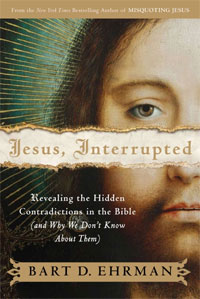
Jesus, Interrupted

The full title of the book is: Jesus, Interrupted: Revealing the Hidden Contradictions in the Bible (And Why We Don’t Know About Them). The author, Bart D. Ehrman, began studying the Bible and its original languages at the Moody Bible Institute and is a 1978 graduate of Wheaton College in Illinois. He received his PhD and M.Div. from Princeton Theological Seminary, where he studied under Bruce Metzger. He received magna cum laude for both his BA in 1978 and PhD in 1985.

I have not read the Bible and — before reading this book — knew almost nothing about it from an historical, scholarly perspective. Here are a few excerpts I highlighted:

The New Testament, consisting of twenty-seven books, was written by maybe sixteen or seventeen authors over a period of seventy years.

A Christianity dependent on the inerrancy of the Bible probably cannot survive the reality of the discrepancies.

Since the nineteenth century, scholars have recognized that Mark was the first Gospel to be written, around 65-70 CE. Continue reading

The Power of Now

I read Eckhart Tolle’s classic The Power of Now in August of 2010. My usual practice for books like this is to highlight passages I find interesting and share them here. I highlighted so many parts of this book, I never go around to it. If you haven’t read the book, the lack of context will make most of these seem, well, just weird. I can assure you everyone line has been valuable to me.

nothing I ever did could possibly add anything to what I already had.

Self = a fiction of the mind

You have it already. You just can’t feel it because your mind is making too much noise.

the knower in you who dwells behind the thinker

All I can do is remind you of what you have forgotten.

Not to be able to stop thinking is a dreadful affliction.

You believe that you are your mind. This is the delusion.

The beginning of freedom is the realization that you are not the possessing entity — the thinker. Knowing this enables you to observe the entity. The moment you start watching the thinker, a higher level of consciousness becomes activated. You then begin to realize that there is a vast realm of intelligence beyond thought, that thought is only a tiny aspect of that intelligence. You also realize that all the things that truly matter — beauty, love, creativity, joy, inner peace — arise from beyond the mind. You begin to awaken.

The voice isn’t necessarily relevant to the situation you find yourself in at the time; it may be reviving the recent or distant past or rehearsing or imagining possible future situations. Here it often imagines things going wrong and negative outcomes; this is called worry. This is because the voice belongs to your conditioned mind.

“watching the thinker” — listen to the voice in your head, be there as the witnessing presence. … The thought then loses its power over you and quickly subsides, because you are no longer energizing the mind through identification with it.

aware but not thinking. This is the essence of meditation.

Because you are identified with it … you derive your sense of self from the content and activity of your mind. Because you believe that you would cease to be if you stopped thinking.

(Ego) a false self, created by unconscious identification with the mind. (It) can only be kept going through constant thinking.

Even when the ego seems to be concerned with the present, it is not the present that it sees: It misperceives it completely because it looks at it through the eyes of the past. Or it reduces the present to a means to an end, an end that always lies in the mind-projected future. The present moment holds the key to liberation. But you cannot find the present moment as long as you are your mind.

Thinking and consciousness are not synonymous. Thinking is only a small aspect of consciousness. Thought cannot exist without consciousness, but consciousness does not need thought.

The mind is essentially a survival machine. It is not at all creative.

Emotion (is) the body’s reaction to the mind.

If there is an apparent conflict between them, the thought will be the lie, the emotion will be the truth.

You will not be free of pain until you cease to derive your sense of self from identification with the mind, which is to say from ego.

Glimpses of love and joy or brief moments of deep peace are possible whenever a gap occurs in the stream of thought. Usually, such moments are short-lived, as the mind quickly resumes its noise-making activity that we call thinking.

Pleasure is always derived from something outside you, whereas joy arises from within.

Become present. Be there as the observer of the mind.

The pain that you create now is always some form of nonacceptance, some form of unconscious resistance to what is.

The mind always seeks to deny the Now and to escape from it. In other words, the more you are identified with your mind, the more you suffer.

Time and mind are in fact inseparable. … The mind, to ensure that it remains in control, seeks continuously to cover up the present moment with past and future,

Unconscious = a complete absence of the watcher.

You can always cope with the present moment, but you cannot cope with something that is only a mind projection — you cannot cope with the future.

ultimately all fear is the ego’s fear of death,

End the delusion of time. Time and mind are inseparable. Remove time from the mind and it stops

Nothing ever happened in the past; it happened in the Now.
Nothing will ever happen in the future; it will happen in the Now.

In the Now, in the absence of time, all your problems dissolve.

The moment you realize you are not present, you are present. Whenever you are able to observe your mind, you are no longer trapped in it.

Usually, the future is a replica of the past.

Ultimately, this is not about solving your problems. It’s about realizing that there are no problems. Only situations — to be dealt with now, or to be left alone and accepted as part of the “isness” of the present moment until they change or can be dealt with. Problems are mind-made and need time to survive. They cannot survive in the actuality of the Now.

it is impossible to have a problem when your attention is fully in the Now

The mind unconsciously loves problems because they give you an identity of sorts

Everything is honored, but nothing matters.

To complain is always nonacceptance of what is. … leave the situation or accept it. All else is madness.

Die to the past every moment. You don’t need it. Only refer to it when it is absolutely relevant to the present.

You can always cope with the Now, but you can never cope with the future — nor do you have to. The answer, the strength, the right action or the resource will be there when you need it, not before, not after.

Eternity does not mean endless time, but no time.

Being cannot become an object of knowledge.

You are cut off from Being as long as your mind takes up all your attention. When this happens — and it happens continuously for most people — you are not in your body. The mind absorbs all your consciousness and transforms it into mind stuff. You cannot stop thinking. Compulsive thinking has become a collective disease. Your whole sense of who you are is then derived from mind activity

Feeling will get you closer to the truth of who you are than thinking.

As there is more consciousness in the body, its molecular structure actually becomes less dense. More consciousness means a lessening of the illusion of materiality.

when presence becomes your normal mode of consciousness and past and future no longer dominate your attention, you do not accumulate time anymore in your psyche and in the cells of the body. The accumulation of time as the psychological burden of past and future greatly impairs the cells’ capacity for self-renewal.

see yourself surrounded by light or immersed in a luminous substance — a sea of consciousness. Then breathe in that light. Feel that luminous substance filling up your body and making it luminous also.

nothing in this world is so like God as silence

You “get” there by realizing that you are there already. You find God the moment you realize that you don’t need to seek God.

the moment that judgment stops through acceptance of what is, you are free of the mind.

Ego is the unobserved mind that runs your life when you are not present as the witnessing consciousness, the watcher.

You cannot have an argument with a fully conscious person.

The whole advertising industry and consumer society would collapse if people became enlightened and no longer sought to find their identity through things.

every moment — is the best. That is enlightenment.

there is no objective world out there. Every moment, your consciousness creates the world that you inhabit.

Only those who have transcended the world can bring about a better world.

who you are is always a more vital teaching and a more powerful transformer of the world than what you say, and more essential even than what you do.

to surrender is to accept the present moment unconditionally and without reservation.

You are walking along a path at night, surrounded by a thick fog. But you have a powerful flashlight that cuts through the fog and creates a narrow, clear space in front of you. The fog is your life situation, which includes past and future; the flashlight is your conscious presence; the clear space is the Now.

Surrender does not transform what is, at least not directly. Surrender transforms you. When you are transformed, your whole world is transformed, because the world is only a reflection.

The amazing and incomprehensible fact is not that you can become conscious of God but that you are not conscious of God.


Random Walk

randomwalkAuthor Lawrence Block on Random Walk: “Every now and then someone comes up to me at a speech or signing and says one of two things. ‘I’ve liked all your books,’ I’ll be told, ‘but there was one I couldn’t make heads or tails out of.’ Or just the opposite: ‘I’ve read most of your books, but there was one that really knocked me for a loop, and I’ve read it seventeen times now, and it’s completely changed my life.’ “It’s always the same book. Random Walk.”

I wrote the book in the spring of 1987, and never was a book more eager to be written. Paradoxically, never was a book less eager to be read–the advance sale was light, the reviews were venomous, and most readers never even knew the book existed. Now it’s getting a new lease on life, and I’m delighted. I don’t know that it’s time has come–it’s just as possible it’s time has come and gone. But I do know Random Walk has enormous impact on some of the people who read it, and I hope that now they’ll have a chance to find it.”

A few of my favorite passages: Continue reading

God as software engineer

“When we make these virtual worlds in the future —worlds whose virtual beings will have autonomy to commit evil, murder, hurt, and destroy options— it’s not unthinkable that the game creator would go in to try to fix the world from the inside. That’s the story of Jesus’ redemption to me. We have an unbounded God who enters this world in the same way that you would go into virtual reality and bind yourself to a limited being and try to redeem the actions of the other beings since they are your creations. So I would begin there. For some technological people, that makes the faith a little more understandable.”

— From a piece titled “Geek Theologian” Kevin Kelly talks with Christianity Today’s Katelyn Beaty.

Difficult to noodle on such things and not recall the scene with The Architect in the later Matrix films.

Einstein on Buddhism

“The religion of the future will be a cosmic religion. It should transcend personal God and avoid dogma and theology. Covering both the natural and the spiritual, it should be based on a religious sense arising from the experience of all things natural and spiritual as a meaningful unity. Buddhism answers this description. If there is any religion that could cope with modern scientific needs it would be Buddhism.” 

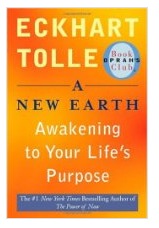
A New Earth by Eckhart Tolle

One measure of a book (for me) is how many passages get highlighted [after the jump]. What ideas will I want to find again? A New Earth by Eckhart Tolle had some on nearly every page. For example:


“Most people are so completely identified with the voice in the head — the incessant stream of involuntary and compulsive thinking and the emotions that accompany it — that we may describe them as being possessed by their mind. You take the thinker to be who you are. … Your thinking, the content of your mind, is of course conditioned by the past: your upbringing, culture, family background, and so on.”

Everything in the book made perfect sense to me. I’m trying to incorporate man of his ideas into my life.


“…when survival is threatened by seemingly insurmountable problems, an individual life-form –or a species– will either die or become extinct or rise above the limitations of its condition through an evolutionary leap.” – pg 20

“A significant portion of the earth’s population will soon recognize, if they haven’t already done so, that humanity is now faced with a stark choice: Evolve or die.” – pg 21

“We are coming to the end not only of mythologies but also of ideologies and believe system. … At the heart of the new consciousness lies the transcendence of thought.” – pg 21

“What a liberation to realize that the “voice in my head” is not who I am. Who am I then? The one who sees that. The awareness that is prior to thought, the space in which the thought–or the emotion or sense perception–happens.” – pg 22

“Thoughts consist of the same energy vibrating at a higher frequency than matter, which is why they cannot be seen or touched.” – pg 146

“You look at the present through the eyes of the emotional past within you. In other words, what you see and experience is not in the event or situation but in you.” – pg 173

“Being present is always infinitely more powerful than anything one could say or do.” – pg 176

“…heaven is not a location but refers to the inner realm of consciousness.” – pg 23

“Words, no matter whether they are vocalized and made into sounds or remain unspoken as thoughts, can cast an almost hypnotic spell upon you. You easily lose yourself in them, bercome hypnotized into implicitly believing that when you have attached a word to something, you know what it is.” – pg 25

“Words reduce reality to something the human mind can grasp.” – pg 27

“Most of the time it is not you who speaks when you say or think “I” but some aspect o fthat mental construct, the egoic self.” – pg 30

“…the shift in identity from being the content of their mind to being the awareness in the background.” – pg 30

“The egoic mind is completely conditioned by the past.” – pg 34

“The unconscious compulsion to enhance one’s identity through association with an object is built into the very structure of the egoic mind.” – pg 35

“Most people don’t inhabit a living reality, but a conceptualized one.” – pg 37

“Being must be felt. It can’t be thought.” – pg 40

“Life will give you whatever experience is most helpful for the evolution of your consciousness.” – pg 41

“The ego isn’t wrong; it’s just unconscious.” – pg 42

“The ego doesn’t mind what it identifies with as long as it has an identity.” – pg 44

“…making yourself right and other wrong is one of the principal egoic mind patterns.” – pg 44

“The ego tends to equate having with Being: I have, therefore I am. And the more I have, the more I am. The ego lives through comparison.” – pg 45

“How do you let go of attachment to things? Don’t even try. It’s impossible. Just be aware of your attachment to things.” – pg 45

“Wanting keeps the ego alive more than having” – pg 46

“The consciousness that says ‘I am’ is not the consciousness that thinks. … When you are aware that you are thinking, that awareness is not part of thinking. … If there were nothing but thought in you, you wouldn’t even know you are thinking.” – pg 55

“The ultimate truth of who you are is not I am this or I am that, but I Am.” – pg 57

“Whenever tragic loss occurs, you either resist or you yield.” – pg 57

“Most people are so completely identified with the voice in the head — the incessant stream of involuntary and compulsive thinking and the emotions that accompany it — that we may describe them as being possessed by their mind. You take the thinker to be who you are. … Your thinking, the content of your mind, is of course conditioned by the past: your upbringing, culture, family background, and so on.” – pg 59

“In most cases, when you say “I,” it is the ego speaking, not you. It consists of thought and emotion, of a bundle of memories you identify with as “me and my story,” of habitual roles you play without knowing it, of collective identifications such as nationality, religion, race social class, or political allegiance. It also contains personal indentifications, not only with possessions, but also with opinions, external appearance, long-standing resentments, or concepts of yourself as better than or not as good as others, as a success or failure.” – pg 60

“Every complaint is a little story the mind makes up that you completely believe in.” – pg 61

“Instead of overlooking unconsciousness in others, you make it into their identity.” – pg 62

“The ego’s greatest enemy of all is the present moment, which is to say, life itself.” – pg 63″The ego’s greatest enemy of all is the present moment, which is to say, life itself.” – pg 63

“Whenever you notice that voice, you will also realize that you are not the voice, but the one who is aware of it. … The moment you become aware of the ego in you, it is strictly speaking no longer the ego, just an old, conditioned mind-pattern. … Every time it is recognized, it is weakened.” – pg 64

“When you complain, by implication you are right and the person or situation you complain about or react against is wrong. There nothing that strengthens the ego more than being right. For you to be right, you need someone else to be wrong. You need to make other wrong in order to get a stronger sense of who you are.” – pg 67

“Every ego is a master of selective perception and distorted interpretation. Only through awareness –not through thinking– can you differentiate between fact and opinion.” – pg 68

“The (church’s) Truth was considered more important than human life. And what was the Truth? A story you had to believe in; which means, a bundle of thoughts. … Thought can at best point to the truth, but it never IS the truth.” – pg 70

“The particular egoic patterns that you react to most strongly in others and misperceive as their identity tend to be the same patterns that are also in you. … Anything that you resent and strongly react to in another is also in you.” – pg 74

“Whatever you fight, you strengthen, and what you resist, persists. … There is a deep interrelatedness between your state of consciousness and external reality.” – pgs 75-76

“All that is required to become free of the ego is to be aware of it.” – pg 78

“Spiritual realization is to see clearly that what I perceive, experience, think, or feel is ultimately not who I am.” – pg 78

“The only thing that ultimately matters: Can I sense my essential Beingness, the I Am, in the background of my life at all times?” – pg 79

“Whatever behavior the ego manifests, the hidden motivating force is always the same: the need to stand out, be special, be in control; the need for power, for attention, for more. … The ego always wants something from other people or situations.” – pg 80

“The ego thrives on others’ attention, which is after all a form of psychic energy.” – pg 85

“Can you cease looking to thought for an identity? … When you play roles, you are unconscious.” – pg 90

“Don’t say, “I’m unhappy.” Unhappiness has nothing to do with who you are.” – pg 95

“Rather than being your thoughts and emotions, be the awareness behind them.” – pg 96

“Awareness is the greatest agent for change.” – pg 99

“Doing is never enough if you neglect Being.” – pg 103

“You are most powerful, most effective, when you are completely yourself. But don’t try to be yourself. That’s another role.” – pg 108

“Assumptions (are) unexamined thoughts that are confused with reality.” – pg 114

“You don’t live your life, but life lives you. Life is the dancer, and you are the dance.” – pg 115

“Before you were the thoughts, emotions, and reactions; now you are the awareness, the conscious Presence that witnesses those states. … To become free of the ego, be aware of your thoughts and emotions — as they happen.” – pg 117

“Your entire personal history, which is ultimately no more than a story, a bundle of thoughts and emotions, (is) of secondary importance.” – pg 117

“Each person is so identified with the thoughts that make up their opinion, that those thoughts harden into mental positions which are invested with a sense of self. Identity and thought merge.” – pg 121

“When work is no more than a means to an end, it cannot be of high quality.” – pg 122

“When work is no more than a means to an end, it cannot be of high quality.” – pg 122

“Strictly speaking, you don’t think: Thinking happens to you. Digestion happens, circulation happens, thinking happens.” – pg 129

“Although the body is very intelligent, it cannot tell the difference between an actual situation and a thought. It reacts to every thought as if it were a reality.” – pg 134

“The ego is the voice in (your) head which pretends to be you.” – pg 134

“Thoughts consist of the same energy vibrating at a higher frequency than matter, which is why they cannot be seen or touched.” – pg 146

“You look at the present through the eyes of the emotional past within you. In other words, what you see and experience is not in the event or situation but in you.” – pg 173

“Being present is always infinitely more powerful than anything one could say or do.” – pg 176

“Who you are requires no belief. In fact, every belief is an obstacle.” – pg 189

“Most people define themselves through the content of their lives. Whatever you perceive, experience, do, think or feel is content. When you think or say, “my life,” you are not referring to the life that you ARE but the life that you HAVE, or seem to have. You are referring to content –your age, health, relationships, finances, work and living situation, as well as your mental-emotional state.” – pg 193

“Only if you resist what happens are you at the mercy of what happens, and the world will determine your happiness and unhappiness.” – pg 200

“It is at this moment that you can decide what kind of relationship you want to have with the present moment.” – pg 201

“The decision to make the present moment into your friend is the end of ego.” – pg 201

“Instead of adding time to yourself, remove time. The elimination of time from your consciousness is the elimination of ego. It is the only true spiritual practice.” – pg 207

“For the ego to survive, it must make time –past and future– more important than the present moment.” – pg 207

“You are present when what you are doing is not primarily a means to an end (money, prestige, winning) but fulfilling in itself, when there is joy and aliveness in what you do.” – pg 211

“People believe themselves to be dependent on what happens for their happiness.” – pg 213

“Become conscious of being conscious. Say or think “I Am” and add nothing to it.” – pg 236

“Breathing isn’t really something that you do but something that you witness as it happens. … Whenever you are conscious of the breth, you are absolutely present. Conscious breathing stops your mind.” – pg 245-246

“Stillness is the language God speaks, and everything else is a bad translation.” – pg 255

“To be still is to be conscious without thought. … When you are still, you are who you were before you temporarily assumed this physical and mental form called a person.” – pg 256

“Awakening is a shift in consciousness in which thinking and awareness separate. … Instead of being lost in our thinking, when you are awake you recognize yourself as the awareness behind it.” – pg 259

“Presence: consciousness without thought” – pg 259

“The separation of thinking and awareness happens through the negation of time. When you negate time, you negate the ego.” – pg 265

“You cannot become successful. You can only be successful. Don’t let a mad world tell you that success is anything other than a successful present moment.” – pg 270

“Your entire life journey ultimately consists of the step you are taking at this moment. This doesn’t mean you don’t know where you are going; it just means this step is primary, the destination secondary. And what you encounter at your destination once you get there depends on the quality of this one step. What the future holds for you depends on your state of consciousness now.” – pg 271

“Thinking cuts reality up into lifeless fragments.” – pg 276

“You can only lose something that you have, but you cannot lose something that you are.” – pg 293