Atheists and anti-theists

The distinction between atheist and anti-theist lies in their attitudes toward belief in God or gods.

Atheist. An atheist is someone who simply does not believe in the existence of a God or gods. Atheism is about a lack of belief, and it can range from passive non-belief to active disbelief, but it does not necessarily imply opposition to religion itself or to religious beliefs.

Anti-theist. An anti-theist, on the other hand, goes a step further. In addition to not believing in God or gods, an anti-theist actively opposes religion and religious belief. This stance often arises from the view that religion is harmful or detrimental to individuals or society. Anti-theists may be outspoken critics of religious institutions and practices, viewing them as misleading or morally problematic.

So, while all anti-theists are atheists, not all atheists are anti-theists.

Answer from ChatGPT

Become What You Are by Alan Watts

Excerpts from Alan Watts’ Become What You Are:


Though your thoughts may run into the past or the future they cannot escape the present moment.

A man does not really begin to be alive until he has lost himself, until he has released the anxious grasp which he normally holds upon his life, his property, his reputation and position.

The one important result of any serious attempt at self-renunciation or self-acceptance is the humiliating discovery that it is impossible. […] The people who have quite genuinely died to themselves make no claims of any kind to their own part in the process.

Our attempts to stand above (our) emotions and control them are the emotions themselves at play.

Your everyday mind is the Tao. Continue reading

Reincarnation

I wrote this in 1988. I was 40 years old and I don’t recall what prompted this musing. I’ve done a fair amount of reading on eastern philosophies in the past 30 years and my thinking/understanding has evolved. But only a little.

Reincarnation. The word conjures up all sorts of mystical images. While I don’t recall any past life as a soldier at the Little Big Horn, it’s sort of like “the undiscovered planet” that makes sense of the orbits of the other planets.

As I think about the idea of a past existence, I feel a fondness for this “earlier me”. A sense of gratitude for whatever spiritual progress he was able to achieve. At the same time, I feel a sense of anticipation or expectation for my “next life”. And some responsibility to that future self. I’d like to move him (or her?) along as far as I can on this “cosmic lap.” To move him closer to…a perfect consciousness? Nirvana?

Mixed in with all of that is a sense of relief that I don’t have to complete everything in this lifetime. This is not the only shot I’ll get. And this awareness is vital because we all know –consciously or subconsciously– that we won’t “get it all done” in a spiritual sense. We hope (and work) for progress but a single lifetime seems hopelessly short.

So, how close am I? What if I’m only a single lifetime (only?) away from reaching this level of consciousness? Suppose I progress sufficiently in what I have left of this lifetime that I’m within “striking distance” in the next?

It’s possible I’m on my first “existence” and have many to go. Or I might have lived thousands of lives and have but a few remaining. The point is, it doesn’t matter where you are on this journey. There’s no race and no time limit. You finish when you finish and everybody finishes. And that’s a liberating thought. There’s no Heavenly Stopwatch ticking away. No point at which you must throw in the towel and face the fact you’11 never be “good enough” to get through those Pearly Gates. Eternity is not pass-fail.

Most of us fear death. We fear the unknown… what might be waiting for us. Most Western theology offers only heaven or hell. Or nothing. Poor choices, all.

What if we’re just as frightened of “being born” as we are of dying? Once you accept the idea that our souls or spirits or consciousness do not die, but are eternal, you can imagine how frightening it might be to face being born into a new existence. There is symmetry here that feels right. If my soul or consciousness is eternal, can it really be that it magically sprang into existence at the moment of my conception? One instant it didn’t exist, the next it did? It came from nowhere, out of nothing? No. I think eternity stretches in both directions.

I wish I could tell the “earlier me” that things worked out fine. There was nothing to fear. I don’t remember “dying” or being born and this life has been terrific. And why not assume the “next me” will do just as well? And will be a little more spiritually evolved thanks to the progress “this me” is making.

Why don’t (most of us) remember our “past lives?” I think it would be an awful distraction. Our purpose is to live each moment of this life fully. To grow through each day’s experience. Not to dwell on and puzzle over a life already lived. Lessons already learned. So we remain unaware of past and future lives, focused on the only life we can ever really live, this one.

And what about Heaven? Can it really be the cosmic end-of-the-line we’ve been taught? Have you ever really believed in this Sunday School heaven with streets of gold and God sitting on his judgment throne? Isn’t there more hope, more promise, in the ongoing spiritual journey?

As for Hell, we are all quite capable of creating our own, anytime, anywhere. And we do.
The idea of timeless existence fills me with a wonderful sense of anticipation. If, after 40 years, I’ve learned to stop worrying, does that mean I can go on to new challenges in this life (and the next)? If I’ve lived a life afraid to take chances, to risk, for fear of failure, will I conquer that fear next time? Can I take the spiritual progress f this life on to the next one? It seems right, doesn’t it?

And equally logical that I’ll take unsolved challenges with me as well. But how many people do you know who expect to leave their enemies behind when they go to “their reward”. Smug in the knowledge those enemies are now paying for their sins.

No, I think He or She would say, “Don’t talk to me about right or wrong, your job is your own spiritual growth. As long as you feel hate, or anger, or guilt, or worry… keep working on it. And to help you, I’ve got a limitless number of real-life situations for you to practice on.”

Does this mean I can coast through this life, dodging spiritual challenges, procrastinating on into eternity? I don’t think so. I’d love to hit that next life free and clear (to the extent that is possible). Unencumbered. I want to put worry and fear and self-doubt behind me now. I want the “next me” to have every opportunity for continued growth. Let’s drop some of this baggage. God knows how many lifetimes I’ve been hauling it (for those who need another reason for not recalling past lives).

The idea of the spirit or consciousness living on past what we call death raises the question of friends and loved ones living (again) among us. Should be sad we don’t recognize them nor they us? No.

First, they have new lessons to learn and new people and experiences will help. In our own lives we tend to find and remain in comfort zones. We do the same things, with the same people, throughout most of our lives. Only when we force ourselves (or are forced) into new situations, do we see real growth and progress. It would be like staying in the first grade for 12 years. We know the teacher and our classmates and the lessons. It’s safe and comfortable. But instead, we are forced to move on to new schools, new rooms, new teachers and classmates, new lessons. Secondly, and perhaps even more importantly, there is a unity of all consciousness. The essence of each of us, exists in all of us. That essence is part of the reborn consciousness of friends and loved ones. One more lesson: Look for and recognize the things we loved about that person, in all people.

Invisible Atheists

“In today’s Arab world, it’s not religiosity that is mandatory; it’s the appearance of it.”

“Religion is a form of surveillance. It’s not about God; it’s about the power wielded by those who act in his name.” Habib, Willoughby, and many others have switched to atheism as an act of rebellion. But their rebellion is less against Islam than against the abuses committed by religiously powered individuals and political systems.”

“Despite the risks and the social and political challenges they’re facing, all the atheist activists I interviewed said they were confident that the future of the Arab world belongs to secularism. Willoughby told me that “atheism is spreading like wildfire” in the Middle East. Brian Whitaker views it as “the symptom of a much bigger thing, which is the battle against oppression.”

From an article in New Republic »

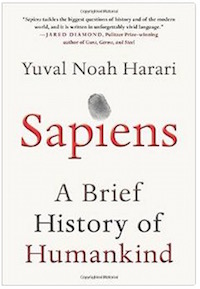
Sapiens: A Brief History of Humankind

sapiens-book-coverAmazon: “Most books about the history of humanity pursue either a historical or a biological approach, but Dr. Yuval Noah Harari breaks the mold with this highly original book that begins about 70,000 years ago with the appearance of modern cognition. From examining the role evolving humans have played in the global ecosystem to charting the rise of empires, Sapiens integrates history and science to reconsider accepted narratives, connect past developments with contemporary concerns, and examine specific events within the context of larger ideas.”

You can scan my favorite nuggets after the jump: Continue reading

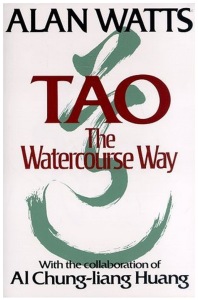
Tao: The Watercourse Way

Screen Shot 2014-09-22 at Mon, Sep 22, 2.13.57 PMExcerpts from Tao: The Watercourse Way by Alan Watts.

The Tao which can be spoken is not the eternal (or regular) Tao.

Our organisms have ways of intelligent understanding beyond words and conscious attention.

The supposition that knowing requires a knower is based on a linguistic and not an existential rule.

Alphabetic writing is a representation of sound. A sign for a sound which is the name of a thing.

Li is the pattern of behavior which comes about when one is in accord with the Tao, the watercourse of nature.

We and our surroundings are the process of a unified field, which is what the Chinese call Tao. #

Technology is destructive only in the hands of people who do not realize that they are one and the same process as the universe.

It is the great and imaginary terror of Western man that nothingness will be the permanent end of the universe. We do not easily grasp the point that the void is creative, and that being comes from nonbeing as sound from silence and light from space.

I find it impossible to conceive any form whatsoever without the component of relatively empty space. […] I cannot get away from the sense that space and my awareness of the universe are the same.

How would you know that you are alive unless you had once been dead? How can one speak of reality or is-ness except in the context of the polar apprehension of void.

There is something in us which may be called upon for a higher wisdom than can be figured out by logic.

The nervous system can integrate more variables than the scanning process of conscious attention.

It is a matter of realizing that oneself and nature are one and the same process. […] The whole cosmos is implicit in every member of it, and every point in it may be regarded as its center.

There is no point in trying to suppress the babble of words and ideas that goes on in most adult brains, so if it won’t stop, let it go on as it will, and listen to it as if it were the sound of traffic or the clucking of hens.

Tao is just a name for whatever happens. […] Yet the Tao is most certainly the ultimate reality and energy of the universe, the Ground of being and nonbeing.

Tao cannot be defined in words and is not an idea or concept.

Verbal description and definition may be compared to the latitudinal and longitudinal nets which we visualize upon the earth and heavens to define and enclose the positions of mountains and lakes, planets and stars. But earth and heaven are not cut by these imaginary strings.

It is basic to the Taoist view of the world that every thing-event is what it is only in relation to all others.

Nature has no “parts” except those which are distinguished by human systems of classification.

The Tao is the pattern of things, but not the enforced law. […] The universe is a harmony or symbiosis of patterns which cannot exist without each other.

Just as every point on the surface of a sphere may be seen as the center of the surface, so every organ of the body and every being in the cosmos may be seen as its center and ruler.

As the universe produces our consciousness, our consciousness evokes the universe.

The only single event is the universe itself.

Pantheism: The idea that the universe, considered as a mass of distinct things and events, is simply God by another name.

But if, as is the case, the Tao is simply inconceivable, what is the use of having the word and saying anything at all about it? Simply because we know intuitively that there is a dimension of ourselves and of nature which eludes us because it is too close, too general, and too all-embracing to be singled out as a particular object.

Taoists do not look upon meditation as “practice,” except in the sense that a doctor “practices” medicine. […] Meditate for the joy of meditation.

“You” cannot go along with “things” unless there is the understanding that there is, in truth, no alternative since you and the things are the same process — the non-streaming Tao. The feeling that there is a difference is also that process. There is nothing to do about it. There is nothing not to do about it. […] In realizing that you are the Tao, you automatically manifest its magic.

As a way of contemplation, (Tao) is being aware of life without thinking about it. 

To be anxious to survive is to wear oneself out. […] If, deep down inside, you want most desperately to survive and be in control of things, you cannot genuinely take the attitude of not worrying about it. You must allow yourself the freedom to worry — to let the mind think whatever it wants to think.”

Hebrew, Islamic, and Catholic scholastics, as well as Protestant fundamentalists, are like tourists who study guidebooks and maps instead of wandering freely and looking at the view.

True knowledge can be encompassed only by instinct and by actual experience.

My Synoptic Gospels

“We accept the reality of the world with which we’re presented.” While watching The Truman Show (again) last night, I found myself wondering how I could be certain I’m not living in an elaborate TV show. Not sure I can.

It also occurred to me that I’m more comfortable getting my metaphysical/cosmic truths from movies than from books cobbled together during the Iron Age. If you’re willing to believe god spoke to Paul, Muḥammad, Joseph Smith and George W. Bush… why not Ridley Scott, Harold Ramis and Peter Weir.

My Synoptic Gospels are Blade Runner, Groundhog Day and The Truman Show. I might add to that list, much in the same way the early church tweaked the scriptures when necessary. Shoot, two of my guys are still alive. With a bit of luck and some persistence, I could probably meet them face to face.

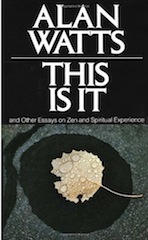
This Is It by Alan Watts

Screen Shot 2014-07-22 at Tue, Jul 22, 8.50.16 AMExcerpts from This Is It: and Other Essays on Zen and Spiritual Experience by Alan Watts.


This — the immediate, everyday, and present experience— is IT, the entire and ultimate point for the existence of a universe. […] We use this simplest of words because we have no word for it.

The high ideals for which we are killing and regimenting each other are empty and abstract substitutes for the unheeded miracles that surround us— not only in the obvious wonders of nature but also in the overwhelmingly uncanny fact of mere existence.

Everything is as right as it can be. […] The universe, precisely as it is at this moment, as a whole and in every one of its parts, is so completely right as to need no explanation or justification beyond what it simply is.

It is usual for the individual to feel that the whole world has become his own body, and that whatever he is has not only become, but always has been, what everything else is.

The immediate now, whatever its nature, is the goal and fulfillment of all living.

The enlightenment or awakening is not the creation of a new state of affairs but the recognition of what always is.

Each thing, each event, each experience in its inescapable nowness and in all its own particular individuality was precisely what it should be, and so much so that it acquired a divine authority and originality.

Solving problems and coping with situations is by no means the only or even the chief business of life.

Nature is much more playful than purposeful, and the probability that it has no special goals for the future need not strike one as a defect.

The point of music is discovered in every moment of playing and listening to it. It is the same, I feel, with the greater part of our lives, and if we are unduly absorbed in improving them we may forget altogether to live them.

“Law of nonidentity” — “whatever you say a thing is, it isn’t.” […] (There is a world other than words) Words represent it, but if we want to know it directly we must do so by immediate sensory contact.

However much I may be impressed by the difference between a star and the dark space around it , I must not forget that I can see the two only in relation to each other, and that this relation is inseparable.

There are no such things as truths by themselves: a truth is always in relation to a point of view.

The price of intelligence as we now know it is chronic anxiety,

Imagine, a point of view, or perhaps a state of mind, which is experiential rather than intellectual— a kind of sensation rather than a set of ideas.

Let your mind alone ; let it think whatever it likes.

Thinker and thoughts are the same. […] When the dualism of thinker and thought disappears so does that of subject and object.

Man is not so much an organism in an environment as an organism-environment relationship.

Strictly speaking, there are no Zen masters because Zen has nothing to teach. […] the experience of awakening (satori) is not to be found by seeking,

One (can) not be right without also being wrong, because the two were as inseparable as back and front.

I believe that Zen appeals to many in the post-Christian West because it does not preach, moralize, and scold in the style of Hebrew-Christian prophetism.

Looking out into it at night, we make no comparisons between right and wrong stars, nor between well and badly arranged constellations. Stars are by nature big and little, bright and dim. Yet the whole thing is a splendor and a marvel which sometimes makes our flesh creep with awe.

In Zen one does not feel guilty about dying, or being afraid, or disliking the heat.

The Hebrew-Christian universe is one in which moral urgency, the anxiety to be right, embraces and penetrates everything.

The appeal of Zen, as of other forms of Eastern philosophy, is that it unveils behind the urgent realm of good and evil a vast region of oneself about which there need be no guilt or recrimination, where at last the self is indistinguishable from God.

Zen is above all the liberation of the mind from conventional thought.

“Fundamentally not one thing exists.” Things are terms, not entities. They exist in the abstract world of thought, but not in the concrete world of nature .

Ego is (a) persona or social role, a somewhat arbitrary selection of experiences with which he has been taught to identify himself.